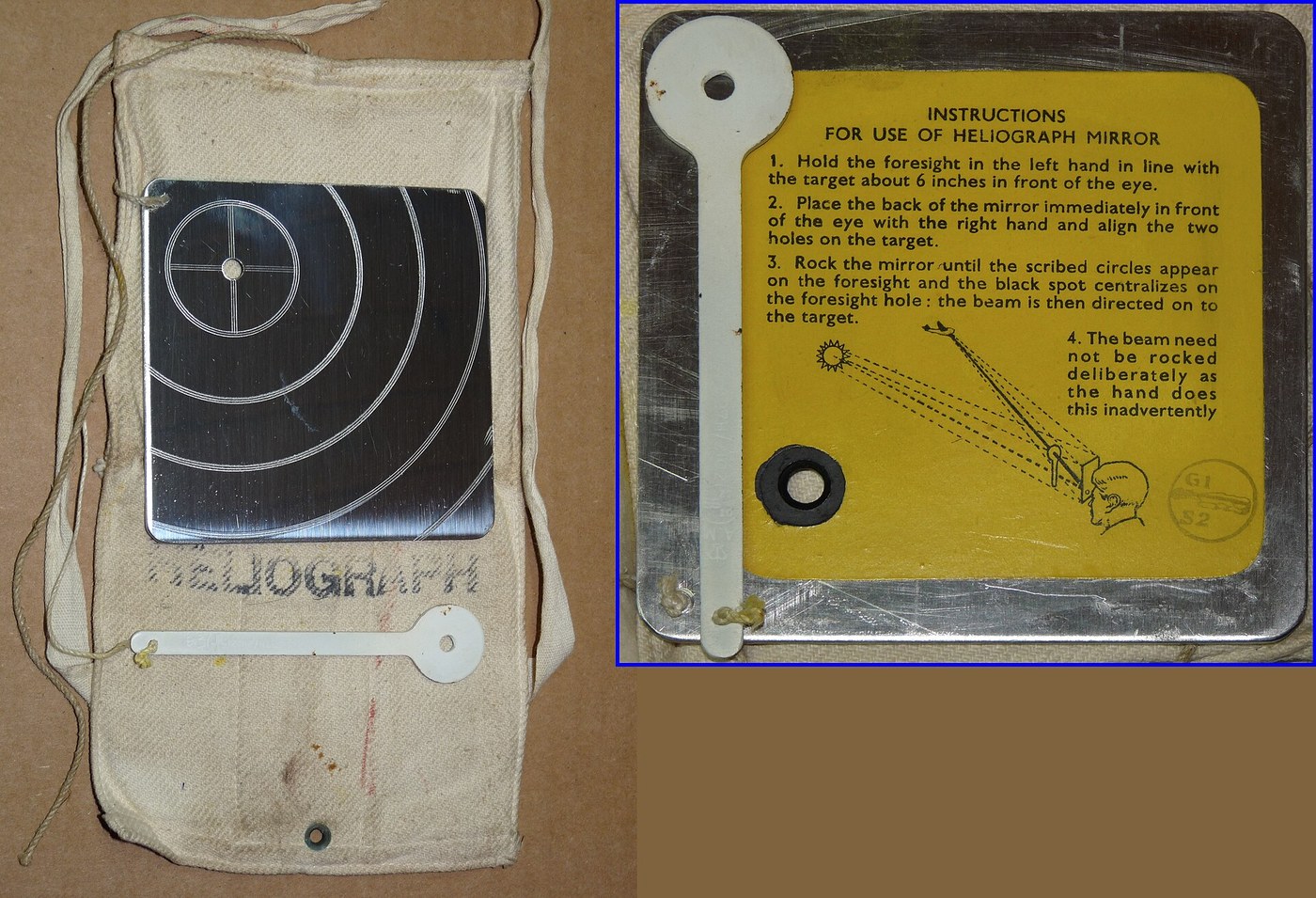
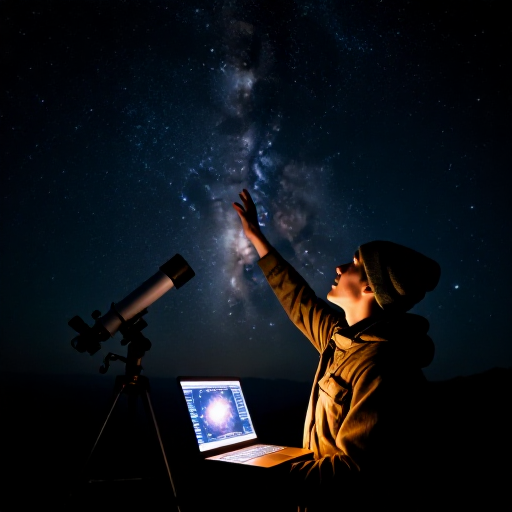

Heliograph
Инструкции
Aim a reflected beam accurately
Aim a reflected beam accurately
Aiming is the hard part, and it is not intuitive.
- Reflect sunlight from a mirror onto a wall some distance away.
- Tilt the mirror by a small angle and watch the spot move.
- Measure the mirror tilt and the spot's movement.
Материалы для этого шага:
 Плоское зеркало1 штука
 Транспортир1 штука
Solve aiming at an invisible station
Solve aiming at an invisible station
You must aim at a place you cannot see, using a spot you also cannot see.
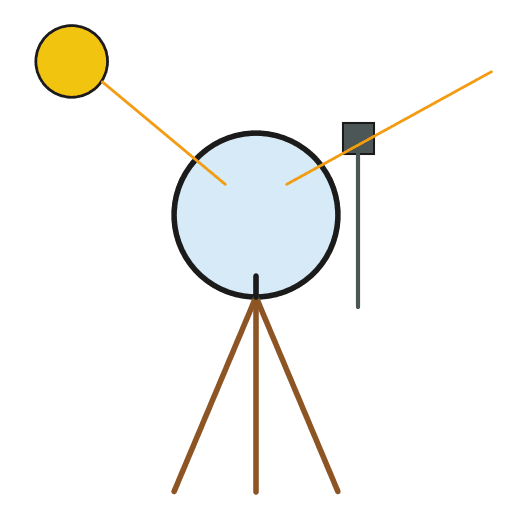
- Set a sighting rod in line with the distant station.
- Put a small mark or hole at the centre of the mirror.
- Adjust until the shadow of the mark falls on the sighting rod's tip.
Материалы для этого шага:
 Латунный пруток1 length
Key the beam
Key the beam
Interrupt the beam rather than moving the mirror.
- Fit a shutter or a second tilting mirror operated by a lever.
- Keep the aiming mirror absolutely still while keying.
- Send short and long flashes — dot and dash.
Find the real limits
Find the real limits
Test what actually stops it working.
- Signal to a partner at increasing distance.
- Try when the sun is low, and when it is behind you versus ahead.
- Try on a hazy day.
History and context
History and context
Signalling with reflected sunlight is ancient, and Carl Friedrich Gauss built a heliotrope in the 1820s to mark survey stations at long distance — a surveying instrument rather than a signalling one. Henry Christopher Mance of the British Indian government telegraph department turned it into a practical field instrument around 1869, and the British Army adopted it.
It suited exactly the places wire did not. Heliographs were used extensively in India and Afghanistan, in the Second Boer War, and by the US Army in the southwestern deserts, where clear air and reliable sun made ranges of eighty kilometres and more routine. General Nelson Miles's network in Arizona and New Mexico in 1886 covered a very large area with nothing but mirrors and tripods.
The tactical properties are double-edged and worth naming. A heliograph emits nothing that can be intercepted at a distance off the beam axis, so it is difficult to eavesdrop on compared with radio — but the beam is a bright light, so the station's position is obvious to anyone in front of it. It is secure against interception and terrible at concealment.
What replaced it: field radio, from the First World War onward. Signal mirrors remain standard survival equipment for exactly the original reason — they need no power, weigh nothing, and can be seen by an aircraft many kilometres away.
Материалы
3- 1 штукаЗаполнитель
- 1 штукаЗаполнитель
- 1 lengthЗаполнитель
По этому чертежу делают
CC0 Общественное достояние
Этот чертёж выпущен под лицензией CC0. Вы можете свободно копировать, изменять, распространять и использовать эту работу в любых целях без запроса разрешения.
Поддержите мейкера, покупая товары через его чертёж, где он получает Комиссию мейкера установленную продавцами, или создайте новую итерацию этого чертежа и включите его как связь в свой чертёж для распределения дохода.