
Caterpillar Traction Engine
A heavy engine is useless on soft ground. Holt's steam traction engines were built to work the rich peat soil of the California delta — and they sank. The weight of the machine pressed down through its wheels onto a small patch of ground, and on soft earth that patch simply gave way, burying the wheels to the axle.
The fix is to spread the weight over a much larger footprint — and to carry your own road with you. Holt replaced the driving wheels with a pair of endless tracks: chains of linked shoes running around sprockets, so that the whole machine rides on a long, flat belt of ground contact instead of two small wheel-prints. Lay the weight over ten times the area and the ground that swallowed a wheel now holds the machine up.
The track literally rolls a firm surface out in front of the machine and picks it up behind — a self-laying road. An observer watching it crawl said it looked like a caterpillar, and the name stuck.
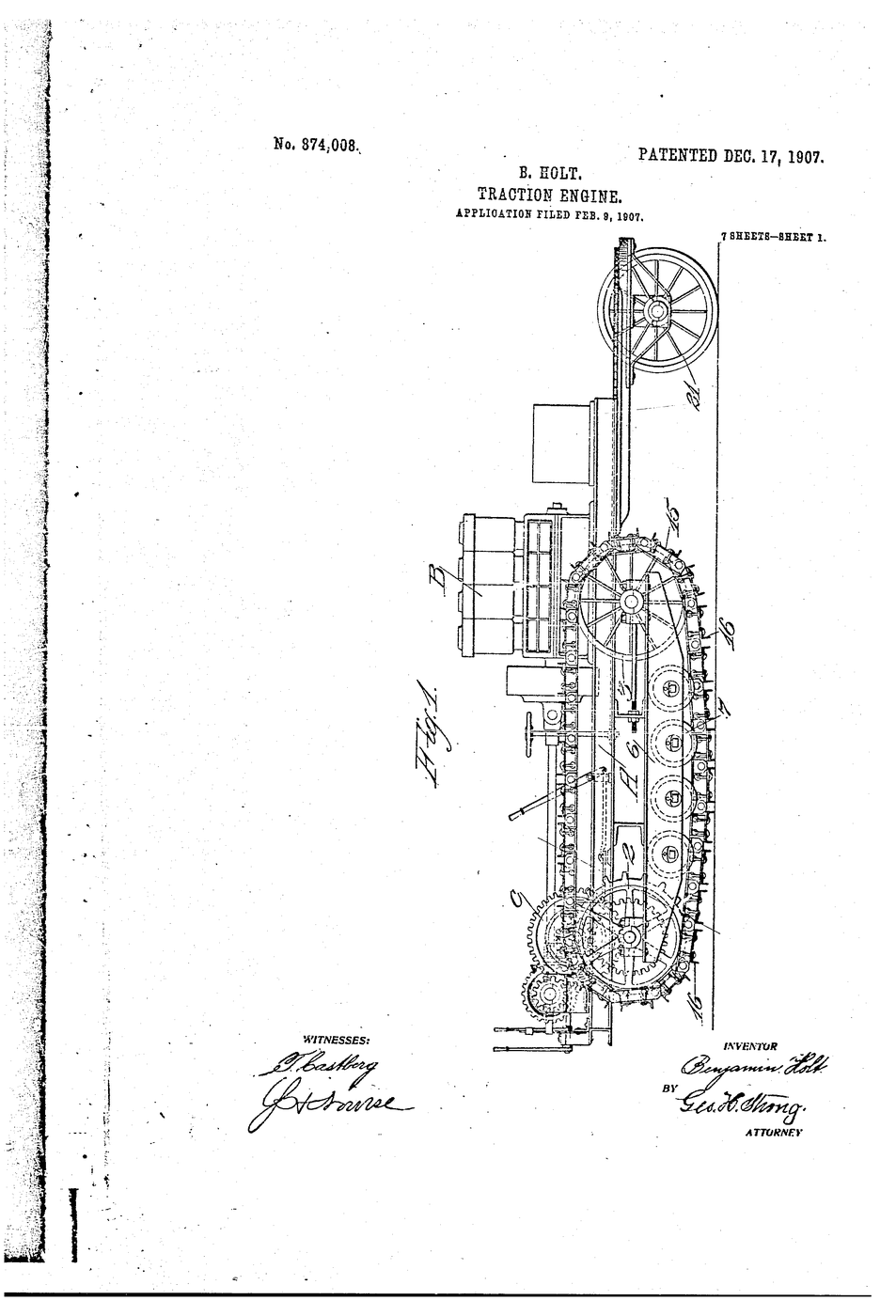
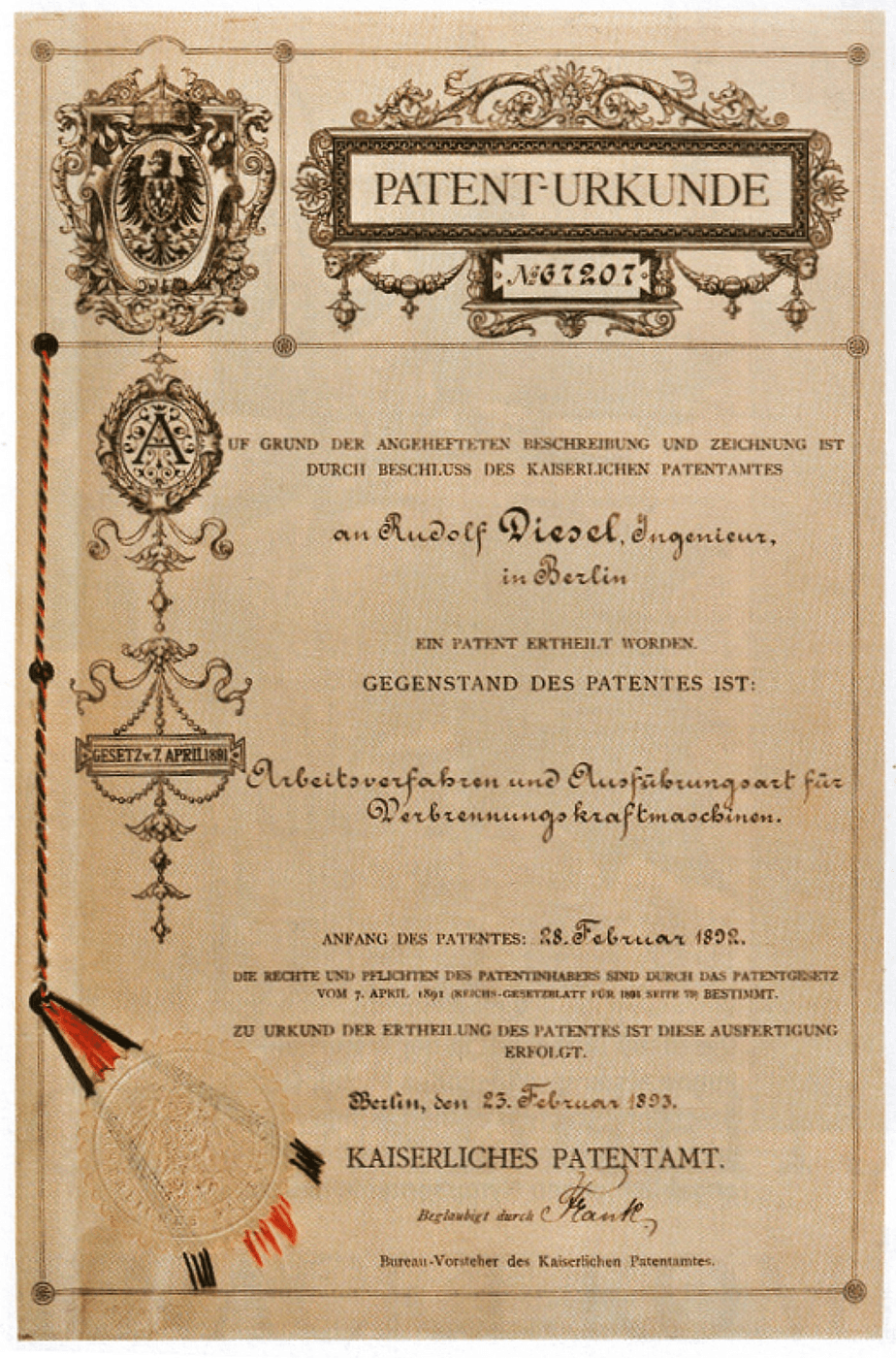
US Patent 874,008, "Traction-Engine", granted 17 December 1907 to Benjamin Holt of Stockton, California.
Инструкции
Read the claim: an endless travelling platform
Read the claim: an endless travelling platform
Holt claims a traction engine carried on "endless traveling platform supports" — sprockets, a chain of shoes, and bearing wheels riding on it. Note the goal: propel over soft ground.
Load a wheel onto soft ground
Load a wheel onto soft ground
Press a loaded wheel into a tray of flour or fine sand. It sinks in. Measure how deep. This is Holt's engines in the delta peat.
Материалы для этого шага:
 Мелкий песок1 кг
Необходимые инструменты:
 Штангенциркуль
Measure the wheel's contact patch
Measure the wheel's contact patch
Ink the wheel and roll it on paper. The mark is its ground contact area — small. Weight divided by that area is the pressure on the soil.
Compute the ground pressure
Compute the ground pressure
Divide the load by the contact area. High pressure on soft ground = sinking. Write the number down; you are going to beat it.
Необходимые инструменты:
 Рычажные весы
Make shoes and link them into a belt
Make shoes and link them into a belt
Cut a set of flat shoes and hinge them into an endless chain that can bend around two ends. Each shoe is a piece of ground contact.
Материалы для этого шага:
 Лист фанеры1 лист
Необходимые инструменты:
 Пассатижи
Run the belt around two sprockets
Run the belt around two sprockets
Fit the chain around two toothed wheels (sprockets) so a driven sprocket walks the belt around. The bottom run lies flat on the ground; the machine rides on it.
Материалы для этого шага:
 Набор заготовок шестерён из POM (ацеталя)1 набор
Carry the load on rollers along the belt
Carry the load on rollers along the belt
Rest the loaded frame on small wheels that roll along the top of the flat bottom run — Holt's "bearing-wheels on rollers." The weight spreads along the whole length of belt on the ground.
Материалы для этого шага:
 Шарикоподшипники1 набор
Measure the track's contact area
Measure the track's contact area
Ink the bottom run and print it. The contact area is many times the wheel's (step 3). Same weight, far bigger footprint.
Compute the track's ground pressure
Compute the track's ground pressure
Divide the same load by the bigger area. The pressure has dropped sharply — compare with step 4. That drop is the whole invention in one number.
Load the track onto the soft ground
Load the track onto the soft ground
Press the loaded track into the same flour or sand. It rides on top where the wheel sank. Measure the sink depth against step 2.
Drive both up a slope of sand
Drive both up a slope of sand
Try to drive the wheel and the track up a loose slope. The wheel spins and digs in; the track grips along its whole length and climbs. More contact means more traction, not just less sinking.
Watch the track lay its own road
Watch the track lay its own road
Drive slowly and watch the belt: shoes lay down flat in front and lift away behind, so the machine always rolls on firm track, never on the soft ground directly. It carries its road with it.
History & Context — the machine that carried its own road
History & Context — the machine that carried its own road
The patent. US 874,008, "Traction-Engine", granted 17 December 1907 to Benjamin Holt of Stockton, San Joaquin County, California. The specification describes the whole crawler in engineering terms — sprocket wheels, a chain of shoes with connecting bolts and side plates, bearing wheels running on rollers — and states the object plainly: to let the engine "most efficiently propel it over the surface upon which it travels."
The problem was specific and local, which is why the solution is so clear. Holt built heavy steam traction engines, and the ground they most needed to work — the reclaimed peat delta around Stockton — was so soft that ordinary drive wheels sank and buried the machine. The physics is exactly steps 2 to 4: a wheel presses the machine's weight through a small contact patch, and pressure is force divided by area, so a small patch means high pressure and, on soft ground, sinking. The endless track attacks the area term directly: it spreads the same weight along a long flat belt (steps 5 to 9), dropping the ground pressure by a large factor, so ground that swallowed a wheel now holds the machine up (step 10). As a bonus, more contact also means more grip, so it climbs and pulls where a wheel just spins (step 11). Holt first tested a track-laying machine around 1904 and patented refinements through the decade.
The name, and a fair word about rivals. The "Caterpillar" name comes from the way it moves — the shoes crawling flat in front and lifting behind (step 12) — reportedly after an observer remarked it looked like a caterpillar, and Holt trademarked it. It is worth being honest that Holt was not the sole inventor of the track: crawler and "endless railway" ideas go back to the early nineteenth century, and Holt had a direct competitor in C. L. Best, whose company built rival crawlers; the two firms fought and eventually merged in 1925 to form the Caterpillar Tractor Company. Naming that history is more honest than the single-genius version.
Where it went. The crawler track transformed anything that had to move heavy loads over ground that would not bear a wheel: it mechanised farming on soft and hilly land, then became the running gear of bulldozers and excavators that built the modern world's roads and dams, and — fatefully — of the military tank in the First World War, which took Holt's agricultural track straight onto the battlefield. Every excavator, dozer and tank you see today is riding on the same idea you measured in step 9: spread the weight over enough track, and the softest ground will carry the heaviest machine.
Материалы
4- 1 кгЗаполнитель
- 1 листЗаполнитель
- Заполнитель
- 1 наборЗаполнитель
Требуемые инструменты
3- Заполнитель
- Заполнитель
- Заполнитель
Связанные чертежи
Эти чертежи делятся знаниями — техники, материалы или принципы



CC0 Общественное достояние
Этот чертёж выпущен под лицензией CC0. Вы можете свободно копировать, изменять, распространять и использовать эту работу в любых целях без запроса разрешения.
Поддержите мейкера, покупая товары через его чертёж, где он получает Комиссию мейкера установленную продавцами, или создайте новую итерацию этого чертежа и включите его как связь в свой чертёж для распределения дохода.