
The Lever Escapement
Every escapement in this batch touches its oscillator throughout the swing. The pallets ride on the pendulum's arbor, so the escape wheel's behaviour — its friction, its dirt, its varying drive — is felt continuously by the thing that is supposed to be an independent timekeeper.
The lever escapement breaks that contact. The balance runs FREE for most of every swing, connected to nothing.
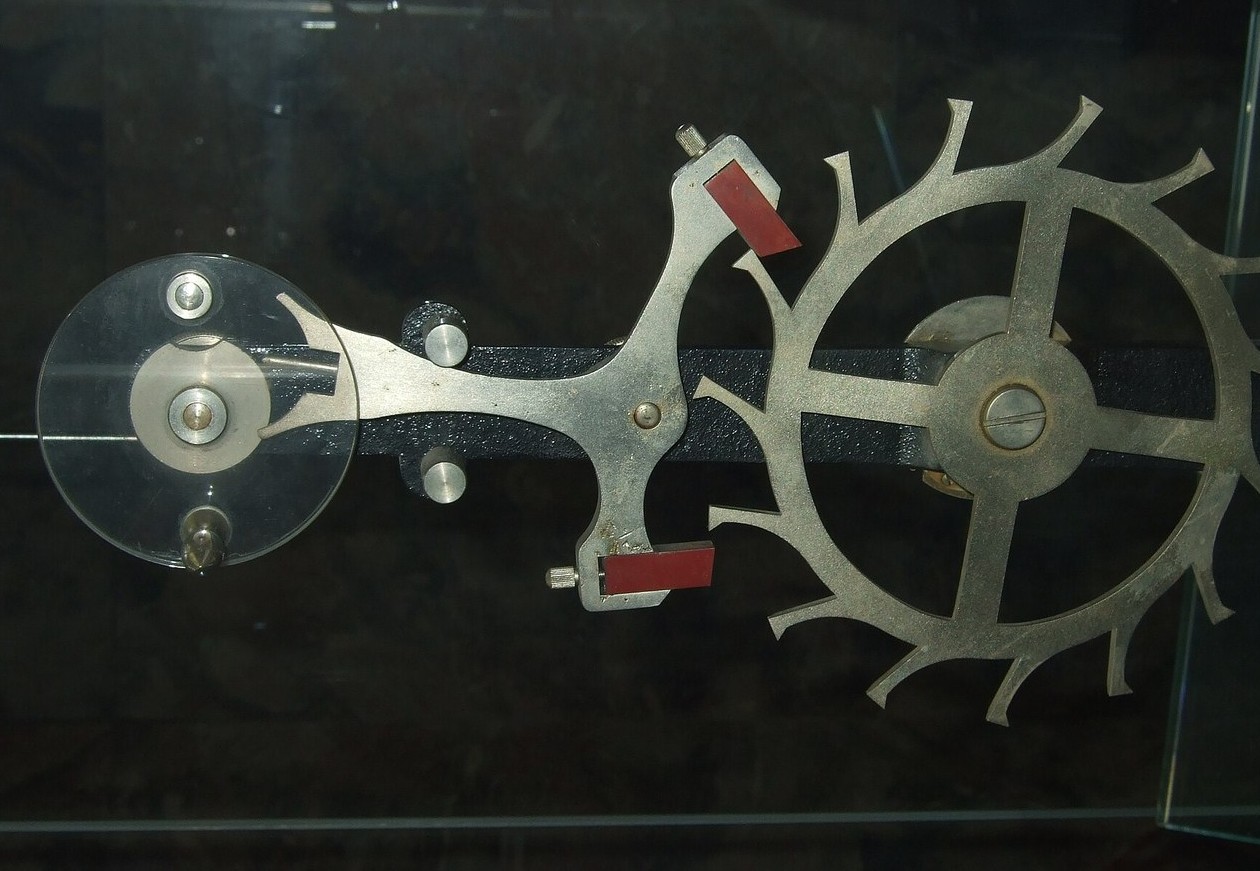
Between the escape wheel and the balance sits a pivoted lever. The balance carries a small ruby pin — the impulse jewel — on a disc. Once per swing the pin enters a slot in the lever's fork, unlocks the escapement, receives a brief kick, and leaves. For the rest of the swing the balance is mechanically alone.
That is a detached escapement, and it changes what a watch is. The oscillator is disturbed once per beat, briefly, near the middle of its travel — where step 4 of the deadbeat blueprint showed a disturbance does least harm.
The lever also has to be safe: a shock must never let it unlock at the wrong moment. A guard pin and a crescent cut in the disc make an interlock that physically forbids it.
Detached, self-starting, shock-safe and cheap to make in quantity — which is why essentially every mechanical watch made since uses one.
Инструкции
Measure what continuous contact costs
Measure what continuous contact costs
Set an oscillator swinging freely and time how long it takes to decay to half amplitude. Then connect it to an escapement with continuous pallet contact and repeat, with the drive removed.
Expect the connected one to die far faster.
That decay rate is the oscillator's Q, and it is the same quantity as in the syntonic tuning blueprint: how many swings it takes to lose its energy.
A high-Q oscillator is one that is left alone, and everything that touches it lowers Q — which is a direct statement about how well it can keep time.
Материалы для этого шага:
 Эмалированный медный провод5 m
Build a fork that grabs and lets go
Build a fork that grabs and lets go
Make a pivoted lever with a forked end, and a disc on the balance carrying a single pin near its rim. Turn the balance slowly by hand.
Expect the pin to enter the fork, move it across, and leave, with the balance free for the rest of the turn.
Measure the fraction of the swing during which pin and fork are in contact.
Expect it to be small.
Write down the design goal that follows: engage for as little of the cycle as you can while still delivering enough energy — the exact opposite of every escapement earlier in this batch.
Add draw, so it stays locked
Add draw, so it stays locked
Angle the locking faces of the pallets slightly so that the escape wheel's pressure pulls the lever further into engagement rather than pushing it out. Now jolt the movement.
Expect the lever to stay locked, and to return firmly to its banking after any disturbance.
Then grind the angle away and jolt it again.
Expect it to unlock spuriously.
This is draw, and it is the difference between a laboratory curiosity and something you can wear. Use the driving force to hold the mechanism in its safe state — the same principle as a self-locking screw thread or a dead-man's handle.
Build the interlock that forbids the wrong move
Build the interlock that forbids the wrong move
Fit a guard pin on the lever and cut a crescent-shaped notch in the balance's disc, so that the lever can only cross when the notch is presented — which happens only when the impulse pin is in place.
Now try to make it unlock at the wrong moment by shaking it.
Expect the guard pin to strike the solid disc and physically refuse.
Note what kind of safety this is. It is not a spring that resists, or a tolerance that makes failure unlikely. It is a geometry in which the wrong action cannot be performed at all — the mechanical ancestor of an interlock, and much stronger than any warning.
Check that it starts by itself
Check that it starts by itself
Stop the balance dead, then release the drive without touching the balance.
Expect the escapement to push the balance and get it swinging on its own.
Compare with a detent escapement if you can, or reason about it: a detent gives impulse in one direction only, so a stopped chronometer must be started by hand.
That single property decided the market. A watch that stops in a pocket and cannot restart itself is not a consumer product, whatever its accuracy — which is why the more accurate detent stayed at sea and the lever went everywhere else.
History & Context
History & Context
Thomas Mudge invented it around 1755, in a watch made for Queen Charlotte, and then largely left it alone — he regarded it as a curiosity beside his chronometer work. It took the trade decades to develop it into the standard form, chiefly through Josiah Emery, Abraham-Louis Breguet and later the English and Swiss factories, which added the straight-line layout, the club-tooth wheel and the safety action described in step 4.
It won by being good enough and manufacturable. The detent escapement in a marine chronometer is more accurate; the lever is self-starting, shock-tolerant, works in any position and can be made to a pattern by machine. When Swiss and American factories began making watches in quantity in the nineteenth century, the lever was the escapement they could actually produce. Nearly every mechanical watch made since — hundreds of millions — uses it.
'Detached' is the idea worth carrying away. Let the oscillator run free and touch it as briefly as possible: it appears in the lever escapement, in the Shortt free-pendulum clock, in the way an electronic oscillator is loaded through a buffer, and in the design of an atomic clock, where the atoms must be interrogated without being disturbed. The general rule is that a good clock measures an oscillator it is trying hard not to affect.
The quartz crisis ended the argument by changing the oscillator. Two centuries of refinement had brought the lever to a few seconds a day; the first quartz wristwatches of about 1969 arrived at a few seconds a MONTH for less money, and the Swiss mechanical industry contracted violently. Mechanical watches survived by becoming valued as craft rather than as instruments. Being outperformed by an order of magnitude is survivable; being outperformed and undercut at the same time is not.
Honest limits. It is a sliding escapement — the pallets slide on the wheel teeth under load — so it needs jewelled pallets, good oil and periodic servicing. It is less efficient and less accurate than a detent. Its rate depends on amplitude, and therefore on mainspring state, position and lubricant age. And it has many small precisely-related parts, so it is unforgiving of wear anywhere in the chain.
Материалы
1- Заполнитель
Материалы из связанных чертежей

Связанные чертежи
Эти чертежи делятся знаниями — техники, материалы или принципы
CC0 Общественное достояние
Этот чертёж выпущен под лицензией CC0. Вы можете свободно копировать, изменять, распространять и использовать эту работу в любых целях без запроса разрешения.
Поддержите мейкера, покупая товары через его чертёж, где он получает Комиссию мейкера установленную продавцами, или создайте новую итерацию этого чертежа и включите его как связь в свой чертёж для распределения дохода.