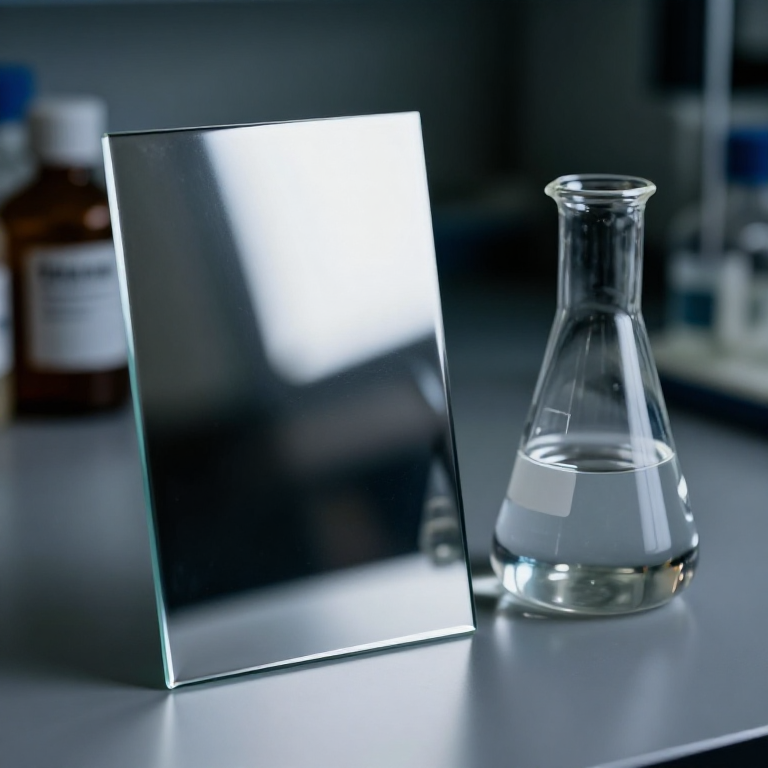


Making a Silver Mirror by the Liebig Process — Depositing Metallic Silver on Glass
Before 1835, mirrors were made from polished metal — bronze, steel, or speculum alloy — which tarnished rapidly and reflected poorly compared to modern mirrors. The revolution came when Justus von Liebig developed a chemical process to deposit a thin, uniform layer of metallic silver directly onto a glass surface. The Liebig process uses the silver mirror reaction: silver nitrate is dissolved in ammonia to form diamminesilver(I) complex (Tollens' reagent), then a reducing sugar (glucose or formaldehyde) is added. The reducing agent donates electrons to the silver ions, which precipitate as metallic silver atoms that bond to the clean glass surface, building up an atomically smooth, highly reflective coating. The process works at room temperature and requires only simple chemicals. By the 1850s, Liebig's silvered glass mirrors had replaced speculum metal in telescopes — Léon Foucault used a silver-on-glass mirror in 1857 to build a reflecting telescope superior to anything made with speculum. Every household mirror, telescope mirror, and optical instrument mirror made between 1856 and the mid-20th century (when aluminium vacuum coating took over) used this process. This blueprint makes a silvered glass mirror using the Tollens' reagent method.
Инструкции
Understand the silver mirror reaction
Understand the silver mirror reaction
Clean the glass thoroughly
Clean the glass thoroughly
Материалы для этого шага:
 Стеклянный лист1 штука
 Гидроксид натрия, 10 % раствор200 мл
Sensitise the glass surface with tin chloride
Sensitise the glass surface with tin chloride
Prepare the silver nitrate solution
Prepare the silver nitrate solution
Материалы для этого шага:
 Раствор нитрата серебра500 мл
Add ammonia to form Tollens' reagent
Add ammonia to form Tollens' reagent
Материалы для этого шага:
 Раствор аммиака 25-28 %50 мл
Prepare the reducing solution
Prepare the reducing solution
Perform the silvering reaction
Perform the silvering reaction
Rinse and inspect the silver film
Rinse and inspect the silver film
Protect the silver coating
Protect the silver coating
Dispose of waste safely
Dispose of waste safely
Материалы
4- 1 штукаЗаполнитель
- Заполнитель
- 500 млЗаполнитель
- Заполнитель
Материалы из связанных чертежей



Связанные чертежи
Эти чертежи делятся знаниями — техники, материалы или принципы


CC0 Общественное достояние
Этот чертёж выпущен под лицензией CC0. Вы можете свободно копировать, изменять, распространять и использовать эту работу в любых целях без запроса разрешения.
Поддержите мейкера, покупая товары через его чертёж, где он получает Комиссию мейкера установленную продавцами, или создайте новую итерацию этого чертежа и включите его как связь в свой чертёж для распределения дохода.