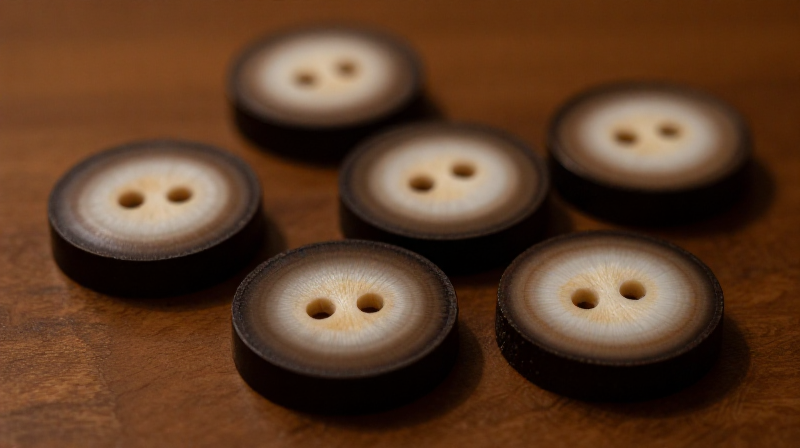


Making Deer Antler Buttons — Cross-Section Slices with Sewing Holes
Antler buttons were widely used from the Stone Age through the 19th century before plastic replaced them. Each cross-section slice is unique — the dark cortex ring, lighter spongy centre, and natural colour gradients make every button one of a kind. Deer antler is hard enough to hold up to daily wear and washing, and the material is completely renewable since male deer shed and regrow their antlers every year.
This blueprint covers making a set of two-hole or four-hole sewing buttons from a single deer antler section: sawing thin rounds, sanding flat, drilling sewing holes, and sealing with beeswax.
Инструкции
Select a beam or thick tine section
Select a beam or thick tine section
Choose a section of the main beam or a thick tine where the diameter matches the button size you want — typically 20-35 mm across. The lower beam produces larger buttons. The natural colour variation in cross-section (dark cortex ring, lighter spongy centre) gives each button a unique appearance.
Материалы для этого шага:
 Отрезок оленьего рога1 штука
 Олень1 штука
Saw cross-section slices
Saw cross-section slices
Clamp the antler in a bench vise with protective jaw pads. Cut slices 4-5 mm thick using a fine-toothed hacksaw (32 TPI for the smoothest cut). Saw slowly and let the blade do the work — forcing it produces angled cuts. Mark each cut line with a pencil to keep slices uniform. One 15 cm beam section yields 20-25 buttons.
Необходимые инструменты:
 Слесарные тиски
 Ножовка по металлу
Sand both faces flat
Sand both faces flat
Lay sandpaper (120 grit) flat on a hard surface and sand each button face by rubbing it in small circles. This flattens the hacksaw marks and ensures both faces are parallel. Progress through 220, then 400 grit. The cortex ring becomes glossy and the spongy centre takes on a creamy texture.
Необходимые инструменты:
 Наждачная бумага
Drill sewing holes
Drill sewing holes
Mark two or four holes evenly spaced, 3-4 mm from the centre. Clamp the slice flat on a scrap board and drill through with a 1.5-2 mm bit at low speed. The slice is thin and can crack if forced, so use light pressure and let the bit cut at its own pace.
Необходимые инструменты:
 Аккумуляторная дрель
 Набор свёрл
Seal with beeswax
Seal with beeswax
Rub a thin coat of melted beeswax over each button and buff with a soft cloth. This seals the porous spongy centre and adds a subtle sheen. Buttons sewn onto garments need no re-finishing — body oils keep them conditioned naturally over time.
Материалы для этого шага:
 Гранулы пчелиного воска20 г
Материалы
3- 1 штукаЗаполнитель
- 1 штукаЗаполнитель
- Заполнитель
Требуемые инструменты
5- Заполнитель
- Заполнитель
- Заполнитель
- 1 vendor sell this, none ship to you yetЗаполнитель
- Заполнитель
Материалы из связанных чертежей

По этому чертежу делают

Связанные чертежи
Эти чертежи делятся знаниями — техники, материалы или принципы
CC0 Общественное достояние
Этот чертёж выпущен под лицензией CC0. Вы можете свободно копировать, изменять, распространять и использовать эту работу в любых целях без запроса разрешения.
Поддержите мейкера, покупая товары через его чертёж, где он получает Комиссию мейкера установленную продавцами, или создайте новую итерацию этого чертежа и включите его как связь в свой чертёж для распределения дохода.