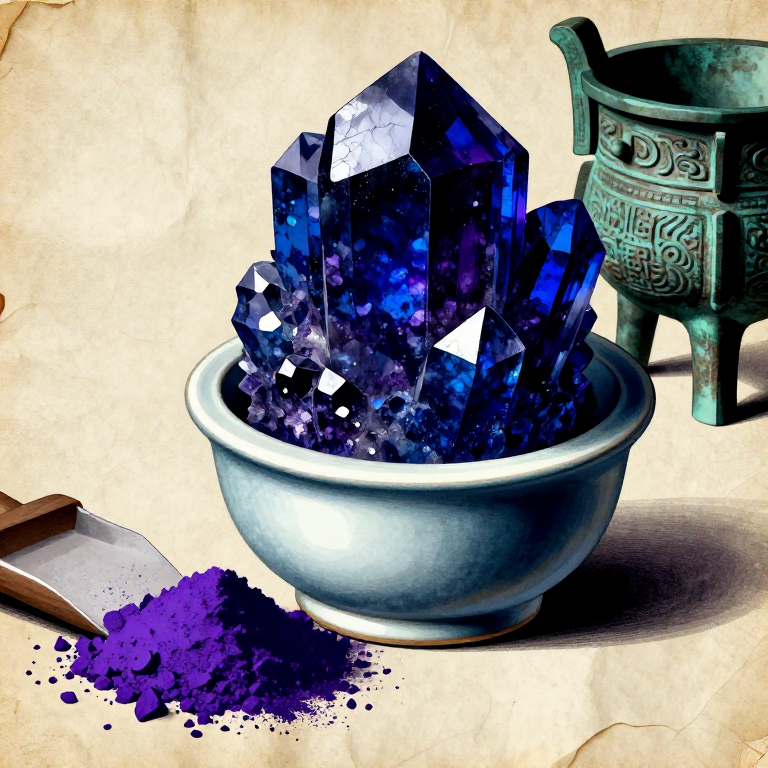

Making Han Purple — Ancient China's Synthetic Barium Copper Silicate Pigment
Han purple (BaCuSi₂O₆) is a synthetic barium copper silicate pigment produced in China from approximately 800 BC through the Han dynasty (206 BC–220 AD). Along with the closely related Han blue (BaCuSi₄O₁₀), it represents one of the earliest and most sophisticated examples of synthetic pigment chemistry — developed independently from Egyptian blue and using a fundamentally different flux chemistry based on lead rather than sodium.
The pigment was used to paint terracotta warriors, ceremonial bronzes, lacquerware, and tomb murals. Modern analysis of the Terracotta Army at Xi'an shows extensive use of both Han purple and Han blue. The chemistry requires barium carbonate (from the mineral witherite), a copper source (malachite), quartz sand, and lead oxide as a flux. These are ground together and fired at 900–1000°C for many hours. The lead oxide reduces the melting point and promotes the crystallisation of the barium copper silicate phase.
Han purple has a distinctive warm reddish-purple hue — deeper and more violet than Tyrian purple, with a crystalline sparkle when coarsely ground. It is reasonably lightfast but less stable than Egyptian blue — it slowly degrades in strongly acidic conditions.
SAFETY WARNING: This process involves HIGHLY TOXIC materials. Lead oxide (litharge) is extremely poisonous — it can be absorbed through skin and causes cumulative lead poisoning. Barium carbonate is toxic if ingested. The process requires kiln temperatures of 900–1000°C. Wear chemical-resistant gloves, goggles, and a P100 respirator. Work outdoors or in a fume hood. Never eat, drink, or smoke near lead compounds.
Опасный контент
Этот чертёж содержит опасные процедуры. Войдите в систему и включите опасный контент в настройках аккаунта, чтобы просмотреть пошаговые инструкции.
ВойтиПо этому чертежу делают

Связанные чертежи
Эти чертежи делятся знаниями — техники, материалы или принципы
Making Azurite Blue Pigment — Grinding the Copper Mineral into the Blue of Medieval Painting
от Charlie
ИСКУССТВО
Making Ultramarine from Lapis Lazuli — Extracting the Most Precious Pigment in History
от Charlie
ИСКУССТВО
Making Malachite Green Pigment — Grinding the Copper Mineral into Painter's Green
от Charlie
ИСКУССТВО
Making Cobalt Blue (Thénard's Blue) — The First Modern Synthetic Blue Pigment
от Charlie
ИСКУССТВО
Egyptian Blue Pigment — Grinding Egyptian Blue from Copper Silicate
от Charlie
Химия
CC0 Общественное достояние
Этот чертёж выпущен под лицензией CC0. Вы можете свободно копировать, изменять, распространять и использовать эту работу в любых целях без запроса разрешения.
Поддержите мейкера, покупая товары через его чертёж, где он получает Комиссию мейкера установленную продавцами, или создайте новую итерацию этого чертежа и включите его как связь в свой чертёж для распределения дохода.