ИСКУССТВО
КРАСОТА И ЗДОРОВЬЕ
РЕМЕСЛО
КУЛЬТУРА И ИСТОРИЯ
РАЗВЛЕЧЕНИЯ
ЭКОЛОГИЯ
ЕДА И НАПИТКИ
ОБРАТНАЯ ИНЖЕНЕРИЯ
НАУКИ
СПОРТ
ТЕХНОЛОГИИ
НОСИМЫЕ УСТРОЙСТВА
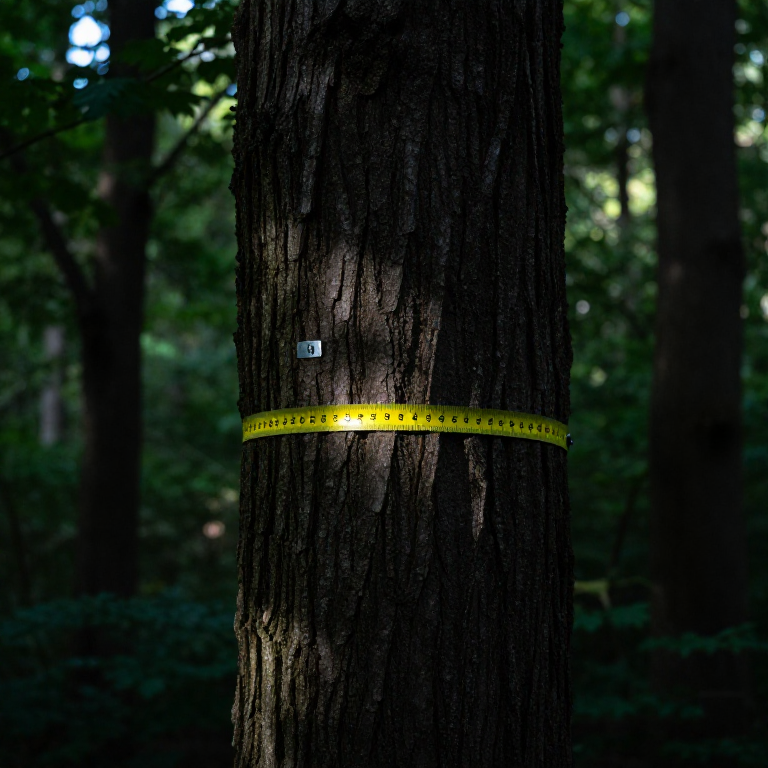


Measuring a Tree Without Felling It
A tree's girth, height, crown spread and age are all measurable from the ground with a tape and a clinometer, and every one of them is routinely measured wrongly.
Girth is taken at a standard height that is defined differently on a slope. Height by clinometer fails quietly when the top you sighted is not above the trunk you stood over. Age from girth is an estimate with a factor-of-two spread that people quote to the year. None of that means the measurements are not worth taking — it means the conventions are the content.
Get them right and a single afternoon gives you a record that can be repeated in a decade to measure growth, estimate stored carbon, and tell you whether a woodland is getting older or being replaced.
Начинающий
1 day
Инструкции
1
1
Measure girth at breast height, defined properly
Measure girth at breast height, defined properly
Measure the circumference at 1.3 metres above ground, with the tape horizontal and snug but not biting into the bark.
On a slope, measure 1.3 m from the UPHILL side. On a leaning tree, measure perpendicular to the trunk, not horizontally. If there is a swelling, burr or fork at 1.3 m, measure below it at the narrowest point and record the height you used. A girth without its measuring convention cannot be compared with anyone else's, including your own from ten years ago.
Необходимые инструменты:
 Рулетка
 Полевой блокнот
 Перманентный маркер
2
2
Measure height by similar triangles or clinometer
Measure height by similar triangles or clinometer
Stand where you can see both the base and the top, measure your horizontal distance to the trunk, then read the angle up to the top and DOWN to the base, and add the two heights.
Adding both angles is what makes it work on sloping ground, where the base is not at your eye level. The classic error is sighting a branch tip that leans toward you — it appears higher than the true top and inflates the result. Walk round and take the height from two directions; if they disagree by more than a few per cent, the crown is leaning.
Необходимые инструменты:
РулеткаПолевой блокнот3
3
Measure the crown spread in two directions
Measure the crown spread in two directions
Find the widest spread of the branches, measure it, then measure the spread at right angles to it, and average the two.
Use a plumb line or sight straight down from the branch tips rather than estimating where they are overhead — the parallax error from guessing is large. Crown spread matters because it drives shading, rainfall interception and competition, and it changes faster than girth does.
Необходимые инструменты:
РулеткаПолевой блокнот4
4
Estimate age honestly, from girth and setting
Estimate age honestly, from girth and setting
Use a growth rate appropriate to the species AND the situation: an open-grown tree puts on girth roughly twice as fast as one crowded in woodland.
Record the estimate as a RANGE and state the rate you assumed. Coring a tree to count rings gives a far better answer and wounds it, so it is not a casual measurement; and rings themselves are unreliable in species that produce false or missing rings. 'Probably 120 to 200 years' is an honest sentence and '164 years' is not.
Необходимые инструменты:
Полевой блокнот5
5
Height, volume, carbon and the size of the error
Height, volume, carbon and the size of the error
Загрузка блокнота Jupyter…
Необходимые инструменты:
Полевой блокнот6
6
Tag the tree so the next measurement is of the same tree
Tag the tree so the next measurement is of the same tree
Record a position, take a photograph from a noted direction, and if you may return, fix a numbered tag loosely with a nail angled downward — or better, note landmarks and skip the nail entirely.
A tag driven tight is swallowed by ten years of growth and injures the tree; a tag on a loose nail rides outward as the trunk expands. In a small woodland, good notes and a photograph beat hardware. The goal is only that someone standing there in 2036 can be certain it is the same stem.
Материалы для этого шага:
 Оцинкованные гвозди10 штук
 Картон5 штук
Необходимые инструменты:
 Молоток-гвоздодёр
 КомпасПолевой блокнот
Связанные чертежи
Эти чертежи делятся знаниями — техники, материалы или принципы



CC0 Общественное достояние
Этот чертёж выпущен под лицензией CC0. Вы можете свободно копировать, изменять, распространять и использовать эту работу в любых целях без запроса разрешения.
Поддержите мейкера, покупая товары через его чертёж, где он получает Комиссию мейкера установленную продавцами, или создайте новую итерацию этого чертежа и включите его как связь в свой чертёж для распределения дохода.