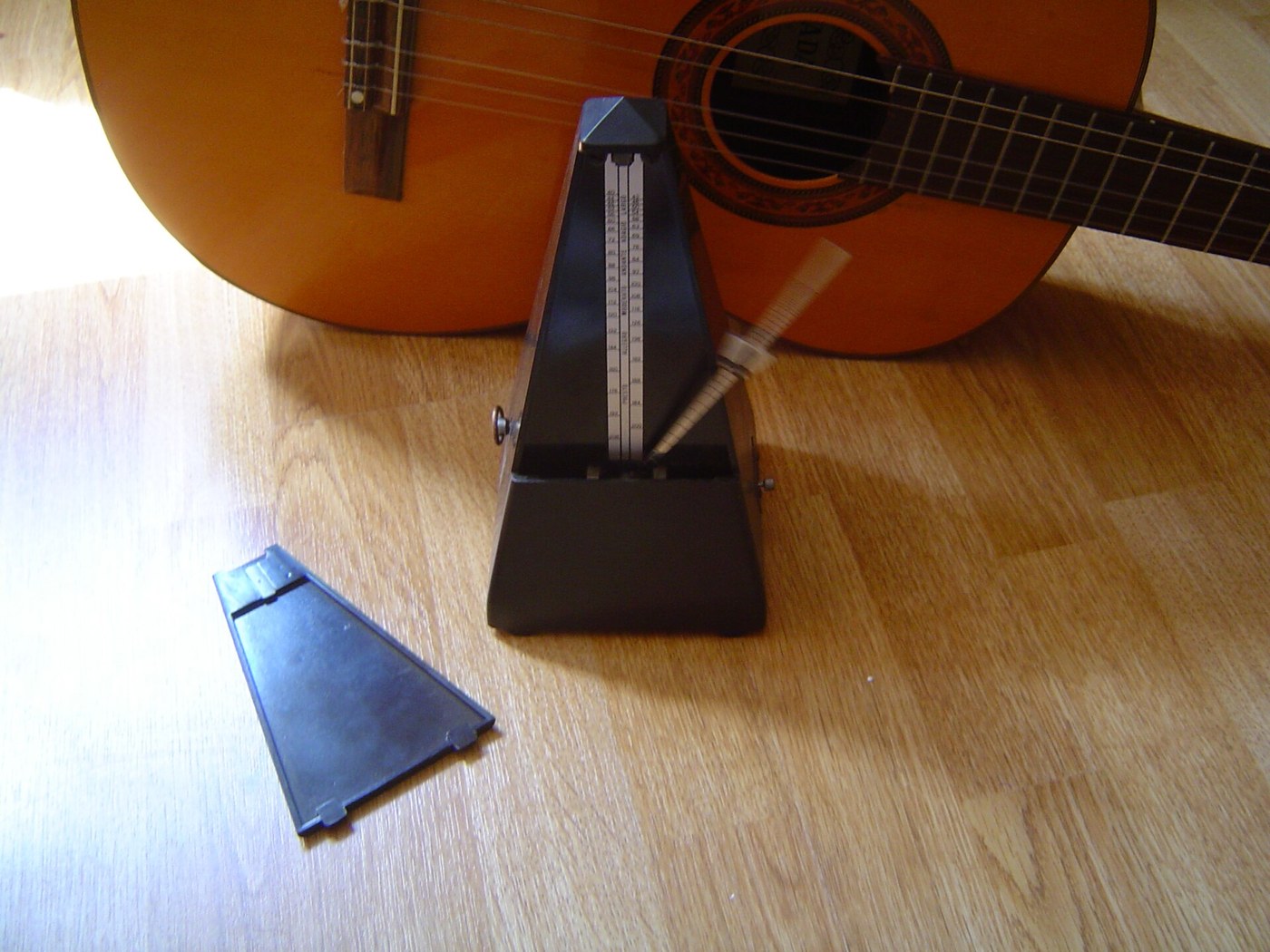


Metronome
Инструкции
Show the length problem
Show the length problem
Establish why an ordinary pendulum will not do.
- Hang a simple pendulum 20 cm long and time twenty swings.
- Convert to beats per minute.
- Calculate the length needed for 60 bpm.
Необходимые инструменты:
 Линейка
 Секундомер
Pivot a rod in the middle, not the end
Pivot a rod in the middle, not the end
Build the double-weighted pendulum.
- Pivot a light rod so that a good length projects both above and below the pivot.
- Fix a heavy weight low on the bottom arm.
- Fit a second, sliding weight on the upper arm.
Материалы для этого шага:
 Латунный пруток1 length
Необходимые инструменты:
 Цифровые кухонные весы
Slide the upper weight and map the tempo
Slide the upper weight and map the tempo
Now calibrate it, which is exactly what Maelzel added to Winkel's mechanism.
- Set the sliding weight low and time twenty beats.
- Move it up in steps, timing at each position.
- Mark the rod with the beats-per-minute you measure.
Find the point where it stops working
Find the point where it stops working
Push the adjustment to its limit and watch the mechanism fail.
- Keep sliding the upper weight higher.
- The beat slows further and further.
- Eventually the pendulum will not return at all and simply falls to one side.
History and context
History and context
Dietrich Nikolaus Winkel, an Amsterdam mechanician, built the double-weighted pendulum around 1814. Johann Nepomuk Maelzel — showman, mechanician, and the man behind the touring chess-playing automaton the Turk — visited him, saw the device, and in 1815 patented a metronome using the same principle with a graduated tempo scale added. Winkel took the dispute to a commission of the Netherlands Royal Institute, which found in his favour and recognised him as the inventor. Maelzel had the name, the patent in other countries and the distribution, and it is his initials that ended up in the repertoire.
Beethoven adopted the device enthusiastically and went back to add M.M. markings to earlier symphonies. Many of those markings strike modern performers as implausibly fast, and there is a long-running argument about why — a faulty metronome, a misread scale, a different convention for what counts as a beat, or simply that he meant it. No explanation has settled the matter, and performances still differ enormously as a result.
What it did to music is worth stating carefully. Before the metronome, tempo words like allegro carried meaning that was regional, traditional and negotiable. A number is not negotiable. Composers gained precise control over something they had previously had to trust performers with — and performers have been arguing about whether that was a gain ever since.
Материалы
1- 1 lengthЗаполнитель
Требуемые инструменты
3- Заполнитель
- Заполнитель
- Заполнитель
По этому чертежу делают

Связанные чертежи
Эти чертежи делятся знаниями — техники, материалы или принципы

CC0 Общественное достояние
Этот чертёж выпущен под лицензией CC0. Вы можете свободно копировать, изменять, распространять и использовать эту работу в любых целях без запроса разрешения.
Поддержите мейкера, покупая товары через его чертёж, где он получает Комиссию мейкера установленную продавцами, или создайте новую итерацию этого чертежа и включите его как связь в свой чертёж для распределения дохода.