

Tinkertoy
Two sticks can only meet at whatever angle you happen to hold them, and glue makes the joint permanent. To build freely in three dimensions — spokes of a wheel, the struts of a dome, the arms of a windmill — you need a connector that joins many rods at known, repeatable angles, and comes apart again.
Pajeau's Tinkertoy is a wooden spool drilled with holes, plus a set of rods. Each spool has a hole through its centre and a ring of holes around its rim, spaced at equal angles. Push rods into the holes and they stick out as spokes at those fixed angles; join spool to spool with rods and you build outward in every direction, squares and triangles and wheels, all from two kinds of part.
The whole system is just a hub with holes at set angles — but that single idea lets a child build almost any framework, then pull it apart and build another. Pajeau is said to have got the idea watching children poke pencils into empty thread spools.
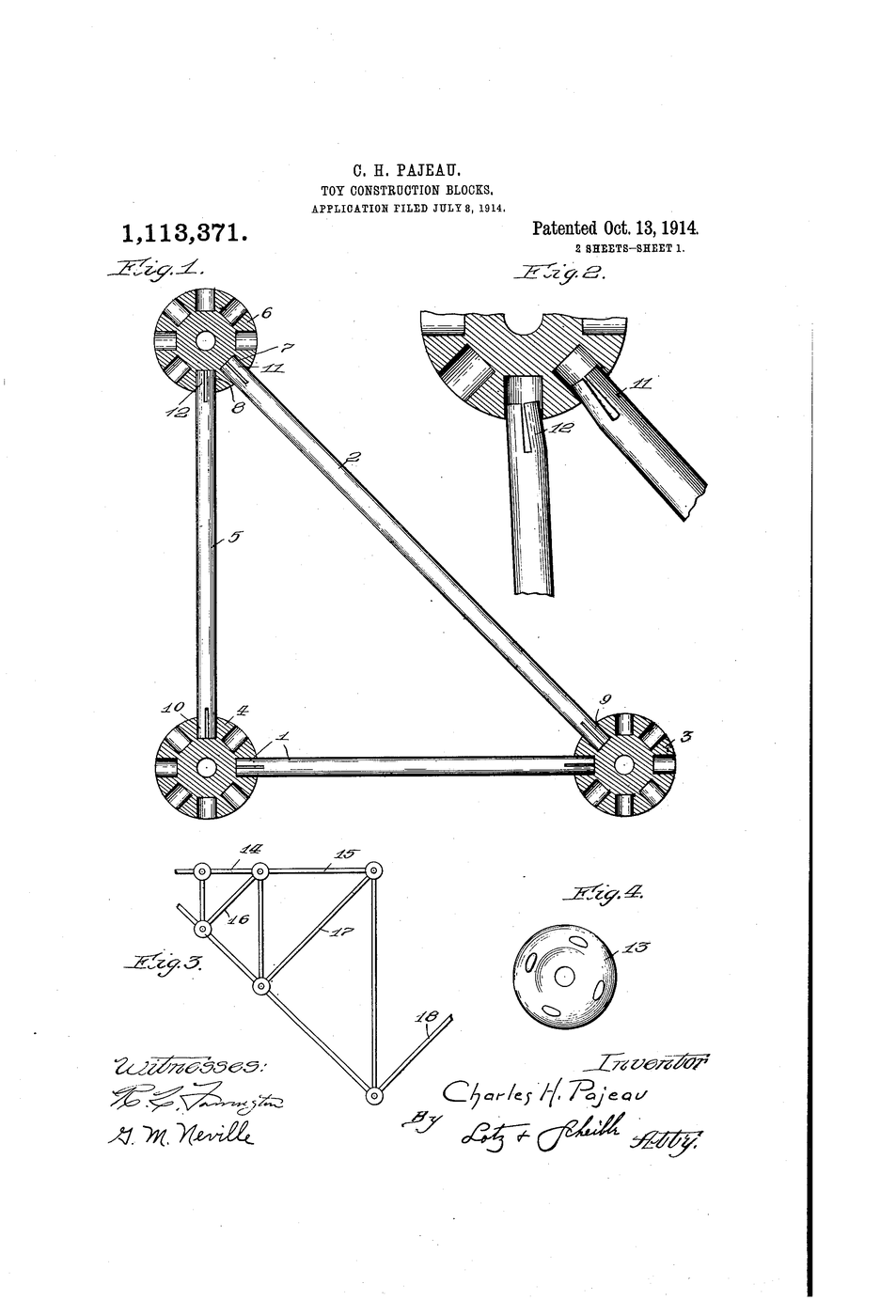
US Patent 1,113,371, "Toy Construction-Blocks", granted 13 October 1914 to Charles H. Pajeau.
Инструкции
Read the claim: a hub with holes at set angles
Read the claim: a hub with holes at set angles
Pajeau claims a spool with a centre hole and a ring of rim holes at equal angles, joined by rods, so structures can be built in any direction. Note: the fixed hole angles are the whole idea.
Cut a thick wooden disc
Cut a thick wooden disc
Cut a short thick disc (a spool) from a fat dowel or plywood. This is the hub every rod will plug into.
Материалы для этого шага:
 Лист фанеры1 лист
Необходимые инструменты:
 Лобзиковая пила
Mark eight rim holes at equal angles
Mark eight rim holes at equal angles
With a protractor, mark eight points 45° apart around the rim, plus one through the centre, and pierce a hole at each. Equal angles are what make the geometry repeatable.
Необходимые инструменты:
 Транспортир / угломер
Make a set of rods
Make a set of rods
Cut several rods from thin dowel, sized to push snugly into the spool holes. Make a few lengths.
Материалы для этого шага:
 Шканты из твёрдых пород 1/4"1 упаковка
Необходимые инструменты:
 Макетный нож
Plug rods into the rim as spokes
Plug rods into the rim as spokes
Push rods into the rim holes. They stick out as spokes at exact 45° steps — a wheel of arms from one spool. No angle guessing.
Join spool to spool
Join spool to spool
Connect two spools with a rod between them. You can now extend in a straight line — spool, rod, spool, rod — as far as you like.
Build a flat square, then push it
Build a flat square, then push it
Make a square from four spools and four rods and push a corner. It racks — like any four-bar frame, it has no stiffness yet.
Add a diagonal rod
Add a diagonal rod
Use a rim hole to plug a diagonal rod across the square. Now it is rigid — the fixed 45° holes gave you the diagonal exactly where you needed it.
Build upward into 3D
Build upward into 3D
Add rods straight up from the corner spools and cap them with more spools. The structure leaves the table and becomes a cube or tower — building in three dimensions from two parts.
Make something that turns
Make something that turns
Fit a rod loosely through a spool's centre hole so it spins, and build a windmill or wheel on it. The centre hole gives you an axle; the rim holes give you spokes.
Take it apart and build anew
Take it apart and build anew
Pull the rods out and build a bridge, a crane, a person. Because nothing is glued, the same handful of parts becomes anything — the point of the system.
Note the power of few parts
Note the power of few parts
Write it down: a hub with angled holes plus plain rods is enough to build almost any framework. Constraint (fixed angles) is what makes free building possible and repeatable.
History & Context — the spool that builds anything
History & Context — the spool that builds anything
The patent. US 1,113,371, "Toy Construction-Blocks", granted 13 October 1914 to Charles H. Pajeau of Evanston, Illinois. (It is often misdated to 1917 — the grant is 1914.) Pajeau, a monument-maker, reportedly watched children endlessly poking pencils and sticks into empty wooden thread spools and turned that play into a system: a spool drilled with a centre hole and eight rim holes, plus rods, sold from 1914 in the famous cardboard canister. It was an immediate hit after he demonstrated it in shop windows at Christmas.
The idea is a connector that fixes the angles for you. Two loose sticks meet at whatever angle your hands hold; to build a repeatable structure you need joints at known angles. Pajeau's spool encodes the angles in the holes: eight rim holes 45° apart mean every rod you plug in points in an exact, predictable direction, and the centre hole gives you an axle for anything that must turn (steps 5, 10). With only two kinds of part — the angled hub and the plain rod — you can make spokes, squares, triangles, cubes, wheels and towers, and (as with the Erector Set's strips) a diagonal turns a floppy square into a rigid triangle (steps 7-8). It is a beautiful lesson that constraint enables freedom: by fixing the angles, the system lets you build almost anything, quickly and repeatably.
Where it sits. Tinkertoy, Erector and Meccano, and later LEGO Technic, are all the same insight — a small kit of standard parts with standard connections, from which endless machines and structures follow. Engineers call this modularity, and it is how everything from scaffolding to electronic connectors to software is built. The wooden spool you drilled, with its ring of angled holes, is one of the purest toys ever made: almost nothing, from which almost anything.
Материалы
2- 1 листЗаполнитель
- 1 упаковкаЗаполнитель
Требуемые инструменты
3- Заполнитель
- Заполнитель
- Заполнитель
По этому чертежу делают
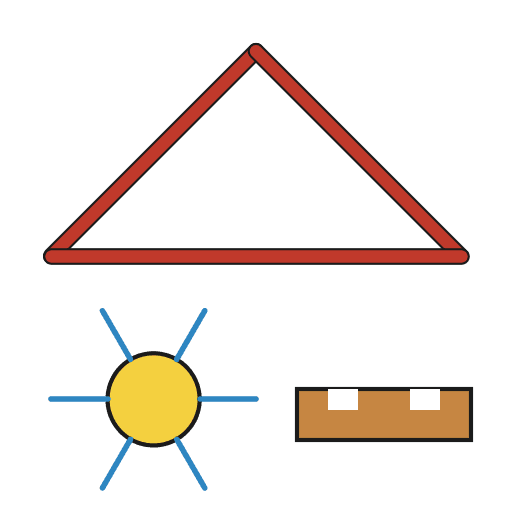
CC0 Общественное достояние
Этот чертёж выпущен под лицензией CC0. Вы можете свободно копировать, изменять, распространять и использовать эту работу в любых целях без запроса разрешения.
Поддержите мейкера, покупая товары через его чертёж, где он получает Комиссию мейкера установленную продавцами, или создайте новую итерацию этого чертежа и включите его как связь в свой чертёж для распределения дохода.