ИСКУССТВО
КРАСОТА И ЗДОРОВЬЕ
РЕМЕСЛО
КУЛЬТУРА И ИСТОРИЯ
РАЗВЛЕЧЕНИЯ
ЭКОЛОГИЯ
ЕДА И НАПИТКИ
ОБРАТНАЯ ИНЖЕНЕРИЯ
НАУКИ
СПОРТ
ТЕХНОЛОГИИ
НОСИМЫЕ УСТРОЙСТВА
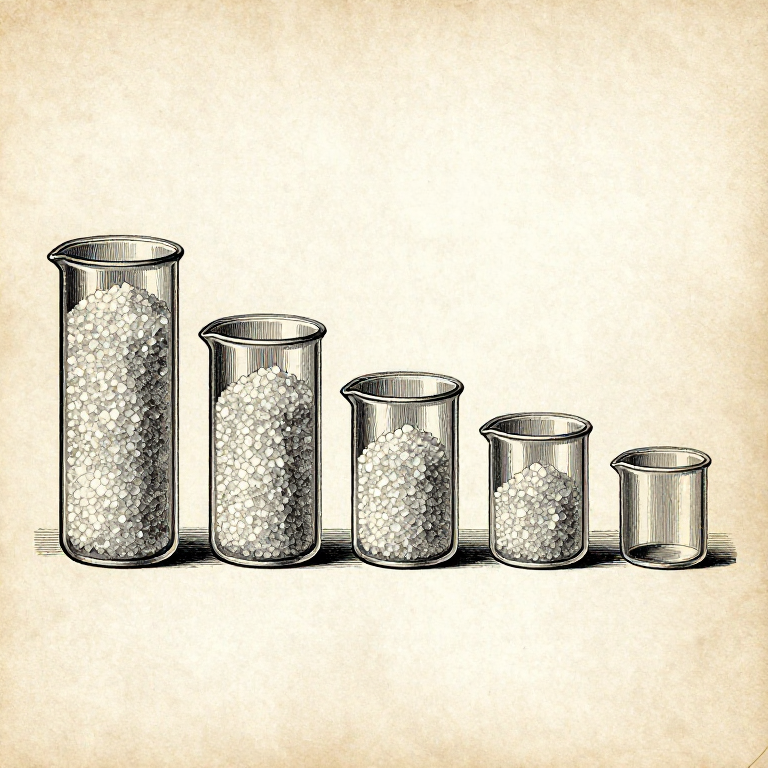


Percent Yield: Over 100% Means the Sample Is Wet
A yield is the honest accounting of a preparation: how much product came out against how much the stoichiometry allowed.
It rests on one idea — the **limiting reagent**, the one that runs out first — and on one discipline: the product must be dry and pure before it is weighed. A yield over 100% is not a success, it is a wet sample, and it is the most commonly reported impossible number in practical chemistry.
This rung is the arithmetic, and then the more useful half: where the missing material actually goes, and which step is worth improving.
Средний
3 hours
Инструкции
1
1
The limiting reagent, in moles and never in grams
The limiting reagent, in moles and never in grams
**Convert every reagent to moles.** Mass divided by relative molecular mass. This is the step that is skipped, and skipping it is why the heaviest charge is so often assumed to be the limiting one when it is not.
**Divide each by its stoichiometric coefficient.** A reagent needed two moles at a time goes half as far as its mole count suggests.
**The smallest result is the limiting reagent**, and it sets the theoretical yield. Everything else is in excess, and the excess does not appear in the calculation at all — although it does appear in the work-up, because it has to be removed.
**Why reagents are used in excess on purpose:** to drive an equilibrium forwards, to make sure the expensive component is consumed completely, or because one reagent is volatile and some of it will be lost. In each case the cheap or plentiful one is the excess, and the valuable one is made limiting deliberately.
**Solvents, catalysts and drying agents are not reagents** and never enter this arithmetic, however much of them there is.
Необходимые инструменты:
 Прецизионные весы
2
2
The arithmetic, and where the material goes
The arithmetic, and where the material goes
Загрузка блокнота Jupyter…
Необходимые инструменты:
 Настольный компьютер
3
3
Weighing the product so the number means something
Weighing the product so the number means something
**Dry to constant weight first.** Not "looks dry". The drying rung gives the method, and the difference between the first and last weighing is the water and solvent that would otherwise have been reported as product.
**Weigh in a tared container**, by difference, as the weighing rung requires.
**Report the purity alongside the yield.** "68%, mp 155 to 157 C, single spot by TLC" is a result. "68%" alone is not, because a yield of impure material is not comparable with anything.
**Say what basis was used.** Yield on the limiting reagent is standard; yield on a recovered starting material, or on a crude product, are different numbers and must be labelled as such.
**Significant figures.** A yield calculated from a mass known to three figures is not known to five. Two or three figures is the honest report, and it is the significant figures rung's rule applied here.
**A yield over 100% has exactly three explanations**, in order of likelihood: the product is wet, the product is impure, or the theoretical yield was miscalculated. It is never a real result, and reporting it unexamined is the clearest possible sign that the work-up was not finished.
Материалы для этого шага:
 Квасцы (алюмокалиевые)1 штука
Необходимые инструменты:
Прецизионные весы Часовое стекло
4
4
Improving a yield, in the right order
Improving a yield, in the right order
**Find the worst step first.** The notebook shows why: losses multiply, so the step keeping 75% is worth ten times the attention of the one keeping 98%. Most effort spent on yield is spent on the wrong step.
**Weigh the crude product before purifying it.** That one extra weighing splits the total loss into "the reaction did not work" and "the work-up threw it away", and those have completely different remedies.
**Keep every fraction and every layer** until the yield is confirmed. This is the habit that turns a mystery into a measurement — the missing material is somewhere, and it is usually in a flask that was about to be washed up.
**Check the mother liquor.** If a recrystallisation is the worst step, the product is in the liquor and a second crop or less solvent will recover it.
**Scale matters.** Losses that are fixed — the film on the glassware, the filter cake, the transfer — are a much larger fraction of a small preparation. A reaction that gives 70% on 50 g may give 40% on 1 g with identical technique, and that is not a mistake.
**Record it all.** A yield without the conditions that produced it cannot be improved, only repeated.
Необходимые инструменты:
Прецизионные весыНастольный компьютерМатериалы
1- 1 штукаЗаполнитель
Требуемые инструменты
3- Заполнитель
- Заполнитель
- Заполнитель
Связанные чертежи
Эти чертежи делятся знаниями — техники, материалы или принципы



CC0 Общественное достояние
Этот чертёж выпущен под лицензией CC0. Вы можете свободно копировать, изменять, распространять и использовать эту работу в любых целях без запроса разрешения.
Поддержите мейкера, покупая товары через его чертёж, где он получает Комиссию мейкера установленную продавцами, или создайте новую итерацию этого чертежа и включите его как связь в свой чертёж для распределения дохода.