ИСКУССТВО
КРАСОТА И ЗДОРОВЬЕ
РЕМЕСЛО
КУЛЬТУРА И ИСТОРИЯ
РАЗВЛЕЧЕНИЯ
ЭКОЛОГИЯ
ЕДА И НАПИТКИ
ОБРАТНАЯ ИНЖЕНЕРИЯ
НАУКИ
СПОРТ
ТЕХНОЛОГИИ
НОСИМЫЕ УСТРОЙСТВА
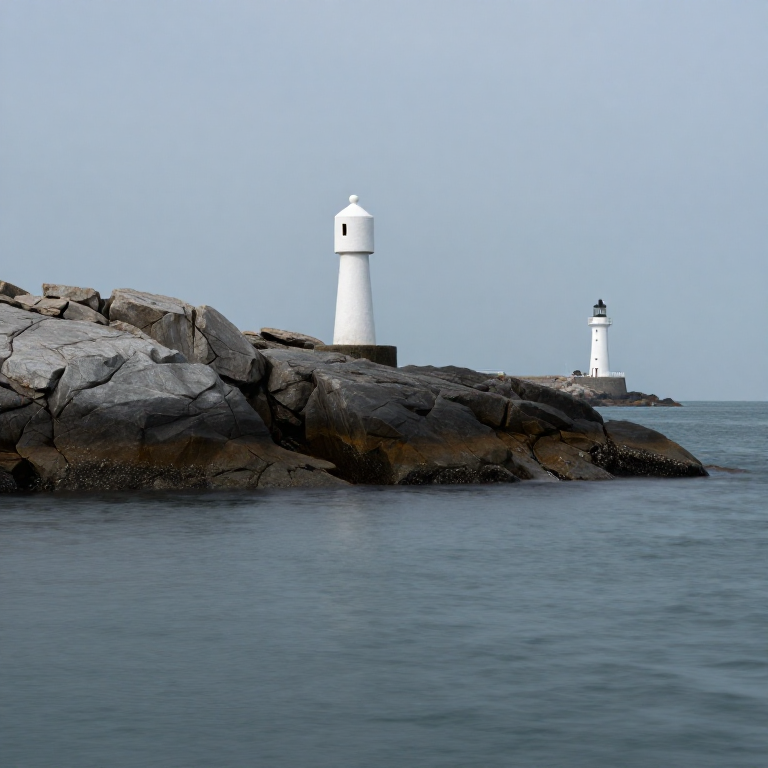


Pilotage: Transits, Clearing Bearings and the Danger Circle
Close to land there is no time to plot. The rocks are minutes away, the tide is setting you toward them, and a chart table below decks is the last place you should be.
Pilotage is navigation by eye, prepared in advance. Before you go anywhere near the hazard you work out a handful of simple, visual tests — a pair of marks that must stay in line, a bearing that must never go below a certain number, a depth that must not decrease — and then you sail by checking those, without measuring anything.
A transit is the most accurate line in navigation and needs no instrument at all: two objects in line ARE a position line, better than any compass bearing, free of variation, deviation and human error. Learning to see them is the single largest improvement available to a coastal navigator.
Средний
1 day
Инструкции
1
1
Find the transits on the chart before you sail
Find the transits on the chart before you sail
Look for pairs of charted objects that line up along a line you want to follow, or that mark the edge of somewhere you must not go. Draw and label them.
A transit's accuracy improves the further apart the two objects are, and it is exact regardless of your compass. Official leading lines are printed on the chart, but the useful ones are usually the ones you find yourself: a chimney over a headland, a beacon against a cliff edge.
Необходимые инструменты:
 Линейка
2
2
Set clearing bearings on the safe side
Set clearing bearings on the safe side
Draw a line from a conspicuous object that passes safely outside the hazard, read its bearing, and write the rule as an inequality: 'keep the castle bearing MORE than 080' or 'NOT LESS than 080'.
Phrase it as an inequality, never as a target. A helm told to steer a bearing will chase it in both directions; a helm told the bearing must stay above a number knows instantly which way is safe. Write it in large letters somewhere readable from the helm, not on the chart below.
Материалы для этого шага:
 Картон6 штук
Необходимые инструменты:
 Транспортир
 Перманентный маркер
3
3
Use a danger circle when there is only one object
Use a danger circle when there is only one object
A horizontal sextant angle between two objects, or a vertical angle to a known height, defines a circle you must stay outside. Work out the angle that corresponds to a safe distance and keep the measured angle SMALLER than it.
The vertical-angle version is the simplest useful sextant work there is: a lighthouse of known height subtends a larger angle the closer you get, so 'keep the angle under 1 degree 20' is a distance-off alarm that needs no chart and no arithmetic at the moment it matters.
4
4
Make the depth sounder a pilotage instrument
Make the depth sounder a pilotage instrument
Choose a contour that runs along your safe route and follow it, or set a minimum depth that means 'turn now'.
Depth is the one measurement that is never confused by mist, darkness or a misidentified landmark, and it disagrees with a wrong position immediately. When the sounder argues with the plot, the sounder is right — that sentence has saved more boats than any instrument on board.
5
5
Why a transit beats a bearing, with numbers
Why a transit beats a bearing, with numbers
Загрузка блокнота Jupyter…
6
6
Write a pilotage plan you can read at arm's length
Write a pilotage plan you can read at arm's length
Put the whole approach on one waterproof card: the transits, the clearing bearings as inequalities, the depths, the lights and their characteristics, and the abort point.
Include the abort explicitly — the conditions under which you turn round and the course that takes you back to safe water. Deciding that in advance, in calm, is completely different from deciding it at the moment things stop making sense, and it is the part of a pilotage plan people leave out.
Материалы для этого шага:
Картон6 штукНеобходимые инструменты:
Перманентный маркерСвязанные чертежи
Эти чертежи делятся знаниями — техники, материалы или принципы




CC0 Общественное достояние
Этот чертёж выпущен под лицензией CC0. Вы можете свободно копировать, изменять, распространять и использовать эту работу в любых целях без запроса разрешения.
Поддержите мейкера, покупая товары через его чертёж, где он получает Комиссию мейкера установленную продавцами, или создайте новую итерацию этого чертежа и включите его как связь в свой чертёж для распределения дохода.