ИСКУССТВО
КРАСОТА И ЗДОРОВЬЕ
РЕМЕСЛО
КУЛЬТУРА И ИСТОРИЯ
РАЗВЛЕЧЕНИЯ
ЭКОЛОГИЯ
ЕДА И НАПИТКИ
ОБРАТНАЯ ИНЖЕНЕРИЯ
НАУКИ
СПОРТ
ТЕХНОЛОГИИ
НОСИМЫЕ УСТРОЙСТВА


Cutting a Curve Without a Frame
A coping saw cuts curves beautifully and its frame decides how far from an edge you can work. A bow saw cuts further in and less tightly. Every frame saw trades reach against control.
The jigsaw removes the frame entirely: a short blade clamped at one end, driven up and down, with a flat shoe riding the work. It will start a cut in the middle of a panel through a drilled hole and follow a line no frame could reach.
Inside is a gear train, an eccentric pin and a slotted link — a different answer from the oblique crank of the reciprocating saw, by the same engineer, nine years later.
Начинающий
About 90 minutes
Инструкции
1
1
Square the shoe, because a one-end blade wanders
Square the shoe, because a one-end blade wanders
Unplug the saw and fit a fresh blade — a blunt jigsaw blade is the single commonest cause of a cut that leans.
Set the shoe to zero bevel, then check it with the combination square against the blade BODY, not the teeth. Most jigsaws adjust by loosening one screw under the shoe; the detent at zero is often approximate, so check rather than trust it.
Now look at the blade guide roller behind the blade. It should just touch the blade's back, not grip it. A roller set too tight heats the blade and a roller worn into a groove steers it. This is the only lateral support the blade has — everything else about keeping the cut straight is your hands and the shoe.
Step 4 works out what a degree of lean costs through different stock thicknesses. Write your own squareness check down so you know what you are starting from.
Необходимые инструменты:
 Электролобзик
 Набор полотен для электролобзика
 Комбинированный угольник
 Набор отвёрток
 Цифровой штангенциркуль 6 дюймов
2
2
Gear, eccentric pin, link and slot
Gear, eccentric pin, link and slot
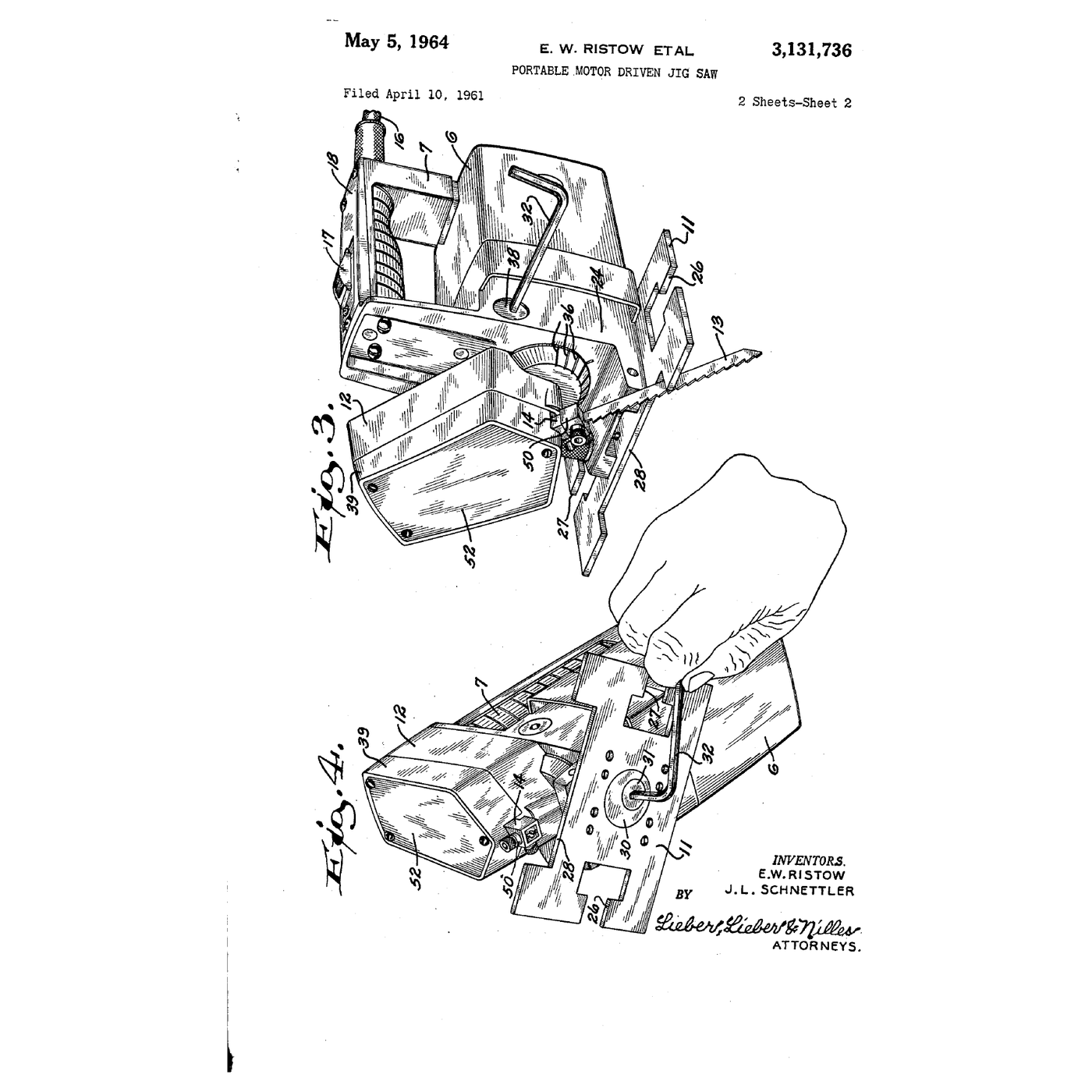
The patent opens by describing 'a portable jig saw comprising, a housing having an end wall provided with a bore, an electric motor confined within said housing' — one casting doing the work of a frame.
The drive is a two-stage reduction. A **pinion 24** on the motor shaft meshes with a **relatively large gear 41**, which meshes in turn with a **second similarly enlarged gear 42**. Two stages, because a jigsaw blade wants roughly ten times less speed than the motor gives and one stage would need an impractically large wheel.
On the second gear sits an **eccentric pin 44**. It drives one end of a **link 45**; the link's far end carries a pin running in a **slot**, and that pin drives the blade actuator. Gear turns, pin sweeps a circle, link converts the circle into a straight line.
The base plate is 'generally rectangular with one straight side and with cut-outs or notches **26, 27, 28** formed in the other three sides' — so the saw can be brought close to an obstruction on three sides. It pivots on an **eccentric disk** for mitre cuts, which tilts the shoe WITHOUT tilting the motor housing. That matters: the tool stays balanced in your hand at 45 degrees instead of hanging off to one side.
Необходимые инструменты:
ЭлектролобзикНабор отвёрток Набор шестигранных ключей
3
3
Start a cut in the middle of a panel
Start a cut in the middle of a panel
This is the thing no frame saw can do without dismantling itself.
Mark a circle on a piece of plywood. Drill a hole inside the waste, large enough to pass the blade — 10 mm is ample. Thread the blade through, set the shoe flat, and cut out to your line, then follow it round.
Cut on the waste side, always, and take the corners as a series of shallow relief cuts in from the waste rather than trying to pivot the blade. A jigsaw blade twisted in the kerf binds, heats and snaps.
Let the tool set its own pace. Pushing harder does not cut faster; it deflects the blade, which is unsupported at the bottom, and the cut leans. Compare the top face and the bottom face of your circle with the square — the difference is your feed pressure made visible.
Finish by cutting the same curve with the orbital action on, if the saw has it. The blade swings forward on the up stroke and clears on the down, cutting faster and rougher. Orbital off for a clean line in thin ply; orbital on for speed in thick softwood.
Материалы для этого шага:
 Лист фанеры1 штука
Необходимые инструменты:
ЭлектролобзикНабор полотен для электролобзика Сетевая дрель
 Набор свёрлКомбинированный угольник
 Струбцина типа C
 Защитные очки
 Защита слуха (наушники, SNR 30 дБ)
4
4
The slotted link, and what a leaning blade costs
The slotted link, and what a leaning blade costs
Загрузка блокнота Jupyter…
Необходимые инструменты:
Комбинированный угольникЦифровой штангенциркуль 6 дюймов5
5
History and context
History and context
**US 3,131,736**, Edward W. Ristow and Jerome L. Schnettler, assignors to Milwaukee Electric Tool Corporation. Filed 10 April 1961, granted 5 May 1964. Long expired.
Ristow's second appearance in this batch. In 1952 he and Behlke patented the reciprocating saw, driven by an oblique crank sweeping a cone. Nine years later, for a lighter tool with a shorter stroke, he used a gear train and a slotted link instead. Same problem — rotation in, reciprocation out, no frame — and a different answer because the constraints changed.
The handheld jigsaw is usually credited to Scintilla of Solothurn, whose Lesto of the late 1940s is widely described as the first; the story that its designer got the idea from his wife's sewing machine is repeated everywhere and is hard to verify. Bosch bought Scintilla and the type spread from there. Milwaukee's patent is a later refinement of a tool that already existed.
**Honest limits.** The blade is held at one end and deflects under feed, so the cut leans and the bottom face is never as accurate as the top. It is slow in thick stock. Blades wander in anything dense or knotty. And it is a shaping tool — anything that has to meet another surface squarely gets finished by a plane, a router or a sander afterwards.
Материалы
1- 1 штукаЗаполнитель
Требуемые инструменты
11- 1 vendor sell this, none ship to you yetЗаполнитель
- Набор полотен для электролобзика10% комиссияЗаполнитель
- Заполнитель
- Заполнитель
- Заполнитель
- Заполнитель
- Заполнитель
- Заполнитель
- Заполнитель
- Заполнитель
- Заполнитель
Связанные чертежи
Эти чертежи делятся знаниями — техники, материалы или принципы



CC0 Общественное достояние
Этот чертёж выпущен под лицензией CC0. Вы можете свободно копировать, изменять, распространять и использовать эту работу в любых целях без запроса разрешения.
Поддержите мейкера, покупая товары через его чертёж, где он получает Комиссию мейкера установленную продавцами, или создайте новую итерацию этого чертежа и включите его как связь в свой чертёж для распределения дохода.