ИСКУССТВО
КРАСОТА И ЗДОРОВЬЕ
РЕМЕСЛО
КУЛЬТУРА И ИСТОРИЯ
РАЗВЛЕЧЕНИЯ
ЭКОЛОГИЯ
ЕДА И НАПИТКИ
ОБРАТНАЯ ИНЖЕНЕРИЯ
НАУКИ
СПОРТ
ТЕХНОЛОГИИ
НОСИМЫЕ УСТРОЙСТВА
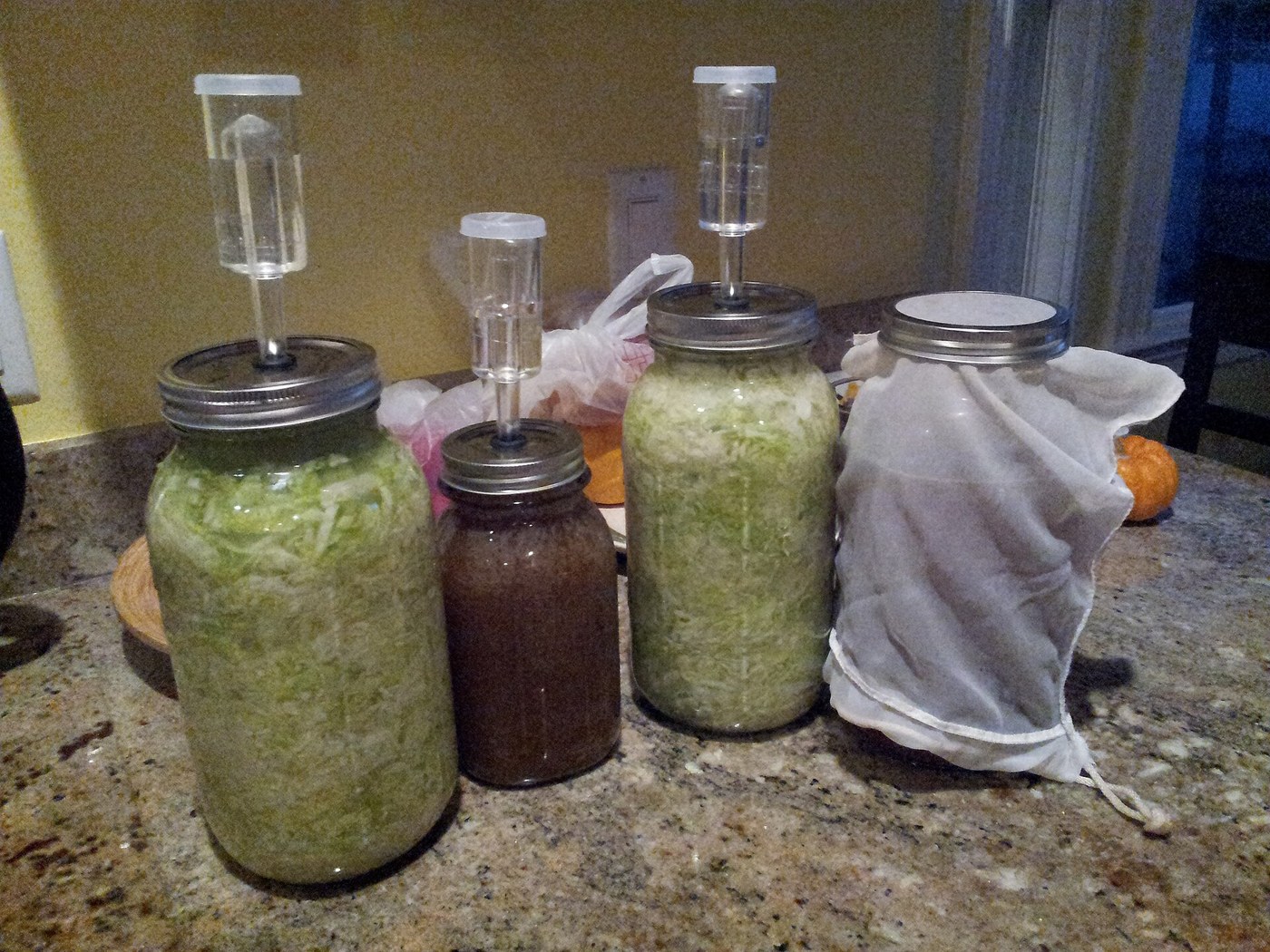


Reading Spoilage: Ferment Three Brines and Watch the Acid Line
Preserved food changes as it ages, and most of those changes are harmless. White bloom on a salami, a grey edge on cured beef, crystals in honey, a skin on a ferment — all normal, all routinely thrown away by people who do not know what they are looking at.
Some changes are not harmless. And the most dangerous case of all shows nothing: no smell, no colour, no taste.
So this rung does not ask you to learn a list of appearances. It asks you to measure the one number that actually decides the question. You will set up three cabbage ferments at different salt concentrations, read the pH of each every day for a week, and watch which jars cross pH 4.6 — the line below which Clostridium botulinum cannot grow — and how long each one takes to get there.
You will also find out something uncomfortable about your pH strips.
Средний
30 minutes to set up, then 5 minutes a day for 7 days
Инструкции
1
1
Weigh three brines — 2.0 %, 3.5 % and 5.0 % salt by weight
Weigh three brines — 2.0 %, 3.5 % and 5.0 % salt by weight
Salt concentration in a ferment is a percentage BY WEIGHT, not a spoonful, and the whole experiment turns on getting it right.
Shred the cabbage and divide it into three roughly equal portions. For each jar: tare the empty jar on the scale, add the cabbage, and write down its mass. Add water to cover and write down the total mass of cabbage plus water. The salt you need is that total times the percentage you are aiming at — so a jar holding 500 g of cabbage and water needs 10.0 g of salt for 2.0 %, 17.5 g for 3.5 % and 25.0 g for 5.0 %.
Weigh the salt on the scale rather than measuring it by spoon. Salt crystal size varies enormously between products and a level teaspoon of one salt can weigh half as much as a level teaspoon of another. Use pickling salt, or any salt without anti-caking agents or added iodine — the additives cloud the brine and can inhibit the bacteria you are trying to encourage.
Stir until the salt has fully dissolved, then make sure the solids stay UNDER the brine. A weight, a folded outer leaf, or a small water-filled bag all work. What is under the brine ferments; what sticks out above it moulds. That single fact accounts for most failed ferments.
Label each jar with its percentage and the date. Take a pH reading on day 0, before anything has happened, and write it down — that is your starting point and without it you cannot say anything changed.
Материалы для этого шага:
 Капуста1 штука
 Соль для засолки60 gram
 Дистиллированная вода1500 millilitre
Необходимые инструменты:
 Банка Mason (для питья)
 Цифровые кухонные весы
 Индикаторные полоски pH
 Мерный цилиндр
 Разметочный карандаш
2
2
Read all three every day for a week, and record what you see as well
Read all three every day for a week, and record what you see as well
Once a day, at roughly the same time, dip a fresh strip in each jar's brine and read it against the chart in good light. Write the three numbers down with the date, the time and the room temperature. Temperature drives fermentation rate strongly, so a week that includes a cold snap will show it in your curves.
Read the strip at the time the instructions specify, not whenever you get round to it. Strips keep developing, and a reading taken late is a different measurement.
Alongside the number, write what you can SEE: cloudiness, bubbling, a film on the surface, colour change, and what it smells like. This is the part that builds the judgement the rung is about — you are watching appearance and number change together, so you learn which appearances track the chemistry and which are just theatre.
Expect bubbling and cloudy brine within a couple of days. Both are the fermentation working. A thin white film that wrinkles is very likely kahm yeast, which is harmless and tastes unpleasant; skim it off and carry on. Fuzzy growth with colour to it — blue, green, black, pink — is mould and is a different matter, covered in the next step.
Do not taste anything to assess it. Not on day one, not on day seven. Tasting is not a test, and the reason is step 4.
Необходимые инструменты:
Индикаторные полоски pH Термометр-гигрометр для камеры созреванияРазметочный карандаш
3
3
Normal, and frequently mistaken for spoiled
Normal, and frequently mistaken for spoiled
Most of what gets thrown away is fine, and the cost of not knowing the difference is paid every week in ordinary kitchens.
**Kahm yeast** — a thin, flat, white-to-grey film on a brine surface, often wrinkled. Harmless. It will give the batch a musty flavour if left, so skim it and make sure everything stays submerged.
**White bloom on dry-cured sausage** — a powdery, even, white coating is the intended surface mould culture on many traditional salami. It is deliberately applied and it protects the surface.
**Crystals in honey** — honey granulating is a sugar coming out of a supersaturated solution. It is a sign of an unheated honey, not a spoiled one. Warm it gently and it redissolves.
**Tyrosine crystals in aged cheese** — gritty white specks in a long-aged hard cheese are an amino acid crystallising, and a marker of proper ageing.
**A grey edge on cured beef or a darkened cut face** — oxidation of the pigment. A colour change, not a safety change.
**Cloudy brine and vigorous bubbling** — the fermentation doing exactly what you set it up to do.
The common thread: these are EVEN, they are on the surface, and they belong to the process. Compare each against your pH column. None of them will coincide with the pH going the wrong way.
Необходимые инструменты:
Индикаторные полоски pH4
4
Spoiled, and the one that shows nothing at all
Spoiled, and the one that shows nothing at all
**Throw it away** when you see: fuzzy or hairy growth of any colour, especially blue-green, black or pink; slime or a ropy texture in the brine; a brine that was acidifying and then went back the other way; a smell that is putrid rather than sour; any pressure or bulging in a sealed container; or solids that were left above the brine and grew something.
Do not cut mould off a soft or high-moisture food and eat the rest. Mould in a soft matrix has already sent threads well beyond what you can see. On a hard cheese, cutting a generous margin away is accepted practice; on a ferment, a soft cheese or a jam, it is not.
**And then the case with no signs.** Botulinum toxin is odourless, tasteless and invisible. It does not make food look wrong, smell wrong or taste wrong. There is no sensory test for it and there never will be, which is why the number you have been writing down all week is the whole point of this rung.
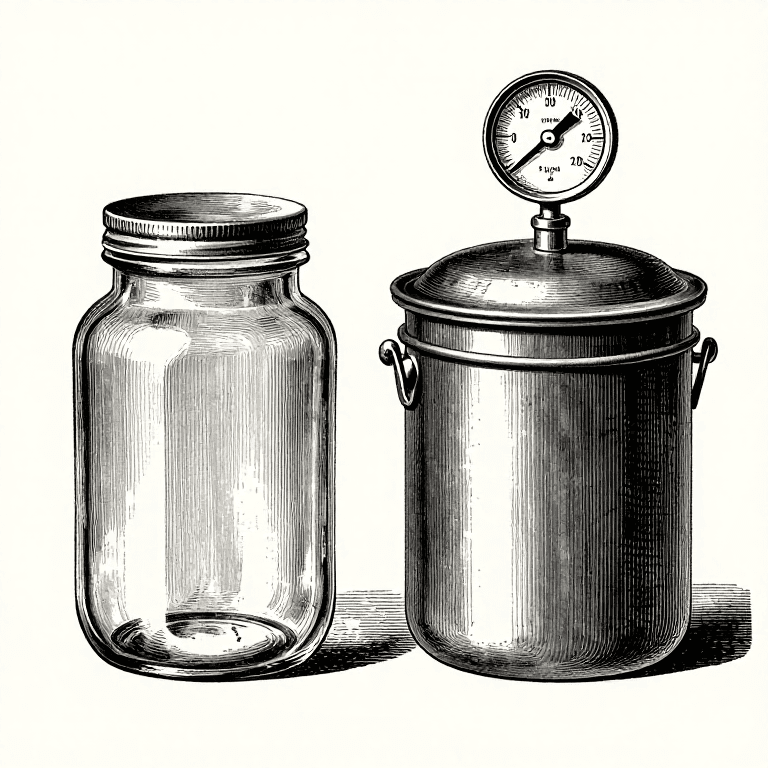
The conditions it needs are an oxygen-free environment, low acidity — above pH 4.6 — and time. That combination is not what an open, brine-covered, acidifying ferment provides; it is what improperly processed home-CANNED low-acid food provides, sealed in a jar. That is the classic case, and it is why low-acid foods must be pressure-canned to a tested schedule rather than water-bathed, and why an acidified recipe must actually reach and hold its target pH.
So the rule that follows from all of it: **never taste to decide whether something is safe.** Tasting tells you about flavour. It cannot tell you about the hazard that has no flavour. When in doubt, throw it out — and write in your book what it was and what it looked like, because that record is what makes the next batch better.
Необходимые инструменты:
Индикаторные полоски pH5
5
Plot your three curves against the line
Plot your three curves against the line
Загрузка блокнота Jupyter…
Необходимые инструменты:
 Калькулятор
6
6
Compendium: what a week of readings teaches
Compendium: what a week of readings teaches
**Why did the saltiest jar acidify slowest?** Salt suppresses the lactic acid bacteria along with everything else. That is the trade a brine recipe is making: more salt buys protection against spoilage organisms in the first days, and costs you days before the acid itself takes over the protecting. Low salt gets under the line faster and is more exposed while it does.
**My 5 % jar never got below 4.6 in the week.** That is a real and useful result. Give it longer, and keep reading. A ferment that stalls well above the line — because it is too cold, too salty, or the culture never established — has not yet done the thing you are relying on it to do.
**Can I use the pH strip reading as proof the batch is safe?** No, and step 5 shows you why in your own numbers. A strip band that straddles 4.6 cannot distinguish 4.5 from 4.7. Strips are excellent for WATCHING a trend and poor for certifying a threshold. For a batch that matters, use a meter that has been two-point calibrated that day.
**Is temperature part of this?** Very much so, and you recorded it. Fermentation roughly doubles in rate over a modest temperature rise, so the same recipe in a warm kitchen and a cold larder gives different curves. That is precisely why the sibling rung insists you change one thing at a time — if you alter salt AND move the jar somewhere warmer, your curve tells you nothing about either.
**Should I reuse the brine from a successful batch to start the next one?** It works and it speeds up the early days, which shortens the exposed window. Weigh it into the salt calculation as part of the liquid, and do not carry brine over from a batch you had any doubt about.
**Where this goes.** Water activity is the other lever on the same problem — acid and dryness are two different doors to close. The acid line rung goes deeper into the chemistry, and the zero-and-tare rung is where the two-point meter calibration this one asks for is actually taught.
Необходимые инструменты:
Индикаторные полоски pHЦифровые кухонные весыМатериалы
3- 1 штукаЗаполнитель
- 60 gramЗаполнитель
- 1500 millilitreЗаполнитель
Требуемые инструменты
7- Банка Mason (для питья)10% комиссияЗаполнитель
- Заполнитель
- Заполнитель
- Заполнитель
- Заполнитель
- Заполнитель
- Заполнитель
Связанные чертежи
Эти чертежи делятся знаниями — техники, материалы или принципы

CC0 Общественное достояние
Этот чертёж выпущен под лицензией CC0. Вы можете свободно копировать, изменять, распространять и использовать эту работу в любых целях без запроса разрешения.
Поддержите мейкера, покупая товары через его чертёж, где он получает Комиссию мейкера установленную продавцами, или создайте новую итерацию этого чертежа и включите его как связь в свой чертёж для распределения дохода.