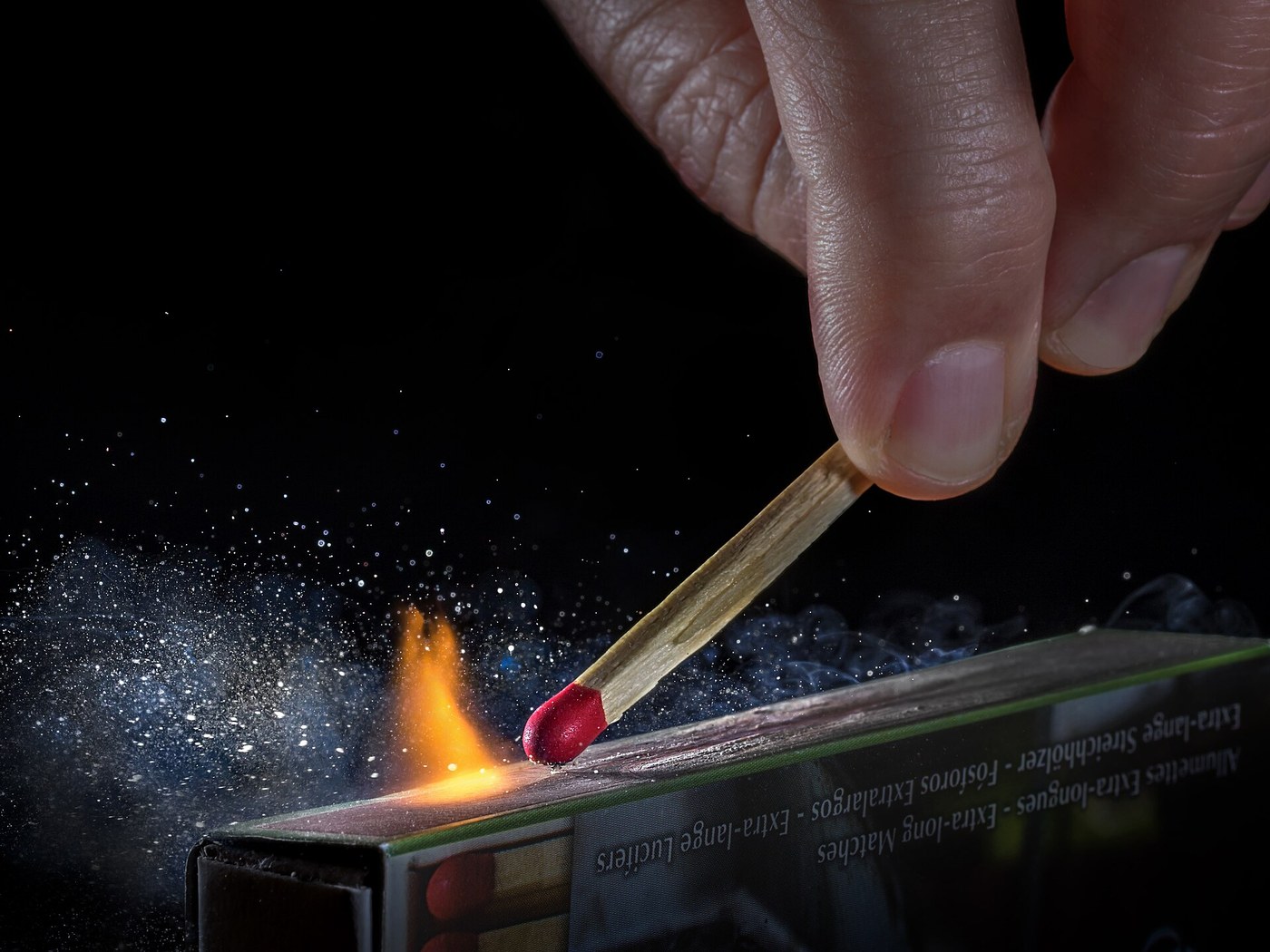


Safety Match
Инструкции
Prove the split chemistry
Prove the split chemistry
Two matches, two surfaces, four combinations. Do this outdoors or over a sink.
- Strike a safety match on its own box. It lights.
- Strike the same type on a stone, a wall, a shoe sole. It does not.
- If you have strike-anywhere matches, repeat both tests with those.
Read the two compositions
Read the two compositions
Neither half will ignite alone. Together they are a complete fire.
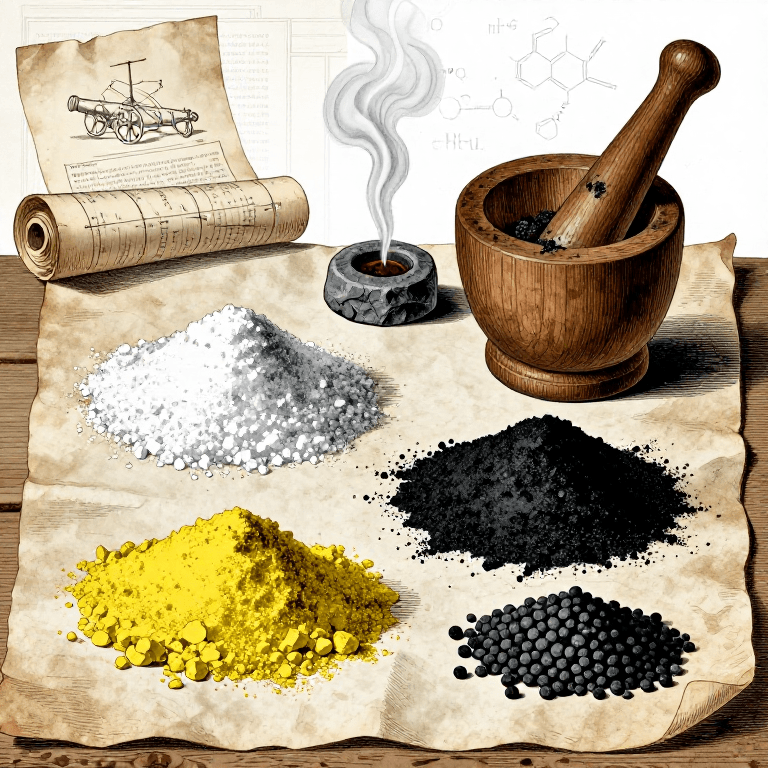
Head: potassium chlorate (the oxidiser), sulfur or a sulfide (the fuel), powdered glass (for friction), and a binder.
Striking surface: red phosphorus, powdered glass, and a binder.
- Friction heats the contact point.
- A trace of red phosphorus converts and ignites.
- That flash sets off the chlorate and fuel in the head.
Материалы для этого шага:
 Хлорат калия1 container
 Красный фосфор1 container
 Порошковая сера1 container
Do NOT mix these — and know why
Do NOT mix these — and know why
This is the step where a curious maker gets hurt, so it is explicit.
- Never grind potassium chlorate together with phosphorus, sulfur or any fuel.
- The mixture is friction- and impact-sensitive and can detonate while being mixed.
- Industrial match plants keep the two compositions in separate rooms for this reason.
Test the friction surface instead
Test the friction surface instead
The safe half of the experiment is the abrasive, and it is genuinely informative.
- Try striking a safety match on fine sandpaper, then coarse.
- Try a smooth painted surface.
- Note which grades give ignition and which just abrade the head.
History and context
History and context
John Walker, a chemist in Stockton-on-Tees, made the first friction matches in 1826 and did not patent them. White phosphorus versions followed and spread very fast, because they were cheap and lit on anything.
The human cost was known and tolerated for decades. Phosphorus necrosis of the jaw appeared in matchworkers within a few years of exposure: toothache, then abscesses, then the jawbone dying and having to be removed. It disfigured and killed. It was overwhelmingly a disease of young women and girls in the dipping rooms. The London matchgirls' strike at Bryant and May in 1888 — over fines, hours and the phosphorus itself — is one of the founding events of British trade unionism. White phosphorus in matches was finally banned by international agreement in the Berne Convention of 1906, more than sixty years after a safe alternative existed.
Pasch and Lundström. Gustaf Erik Pasch patented the separated-composition idea in Sweden in 1844, using red phosphorus — an allotrope discovered by Anton Schrötter in 1845, which is far less toxic than the white form. Pasch could not make it work commercially. Johan Edvard Lundström and his brother Carl solved the manufacturing at Jönköping and showed the matches at the Paris Exposition in 1855. Sweden dominated the match trade for a century afterwards.
What this blueprint deliberately does not do: make matches. The chemistry is described because understanding it is the point, and the mixing is prohibited because the mixture is dangerous out of proportion to anything you would learn. Striking real matches on graded surfaces demonstrates the actual principle safely.
Материалы
3- 1 containerЗаполнитель
- 1 containerЗаполнитель
- 1 containerЗаполнитель
Связанные чертежи
Эти чертежи делятся знаниями — техники, материалы или принципы
CC0 Общественное достояние
Этот чертёж выпущен под лицензией CC0. Вы можете свободно копировать, изменять, распространять и использовать эту работу в любых целях без запроса разрешения.
Поддержите мейкера, покупая товары через его чертёж, где он получает Комиссию мейкера установленную продавцами, или создайте новую итерацию этого чертежа и включите его как связь в свой чертёж для распределения дохода.