Сотрудничество
ИСКУССТВО
КРАСОТА И ЗДОРОВЬЕ
РЕМЕСЛО
КУЛЬТУРА И ИСТОРИЯ
РАЗВЛЕЧЕНИЯ
ЭКОЛОГИЯ
ЕДА И НАПИТКИ
ОБРАТНАЯ ИНЖЕНЕРИЯ
НАУКИ
СПОРТ
ТЕХНОЛОГИИ
НОСИМЫЕ УСТРОЙСТВА
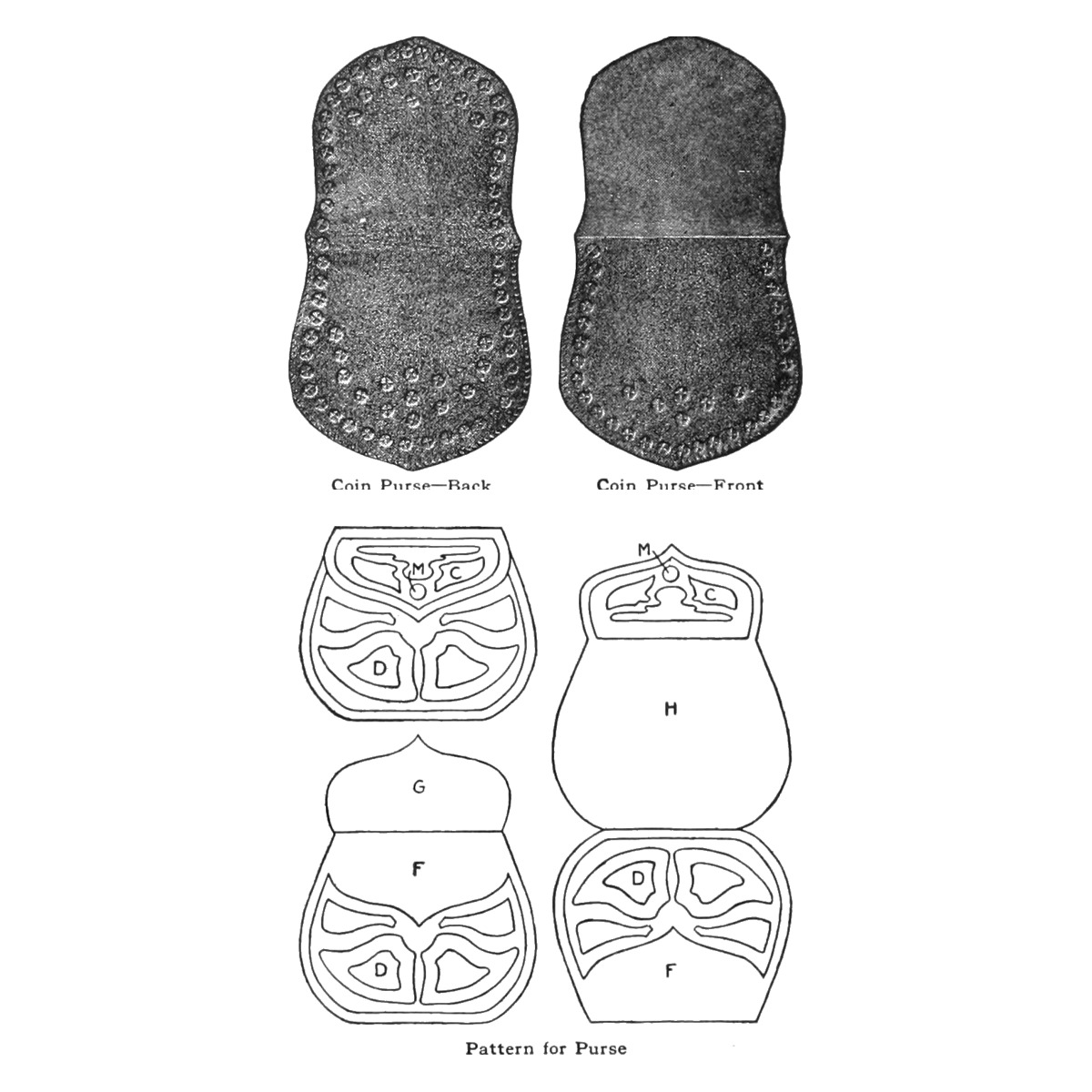


Tooled Calfskin Coin Purse: Lined, Flap Over Front, Design Split Between Flap and Front (Boy Mechanic, 1915)
The first piece in Mary C. Scovel's leather course (The Boy Mechanic, Book 2, 1915): a coin purse of Russian calfskin from a 4 by 8 in piece, its design traced, lined and tooled or stamped, split so half sits on the flap and half on the front below it, then lined with silk and stitched.
Начинающий
About 3 hours
Инструкции
1
1
Her sizes in centimetres
Her sizes in centimetres
Загрузка блокнота Jupyter…
2
2
Read The Boy Mechanic, Book 2
Read The Boy Mechanic, Book 2
Her outfit: "two special tools costing 50 cents each, one with a narrow edge for lining patterns, and one with broad ends for tooling; and a piece of tin, plate glass, or very smooth hard wood, which should not be smaller than 9 by 12 in. A soft sponge, a triangle, a rule, tracing paper and a hard pencil are also needed." Russian calfskin is best for tooling and stamping.
3
3
Make the paper pattern
Make the paper pattern
The purse has three parts: front, back and flap. Fold paper to the proportions you want, with the design for the front D on the same side of the paper as the flap C; the space F under the flap has no design. Fold F behind H, then C behind H and F, and turn the pattern over to see the purse. Cut a piece of leather 4 by 8 in, which leaves 1/4 in outside the pattern for pinning.
Материалы для этого шага:
 Опоек1 штука
Необходимые инструменты:
 Калька
 Карандаш
 Ножницы
 Линейка
4
4
Damp the leather and transfer the design
Damp the leather and transfer the design
Draw the whole design for the purse on tracing paper. Wet the leather on the wrong (unfinished) side with a soft sponge: pat it to moisten, not soak, it; too wet and the tool sticks and leaves an uneven background. Pin the design firmly on the leather, tack the leather down on its outer margin to the glass or board, and go over every line with a hard pencil, with firm, even pressure. Lift the paper and go over the lines with the narrow lining tool, with a strong, firm stroke. A line design can stop here.
Материалы для этого шага:
Опоек1 штукаНеобходимые инструменты:
 ГубкаКалькаКарандаш
 Канцелярские кнопки (коробка 50 штук)
 Стеклянный лист
 Модельер для кожи
5
5
Tool or stamp the background
Tool or stamp the background
Leave at least 1/8 in between the edge of the pattern and the design. To tool, press the background down with the broad end in even, long strokes; if it will not go down, the leather is too dry, so take it off and damp the back again. Keep the edges sharp between pressed and raised parts. To stamp instead, strike a small carpenter's nail set lightly with a wooden mallet in rows of circles; too hard a blow cuts the leather.
Необходимые инструменты:
Модельер для кожи Добойник для гвоздей
 Деревянная киянкаГубка
6
6
Line and stitch
Line and stitch
Fold the parts together, line with silk to match the leather, and stitch the front and back parts close to the edge. Stitch on a sewing machine with a long stitch, a large needle and silk as heavy as the needle takes; try it on a scrap first, and put tissue paper over the leather if the foot marks it. Without a machine, prick holes with an awl and sew with needle and silk, running or over-and-over; going over-and-over to the end and back gives an X stitch. She has the catch M put on by a shoemaker or trunk store; a snap fastener is used here.
Материалы для этого шага:
 Шёлковая ткань1 штука
 Шёлковая нить1 штука
 Клейстер из пшеничной муки1 штука
 Кнопка-застёжка1 штука
Необходимые инструменты:
Ножницы Швейная машина
 Шило
 Две шорные иглы
7
7
Troubleshooting
Troubleshooting
Tooled leather troubleshooting.
Flow
Loading...
8
8
History and honest limits
History and honest limits
From Mary C. Scovel, "Arts-Crafts Leather Work", in **The Boy Mechanic, Book 2**, Popular Mechanics, 1915 (Project Gutenberg 44585; checked on the archive.org scan boymechanicbook200chic2, pp. 432-441), Part I. She gives the piece size but no finished purse size; the shape comes from her pattern. The snap fastener, tools and metric figures are ours.
Материалы
5- 2 штукЗаполнитель
- 1 штукаЗаполнитель
- 1 штукаЗаполнитель
- 1 штукаЗаполнитель
- 1 штукаЗаполнитель
Требуемые инструменты
13- Заполнитель
- 1 vendor sell this, none ship to you yetЗаполнитель
- Заполнитель
- Заполнитель
- Заполнитель
- Заполнитель
- Заполнитель
- Заполнитель
- Заполнитель
- Заполнитель
- Заполнитель
- Заполнитель
- Заполнитель
По этому чертежу делают
Связанные чертежи
Эти чертежи делятся знаниями — техники, материалы или принципы
CC0 Общественное достояние
Этот чертёж выпущен под лицензией CC0. Вы можете свободно копировать, изменять, распространять и использовать эту работу в любых целях без запроса разрешения.
Поддержите мейкера, покупая товары через его чертёж, где он получает Комиссию мейкера установленную продавцами, или создайте новую итерацию этого чертежа и включите его как связь в свой чертёж для распределения дохода.