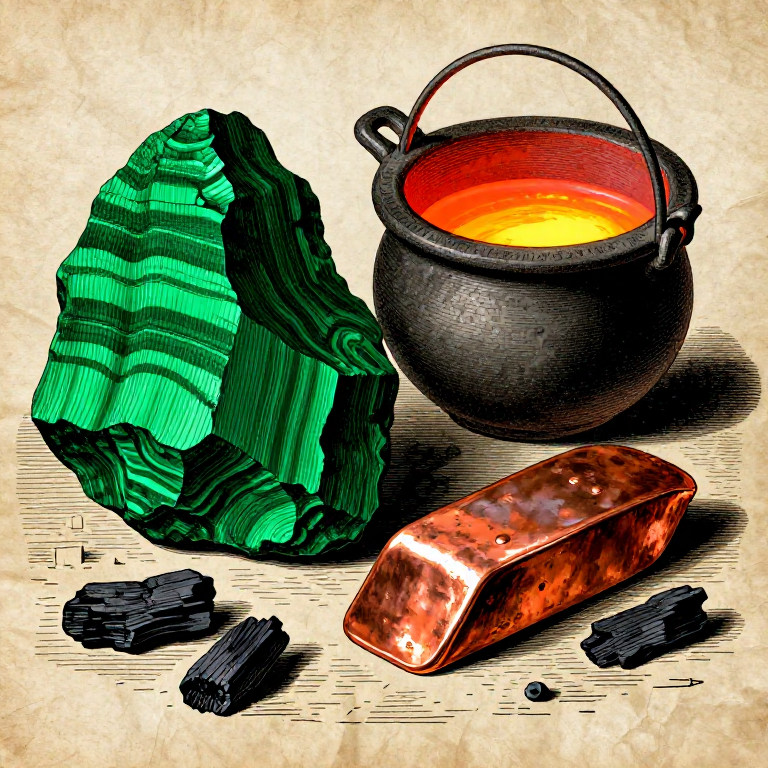

Плавка меди из малахита — от зелёной руды к красному металлу
Инструкции
Понять химию процесса
Понять химию процесса
Малахит разлагается при нагревании: Cu₂CO₃(OH)₂ → 2CuO + CO₂ + H₂O (при ~300°C). Образовавшийся оксид меди (CuO) затем восстанавливается угарным газом от горящего древесного угля: CuO + CO → Cu + CO₂. Медь плавится при 1085°C. Общий выход меди из чистого малахита составляет приблизительно 57,5%.
Измельчить малахит
Измельчить малахит
Разбейте малахит на кусочки размером менее 1 см с помощью молотка и наковальни. Чем мельче помол, тем быстрее и полнее пройдёт восстановление. Используйте ступку и пестик для финального измельчения, если они доступны. Стремитесь к фрагментам размером с горошину или мельче.
Материалы для этого шага:
 Малахитовая руда2 kilogram
Необходимые инструменты:
 Геологический молоток
 Ступка и пестик
Подготовить тигель
Подготовить тигель
Используйте глиняный тигель, выдерживающий 1200°C и выше. Графитово-глиняный тигель — идеальный вариант. Тигель должен вмещать не менее 500 мл. Если изготавливаете свой, смешайте шамотную глину с песком (соотношение 2:1) и медленно обожгите в печи до 1000°C перед использованием. Предварительно обожжённые тигли трескаются реже.
Материалы для этого шага:
 Тигель из огнеупорной глины1 штука
Layer ore and charcoal in the crucible
Layer ore and charcoal in the crucible
Place a 2 cm layer of charcoal pieces at the bottom of the crucible. Add a layer of crushed malachite (2-3 cm). Top with another layer of charcoal. The charcoal both provides carbon for reduction and protects the copper from re-oxidation. Fill to about 2/3 full.
Материалы для этого шага:
 Древесный уголь5 kilogram
Build or prepare the forge
Build or prepare the forge
You need a forge or furnace capable of reaching 1100-1200°C. A simple charcoal forge with forced air (bellows or blower) works well. The crucible sits in a bed of burning charcoal with additional charcoal piled around and above it. The air supply must be controllable.
Материалы для этого шага:
 Диск древесного угля20 kilogram
Необходимые инструменты:
 Меха (кузнечные)
Put on safety equipment
Put on safety equipment
Copper smelting involves extreme heat, toxic fumes, and molten metal. Wear: leather apron, leather gauntlet gloves, face shield, safety boots (no synthetic materials). Work outdoors or in a well-ventilated space. Copper oxide fumes cause metal fume fever if inhaled. Keep a bucket of dry sand nearby for spill containment.
Необходимые инструменты:
 Кожаный фартук
 Кожаные краги
 Защитный щиток для лица
 Ведро сухого песка
Light the forge and preheat
Light the forge and preheat
Light the forge charcoal and bring it to full heat over 30-45 minutes with gentle bellows action. Place the loaded crucible into the forge once the coals are glowing white-hot. Pack charcoal tightly around the crucible. Increase bellows speed gradually.
Maintain temperature for 2-3 hours
Maintain temperature for 2-3 hours
Keep the forge at 1100-1200°C for 2-3 hours. The malachite first decomposes (green changes to black CuO at ~300°C), then the CuO reduces to copper as temperature climbs. Add charcoal to the forge as needed to maintain heat. The crucible contents will shrink as CO₂ gas escapes.
Check for completion
Check for completion
After 2-3 hours, carefully lift the crucible lid with tongs and peek inside. You should see a bright orange-red pool of molten copper beneath a layer of slag (glassy dark material). If you see unmelted green or black chunks, continue heating for another 30 minutes.
Необходимые инструменты:
 Клещи с длинными ручками
Prepare the ingot mold
Prepare the ingot mold
While the copper melts, prepare a sand mold or a flat stone depression for pouring. Preheat the mold with a torch to prevent thermal shock cracking. A simple bar-shaped mold carved into a sandstone block works well. Ensure the mold is completely dry — any moisture causes explosive splattering of molten metal.
Необходимые инструменты:
 Песчаниковая изложница
Pour the copper
Pour the copper
Using crucible tongs, lift the crucible from the forge. Tilt slowly to pour molten copper into the mold. The dark glassy slag floats on top and can be held back with a stick while the copper flows under it. Pour steadily — interrupted pours create cold shuts (weak seams).
Необходимые инструменты:
 Щипцы для тигля
Let the ingot cool
Let the ingot cool
Allow the copper ingot to cool in the mold for at least 30 minutes. Do not quench in water — rapid cooling makes copper brittle with internal stresses. Air cooling produces a softer, more workable metal. The copper surface oxidizes to a dark red-brown as it cools.
Remove and clean the ingot
Remove and clean the ingot
Once cool enough to handle (below 100°C), remove the ingot from the mold. Brush off adhering sand and slag with a wire brush. The ingot should have the characteristic salmon-pink color of fresh copper on freshly exposed surfaces. Any dark patches are trapped slag or oxide inclusions.
Необходимые инструменты:
 Набор проволочных щёток
Weigh and assess yield
Weigh and assess yield
Weigh the clean copper ingot. From 2 kg of good malachite ore, expect 800-1000 g of copper (40-50% yield, accounting for slag losses and impurities). Pure malachite would yield 1150 g, but field-collected ore is rarely pure. Record the yield for future optimization.
Необходимые инструменты:
 Цифровые кухонные весы
Test the copper quality
Test the copper quality
Hammer the edge of the ingot on an anvil. Good copper deforms plastically without cracking — it is one of the most malleable metals. If it cracks, it contains too much slag or oxide. File a small area to expose fresh metal — pure copper is salmon-pink. A green tinge indicates incomplete reduction.
Необходимые инструменты:
 Напильник по металлу
Store the copper ingot
Store the copper ingot
Copper oxidizes slowly in air (forming green patina over months). For short-term storage, keep dry. For long-term, coat with a thin layer of oil. Label with date, source ore, and weight. This copper is ready for casting, hammering into sheet, or alloying with tin to make bronze.
Материалы
4- 2 kilogramЗаполнитель
- 1 штукаЗаполнитель
- 5 kilogramЗаполнитель
- 20 kilogramЗаполнитель
Требуемые инструменты
15- Заполнитель
- Заполнитель
- Заполнитель
- Заполнитель
- Заполнитель
- Заполнитель
- Заполнитель
- Заполнитель
- Заполнитель
- Заполнитель
- Заполнитель
- Заполнитель
- Заполнитель
- Заполнитель
Материалы из связанных чертежей
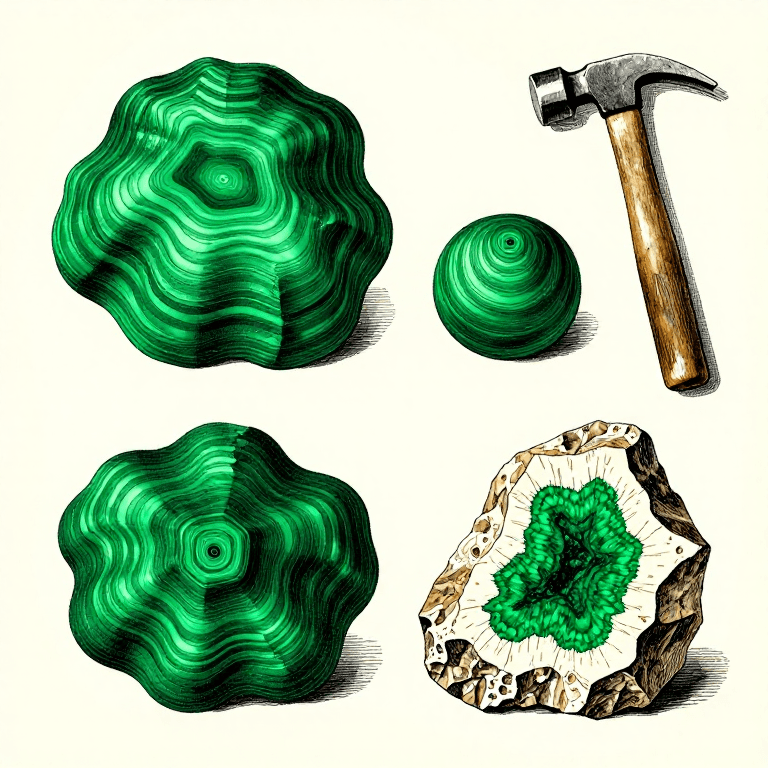
Identifying and Collecting Malachite — Copper Carbonate Ore from the Earth
от Peter
Металлообработка
Recovering Selenium from Copper Refinery Anode Slime — The Photoconductor That Sees Light
от Peter
Горное дело
Making Malachite Green Pigment — Grinding the Copper Mineral into Painter's Green
от Charlie
ИСКУССТВО
По этому чертежу делают

Связанные чертежи
Эти чертежи делятся знаниями — техники, материалы или принципы
CC0 Общественное достояние
Этот чертёж выпущен под лицензией CC0. Вы можете свободно копировать, изменять, распространять и использовать эту работу в любых целях без запроса разрешения.
Поддержите мейкера, покупая товары через его чертёж, где он получает Комиссию мейкера установленную продавцами, или создайте новую итерацию этого чертежа и включите его как связь в свой чертёж для распределения дохода.