Сотрудничество
ИСКУССТВО
КРАСОТА И ЗДОРОВЬЕ
РЕМЕСЛО
КУЛЬТУРА И ИСТОРИЯ
РАЗВЛЕЧЕНИЯ
ЭКОЛОГИЯ
ЕДА И НАПИТКИ
ОБРАТНАЯ ИНЖЕНЕРИЯ
НАУКИ
СПОРТ
ТЕХНОЛОГИИ
НОСИМЫЕ УСТРОЙСТВА
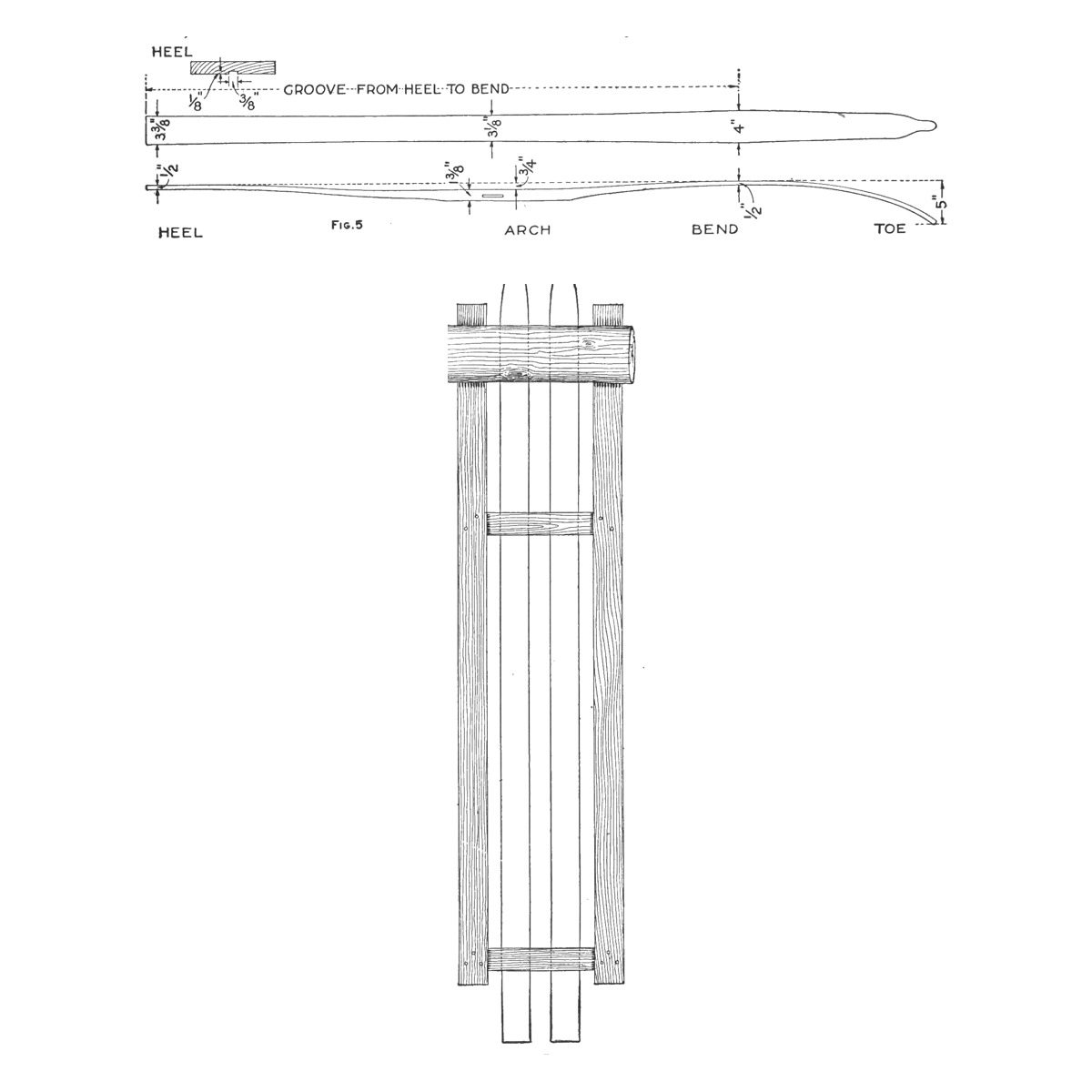


Skis: Ash or Hickory Planks Shaped to an 8 ft Pattern, Steam-Bent Tips and a Running Groove (Boy Mechanic, 1919)
Stillman Taylor's skis from The Boy Mechanic, Book 3 (1919): "far easier than snowshoe construction, since each runner is made from a single piece of plank". Ash or hickory is cut to his 8 ft pattern, thinned from the top only, the tips steamed to a 6 in bend, a centre groove cut, and the skis oiled and waxed.
Средний
About 1 week
Инструкции
1
1
Fig. 5 in centimetres, and the wax
Fig. 5 in centimetres, and the wax
Загрузка блокнота Jupyter…
2
2
Read The Boy Mechanic, Book 3
Read The Boy Mechanic, Book 3
"Either hickory or ash will give satisfaction, because both are heavy woods, as well as strong and flexible." For a man of good height, 7 to 8 ft is the right length.
3
3
Get and choose the wood
Get and choose the wood
Get two ash or hickory planks about 9 ft long and 2 in thick, from the outside of the lower trunk, with the grain running as in his Fig. 6, A/D (in ash choose open, widely spaced grain). Or split a sound, straight tree about 10 in across and clear of knots for 10 ft: axe a straight groove about 1 in deep along each side and drive small wood wedges along it; hew only enough off the outside to make the flat running surface.
Материалы для этого шага:
 Доска из твёрдой древесины2 штук
Необходимые инструменты:
 Ножовка по дереву
 Рулетка
4
4
Lay out and saw
Lay out and saw
Make a paper pattern from his Fig. 5 (8 ft ski): 3-3/8 in wide at the heel, 3-1/8 in at the foot, 4 in at the bend, rounding to the toe. Trace it on the plank and saw out; on green wood make the width about 1/4 in greater for shrinkage.
Материалы для этого шага:
Доска из твёрдой древесины1 штукаНеобходимые инструменты:
 КарандашНожовка по деревуРулетка
5
5
Plane to thickness
Plane to thickness
Plane the running surface perfectly smooth, grain straight from point to heel. Work the thickness down from the top side only, never the bottom: about 1/2 in at the heel, 3/4 in at the foot and 1/2 in at the bend.
Необходимые инструменты:
 Ручной рубанок
 Струг
6
6
Steam the tip
Steam the tip
Lay the ski over a wash boiler of boiling water and soak the tip by mopping it with the water on a cloth tied to a stick. Bend gradually over many treatments to a good 6 in bend (it finishes near 5 in, as the wood straightens a little as it dries). Hold it in a rough frame over a short log, or lash or cleat the tips to the bench, as in his Fig. 7. The arch under the foot is easily put in, and easily straightened when cold if overdone.
Необходимые инструменты:
 Большая кастрюля
 Швабра
 Струбцина с направляющей
7
7
Binding hole, balance and groove
Binding hole, balance and groove
Put in the hole for the foot binding. If the wood was left long, trim the heel so the ski balances when lifted by the toe straps (he sees no advantage in weighting a light heel with lead). Cut a groove in the exact centre of the running surface, about 1/8 in deep and 3/8 to 1/2 in wide, from the heel to the start of the bend, with a grooving plane or a small gouge.
Материалы для этого шага:
 Кожаный ремешок2 штук
Необходимые инструменты:
 Ручная дрель
 Стамески
 Полукруглая стамескаНожовка по дереву
8
8
Finish and wax
Finish and wax
Sandpaper top and bottom and rub down with linseed oil with a little paraffin or beeswax in it; oil and wax the running surface (spar varnish on the tops if you want gloss). For a hard wax, melt 10 oz of beeswax with 5 oz of rosin, stir in 1 oz of turpentine and pour into small boxes. Rub it on and go over it with a hot flatiron; too much wax makes climbing hard.
Материалы для этого шага:
 Наждачная бумага1 штука
 Льняное масло1 штука
 Парафин1 штука
 Пчелиный воск1 штука
 Сосновая канифоль1 штука
 Скипидар1 штука
Необходимые инструменты:
Большая кастрюля Чугунный утюг
 Широкая малярная кисть
9
9
Troubleshooting
Troubleshooting
Ski troubleshooting.
Flow
Loading...
10
10
History and honest limits
History and honest limits
From "How to Make Skis" by Stillman Taylor, in **The Boy Mechanic, Book 3**, Popular Mechanics, 1919 (Project Gutenberg 71856; checked on the archive.org scan boymechanic0003unse, pp. 27-30). His text gives the groove as 3/8 to 1/2 in wide; Fig. 5 shows 3/8 in. He does not describe the binding. The tools and metric figures are ours.
Материалы
8- Заполнитель
- 2 штукЗаполнитель
- 1 штукаЗаполнитель
- 1 штукаЗаполнитель
- 1 штукаЗаполнитель
- 1 штукаЗаполнитель
- 1 штукаЗаполнитель
- 1 штукаЗаполнитель
Требуемые инструменты
13- Заполнитель
- 1 vendor sell this, none ship to you yetЗаполнитель
- 1 vendor sell this, none ship to you yetЗаполнитель
- Заполнитель
- Заполнитель
- Заполнитель
- Заполнитель
- Заполнитель
- Заполнитель
- Заполнитель
- Заполнитель
- Заполнитель
- Заполнитель
По этому чертежу делают
Связанные чертежи
Эти чертежи делятся знаниями — техники, материалы или принципы
CC0 Общественное достояние
Этот чертёж выпущен под лицензией CC0. Вы можете свободно копировать, изменять, распространять и использовать эту работу в любых целях без запроса разрешения.
Поддержите мейкера, покупая товары через его чертёж, где он получает Комиссию мейкера установленную продавцами, или создайте новую итерацию этого чертежа и включите его как связь в свой чертёж для распределения дохода.