ИСКУССТВО
КРАСОТА И ЗДОРОВЬЕ
РЕМЕСЛО
КУЛЬТУРА И ИСТОРИЯ
РАЗВЛЕЧЕНИЯ
ЭКОЛОГИЯ
ЕДА И НАПИТКИ
ОБРАТНАЯ ИНЖЕНЕРИЯ
НАУКИ
СПОРТ
ТЕХНОЛОГИИ
НОСИМЫЕ УСТРОЙСТВА
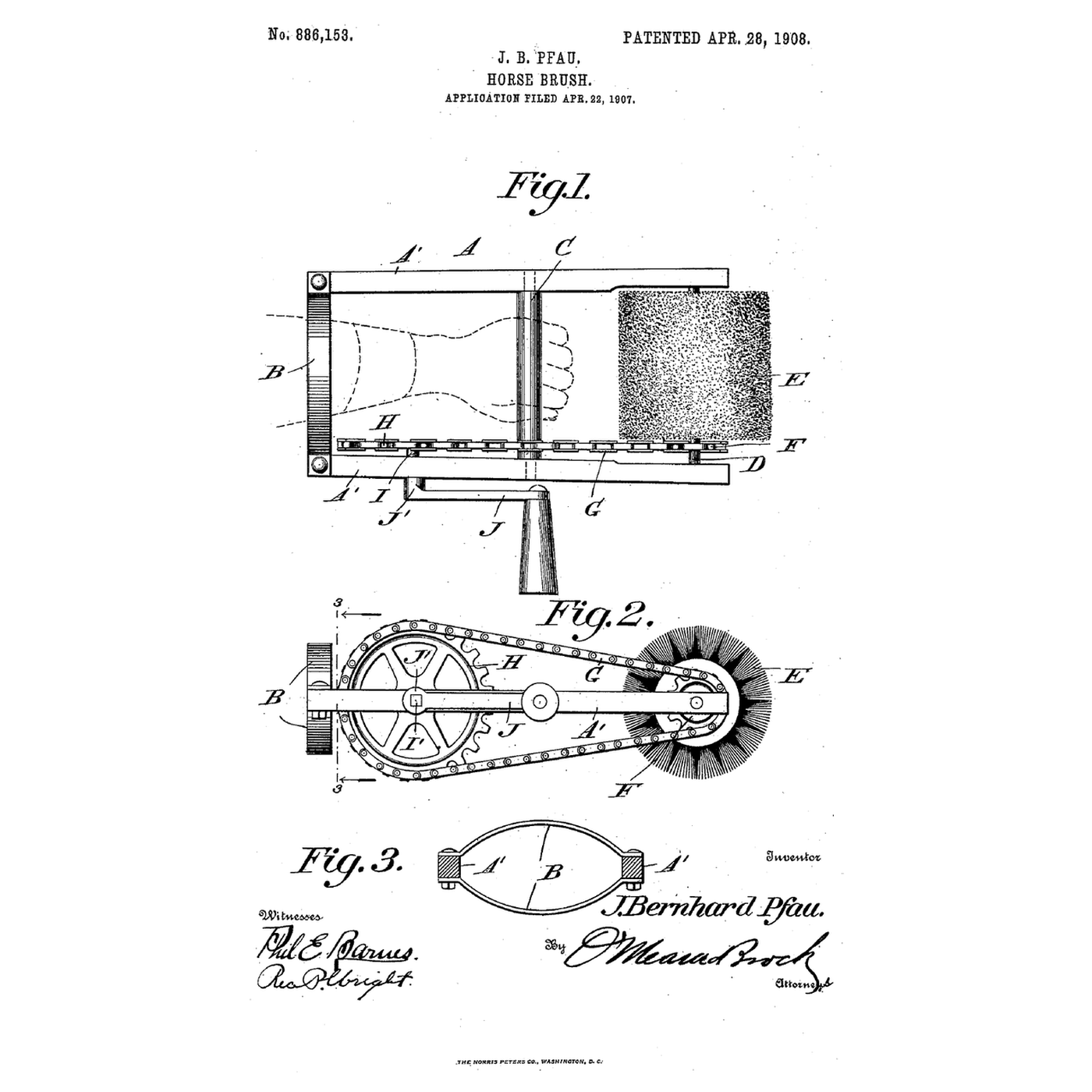


The Crank-Driven Rotary Horse Brush: Worn on the Forearm, Spun by a Sprocket Chain
Brushing a horse by hand stroke after stroke takes a long time and tires the arm.
John Bernard Pfau of Duluth, Minnesota, received US 886,153, patented 28 April 1908, for a rotary horse brush "so constructed that it can be readily held with one hand and operated with the other, so that a horse can be easily and quickly groomed". The arm is pushed between two bowed plates at the end of a frame of two parallel bars and the hand grips a handle between them; the other hand turns a crank whose sprocket drives, through a chain, a sprocket on the shaft of a cylinder brush at the frame's open end.
This rung works out the brush's speed and the effort at the crank, then builds the frame, a bristle roller and the chain drive, and counts the brush's turns against the crank's.
Продвинутый
About 8 hours
Инструкции
1
1
Brush speed and crank effort
Brush speed and crank effort
Загрузка блокнота Jupyter…
2
2
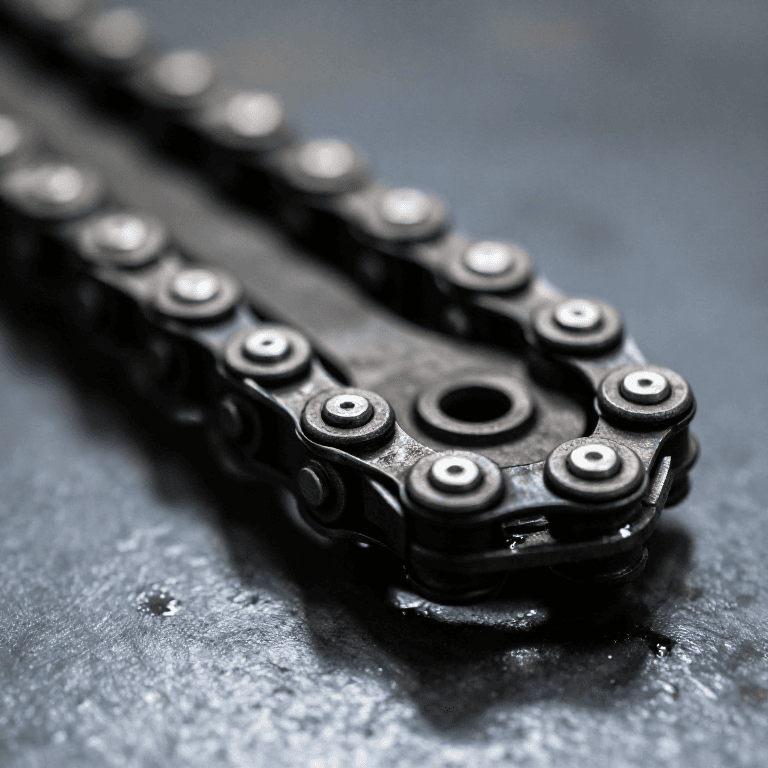
A roller chain before it
A roller chain before it
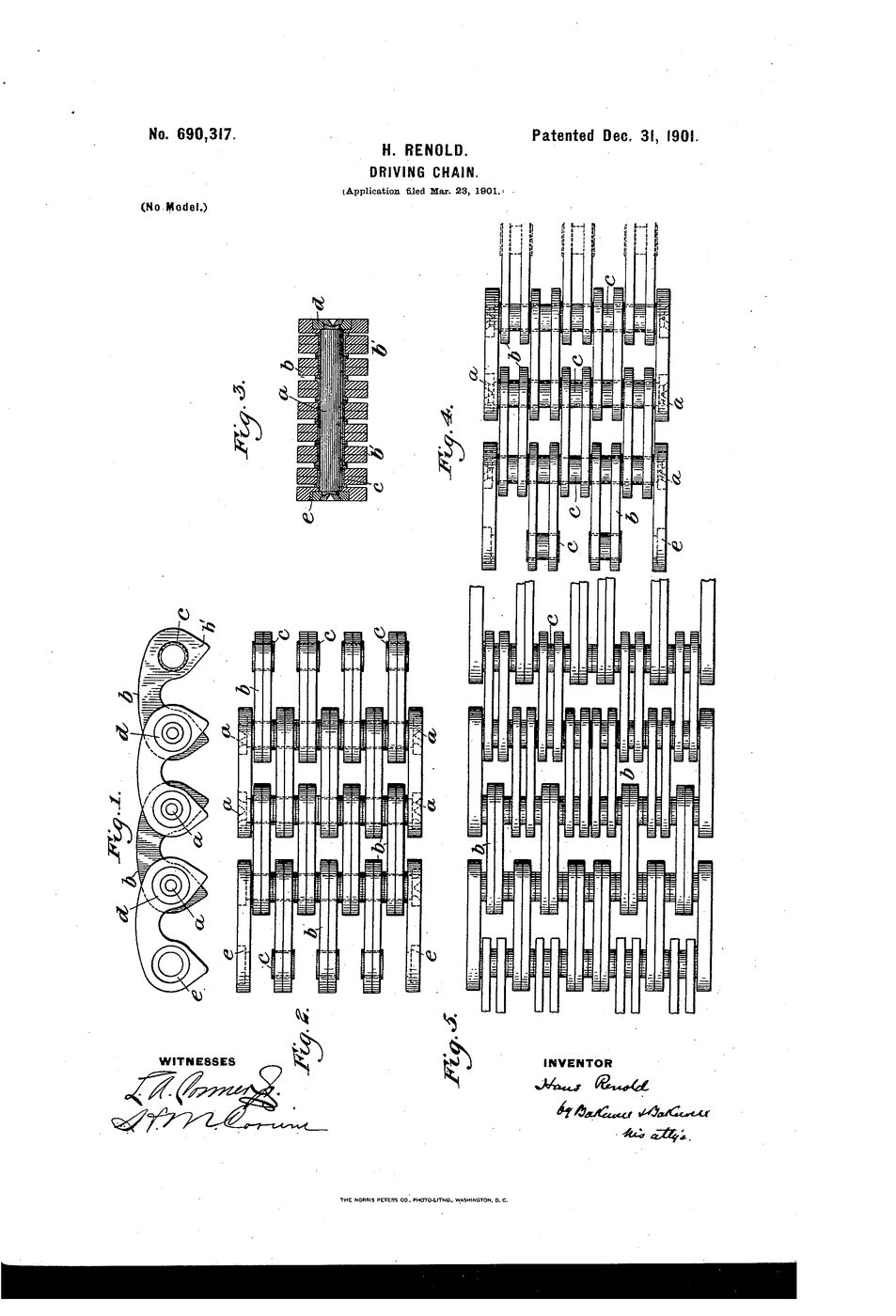
The embedded blueprint builds the roller chain that carries a drive from one sprocket to another. Pfau runs one from a hand crank to a brush, on a frame held on the forearm.
3
3
Read US 886,153
Read US 886,153
"In the drawing A indicates the frame of my improved brush which is formed of a pair of parallel bars A' connected together at one end by a pair of bowed plates B, through which the arm of the operator is adapted to be shoved, so as to support the same."
"Mounted in the parallel bars of the frame, adjacent its open end is a shaft D carrying a brush E and provided with a sprocket wheel F over which passes a sprocket-chain G carried by a sprocket wheel H secured on the shaft I which is mounted in one of the side bars of the frame, adjacent one end and is provided with a square end I' over which the socket J' of a crank-arm J is adapted to fit, so that the sprocket can be rotated, by operating the crank arm."
4
4
Build the brush and time it
Build the brush and time it
**Frame.** Saw two hardwood bars 50 × 4 × 2 cm. Bend two 30 cm lengths of 20 × 3 mm mild steel flat bar into bows and bolt one above and one below across one end of the bars, making an oval your forearm slides through. Glue a 25 mm dowel across the bars at their middle as the handle.
**Brush.** Cut a 12 cm length of 40 mm hardwood dowel and drill it through its axis for an 8 mm steel rod. Drill 5 mm holes 8 mm deep in rows around it, fold a tuft of boar bristle into each and set it with epoxy; when it has cured, trim the tips even about 2 cm out. Epoxy the rod through it, leaving ends to run in holes near the open end of the bars, and fit a sprocket on one end outside the bar, drilled to the rod and held with a set screw.
**Drive.** Near the forearm end, run a second rod through the same bar as the crank shaft, with a larger sprocket in line with the first. File a square on its outer end, and make a crank arm from flat bar with a square hole to fit and a set screw, and a dowel handle on a bolt 10 cm from the shaft. Fit the chain and join it with its connecting link.
**Test.** Mark the brush with a marker. Turn the crank 20 times at a steady pace, timed with a stopwatch, and count the brush's turns. Compare with the sprockets' teeth, then brush a folded wool blanket and look at how much dust comes out.
Материалы для этого шага:
 Доска из твёрдой древесины1 штука
 Полоса из малоуглеродистой стали0.8 метр
 Набор шестигранных болтов1 штука
 Плоская шайба8 штук
 Деревянный шкант1 штука
 Шканты из твёрдой древесины1 штука
 Щетина кабана1 штука
 Двухкомпонентная эпоксидка1 штука
 Круг из низкоуглеродистой стали0.5 метр
 Звёздочка2 штук
 Роликовая цепь1 штука
 Установочный винт с чашеобразным концом3 штук
 Столярный клей1 штука
Необходимые инструменты:
 Ножовка по дереву
 Аккумуляторная дрель
 Набор свёрл
 Слесарные тиски
 Ножовка по металлу
 Напильники (ручной напильник)
 Молоток
 Разводной ключ
 Набор отвёрток
 Струбцины
 Линейка
 Секундомер
 Перманентный маркер
 Прозрачные защитные очки
5
5
A brush that stalls, slips or throws its chain
A brush that stalls, slips or throws its chain
Crank-driven rotary horse brush troubleshooting.
Flow
Loading...
6
6
History and honest limits
History and honest limits
**John Bernard Pfau** of Duluth, St. Louis County, Minnesota, filed US 886,153 on 22 April 1907; it was patented 28 April 1908. The handle C connects the bars centrally so the frame can be held securely and moved into any position on the horse; the crank arm J fits the square end I' of the shaft I. In operation the arm is forced between the bowed plates, the hand grasps the handle, the brush is placed against the animal and the other hand turns the crank. His claims cover the frame with a shaft carrying a brush, a means to receive the arm and a means to turn the shaft; the frame with a handle and an opening for the arm; the parallel bars with bowed plates, handle and rotary brush; and the sprockets, chain and crank.
**Honest limits.** A hardwood frame, a hand-tufted roller and stock sprockets stand in for his, and the chain runs outside a bar here, where his runs inside the frame; he gives no sizes or tooth numbers. The notebook leaves out friction; its teeth, radii, speed and drag are examples. Your counted turns are the result.
Материалы
13- 1 штукаЗаполнитель
- 0.8 метрЗаполнитель
- 1 штукаЗаполнитель
- 8 штукЗаполнитель
- 1 штукаЗаполнитель
- 1 штукаЗаполнитель
- 1 штукаЗаполнитель
- 1 штукаЗаполнитель
- 0.5 метрЗаполнитель
- 2 штукЗаполнитель
- 1 штукаЗаполнитель
- Заполнитель
- 1 штукаЗаполнитель
Требуемые инструменты
14- Заполнитель
- 1 vendor sell this, none ship to you yetЗаполнитель
- Заполнитель
- Заполнитель
- Заполнитель
- Заполнитель
- Заполнитель
- Заполнитель
- Заполнитель
- Заполнитель
- Заполнитель
- Заполнитель
- Заполнитель
- Заполнитель
Связанные чертежи
Эти чертежи делятся знаниями — техники, материалы или принципы

CC0 Общественное достояние
Этот чертёж выпущен под лицензией CC0. Вы можете свободно копировать, изменять, распространять и использовать эту работу в любых целях без запроса разрешения.
Поддержите мейкера, покупая товары через его чертёж, где он получает Комиссию мейкера установленную продавцами, или создайте новую итерацию этого чертежа и включите его как связь в свой чертёж для распределения дохода.