ИСКУССТВО
КРАСОТА И ЗДОРОВЬЕ
РЕМЕСЛО
КУЛЬТУРА И ИСТОРИЯ
РАЗВЛЕЧЕНИЯ
ЭКОЛОГИЯ
ЕДА И НАПИТКИ
ОБРАТНАЯ ИНЖЕНЕРИЯ
НАУКИ
СПОРТ
ТЕХНОЛОГИИ
НОСИМЫЕ УСТРОЙСТВА
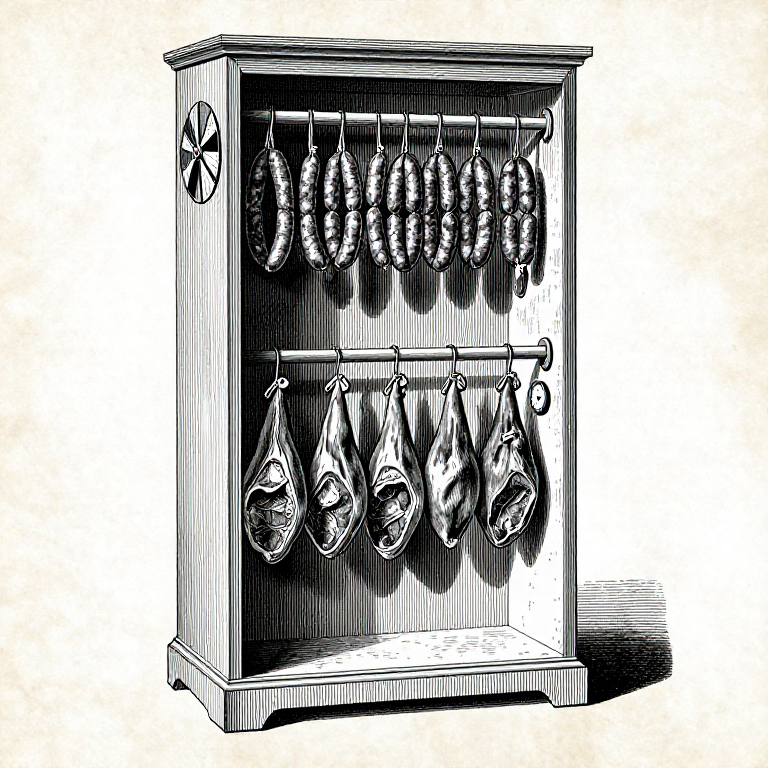


The Curing Chamber: Cold, Damp, and Moving Slowly
A dry cure needs somewhere to hang for weeks or months, and that place has to hold three things at once: a temperature cold enough to be safe, a humidity high enough that the surface does not seal, and enough air movement to carry the water away without drying the outside faster than the inside can follow.
Those three pull against each other, which is why a cellar in the right climate makes excellent ham and a garage in the wrong one makes case-hardened failures.
This rung is the numbers, the failure modes each one causes, and how to build something that holds them — because the traditional answer, a stone cellar in a mountain winter, is not available to most people.
Продвинутый
4 hours
Инструкции
1
1
The three numbers
The three numbers
**Temperature: 11 to 15 C.** Cold enough that pathogens grow slowly, warm enough that drying proceeds and that the flavour develops. A refrigerator at 4 C is too cold — the piece dries very slowly and never develops.
**Humidity: 70 to 80% RH.** This is the number that matters most and is hardest to hold. Too dry and the surface seals; too damp and the surface stays wet and the wrong things grow.
The link to the water-activity rung is direct: **the chamber humidity divided by 100 is the water activity the surface is heading towards.** A chamber at 75% RH is pulling the surface towards 0.75, which is why 70 to 80 is chosen — it dries the surface steadily without racing.
**Airflow: slow and intermittent.** Enough to prevent still, saturated pockets around the meat; not a draught. A small fan running a few minutes an hour is the usual arrangement. Still air lets a damp skin form directly on the surface; moving air strips the surface faster than water can arrive from inside.
All three need measuring, not guessing. A combined thermometer-hygrometer inside the chamber, checked whenever the pieces are weighed, is the whole instrument list.
Необходимые инструменты:
 Термометр-гигрометр для камеры созревания
 Гигрометр (измеритель влажности)
2
2
Case hardening, and why it is the defining failure
Case hardening, and why it is the defining failure
Case hardening is what happens when the surface dries faster than water can travel out from the middle. The outer few millimetres become hard and nearly impermeable, and the piece stops losing weight with wet meat sealed inside.
It is the characteristic failure of a home chamber, and it is nearly always too little humidity, too much airflow, or both.
**Recognising it:** the weight loss curve flattens far too early, the outside feels hard and the piece feels heavy for its size, and cutting one open shows a dark dry rim around a pale soft centre.
**Why it is dangerous rather than merely disappointing:** the trapped centre is moist, low-oxygen, low-acid meat at cellar temperature. That is the botulism case exactly, and it is why nitrite belongs in anything hung for months.
**The rescue:** vacuum-seal the piece and leave it in the fridge for a week or two. The moisture equalises through the piece, the crust softens, and it can go back on the hook. Then fix the chamber before hanging anything else.
**The prevention:** start humid. The first week is when the surface is wettest and most vulnerable, so 80 to 85% RH for the first days, easing down to 75 as the piece firms.
Материалы для этого шага:
 Свиная лопатка (на кости)1 штука
Необходимые инструменты:
Гигрометр (измеритель влажности) Цифровые кухонные весы
 Вакуумный упаковщик
 Набор мясницких ножей и инструментов для разделки
 Пакеты для вакуумной упаковки
3
3
Building one from a fridge
Building one from a fridge
An old refrigerator is the standard home chamber, because it is an insulated box that already has a cooling system. It needs three additions.
**An external temperature controller.** The fridge's own thermostat will not go up to 13 C. A plug-in controller with its probe inside the chamber switches the whole fridge on and off at whatever temperature is set, and the fridge's own dial is turned to its coldest so it simply obeys.
**A humidity source and a controller.** A fridge dehumidifies as it runs, so it will sit far below 70% left alone. A small ultrasonic humidifier on a humidistat is the usual answer. A tray of saturated salt solution is the low-tech version and holds about 75%, which is the target — the same physical constant the water-activity rung uses for calibration.
**Air movement.** A small computer fan on a timer, a few minutes an hour, pointed at a wall rather than at the meat.
Hang pieces so nothing touches anything else or the walls. A contact point does not dry, and it is where mould starts.
Keep the chamber for curing. A fridge shared with other food is a fridge with the door opened several times a day, which destroys both the temperature and the humidity, and cross-contamination runs both ways.
Материалы для этого шага:
 Соль1 штука
Необходимые инструменты:
Термометр-гигрометр для камеры созреванияГигрометр (измеритель влажности)4
4
Mould: the ones you want and the ones you do not
Mould: the ones you want and the ones you do not
A dry-cured product hung for months will grow mould. Some of it is the point.
**White, powdery, even** — usually *Penicillium nalgiovense* or a relative, and it is wanted. It occupies the surface so nothing else can, regulates drying by slowing surface moisture loss, and contributes flavour. Traditional cellars are colonised with it; a new chamber can be inoculated with a starter culture, or by hanging a piece next to one that already carries it.
**Green, blue, black, or fuzzy and raised** — not wanted. Green and blue moulds on meat can produce mycotoxins. Black spots are usually a sign the humidity is too high.
**Fuzzy grey and growing fast** — too wet. Lower the humidity and improve the airflow.
**What to do about unwanted mould:** wipe it off with a cloth dampened with vinegar or brine, and fix the humidity. On a hard dry surface this is genuinely effective, because the mould is on the outside of a piece whose surface is far too dry and salty for it to penetrate.
**When to give up on a piece:** mould that has penetrated into a cut surface or a crevice rather than sitting on the rind, any sliminess under the mould, or a smell that is ammoniac or putrid rather than earthy. Those are covered in the spoilage rung, and the answer there is to discard it.
Материалы для этого шага:
Свиная лопатка (на кости)1 штукаНеобходимые инструменты:
 Марля для сыраГигрометр (измеритель влажности)
Требуемые инструменты
7- Заполнитель
- Заполнитель
- Заполнитель
- Заполнитель
- Заполнитель
- Заполнитель
Связанные чертежи
Эти чертежи делятся знаниями — техники, материалы или принципы
CC0 Общественное достояние
Этот чертёж выпущен под лицензией CC0. Вы можете свободно копировать, изменять, распространять и использовать эту работу в любых целях без запроса разрешения.
Поддержите мейкера, покупая товары через его чертёж, где он получает Комиссию мейкера установленную продавцами, или создайте новую итерацию этого чертежа и включите его как связь в свой чертёж для распределения дохода.