ИСКУССТВО
КРАСОТА И ЗДОРОВЬЕ
РЕМЕСЛО
КУЛЬТУРА И ИСТОРИЯ
РАЗВЛЕЧЕНИЯ
ЭКОЛОГИЯ
ЕДА И НАПИТКИ
ОБРАТНАЯ ИНЖЕНЕРИЯ
НАУКИ
СПОРТ
ТЕХНОЛОГИИ
НОСИМЫЕ УСТРОЙСТВА



The Pressure Cooker: A Lid the Steam Holds Shut
Papin's digester of the 1670s showed that food cooks faster in steam under pressure, and needed a safety valve to do it safely. Home pressure cookers of the early twentieth century clamped a heavy lid down with screws or bails that had to hold a force of hundreds or thousands of pounds.
Alfred Vischer Jr. of Park Ridge, Illinois, assignor to Vischer Products Company, filed US 2,282,011, *Pressure Cooker and Similar Container*, on 18 November 1938 (continuing applications of 1934 and 1936); it was granted 5 May 1942. His Flex-Seal lid is a thin dished stainless steel disc, larger than the pan's opening, which is warped to slip inside and then drawn up against a smooth seat under the rim. The pressure itself holds it: the higher the pressure, the tighter the seal, and it cannot be taken out until the pressure has fallen.
This rung computes the boiling point and the lid force, and measures a modern cooker's working temperature.
Средний
About 2 hours
Инструкции
1
1
Boiling point and lid force
Boiling point and lid force
Загрузка блокнота Jupyter…
2
2
Read Vischer's inside lid
Read Vischer's inside lid
The patent's saucepan is an aluminium casting whose upper end is reduced to form a cover guiding surface, a centring wall and a downward-facing seating surface, "machined or otherwise suitably finished". The cover 40 is "thin, strong, flexible sheet metal, such as stainless steel, drawn to a dished shape", with an upturned flange 42 and a gasket 44 of synthetic rubber bonded to it.
Larger than the opening, the cover is warped to pass inside, then drawn up by its handle rod so the gasket meets the seating surface. The objects the patent lists: no clamps; a closure "held in place by the pressure within the container"; a seal whose effectiveness increases with pressure; and a closure that "cannot be removed until the pressure in the container drops to substantially atmospheric pressure".
3
3
Where cooking under pressure began
Where cooking under pressure began
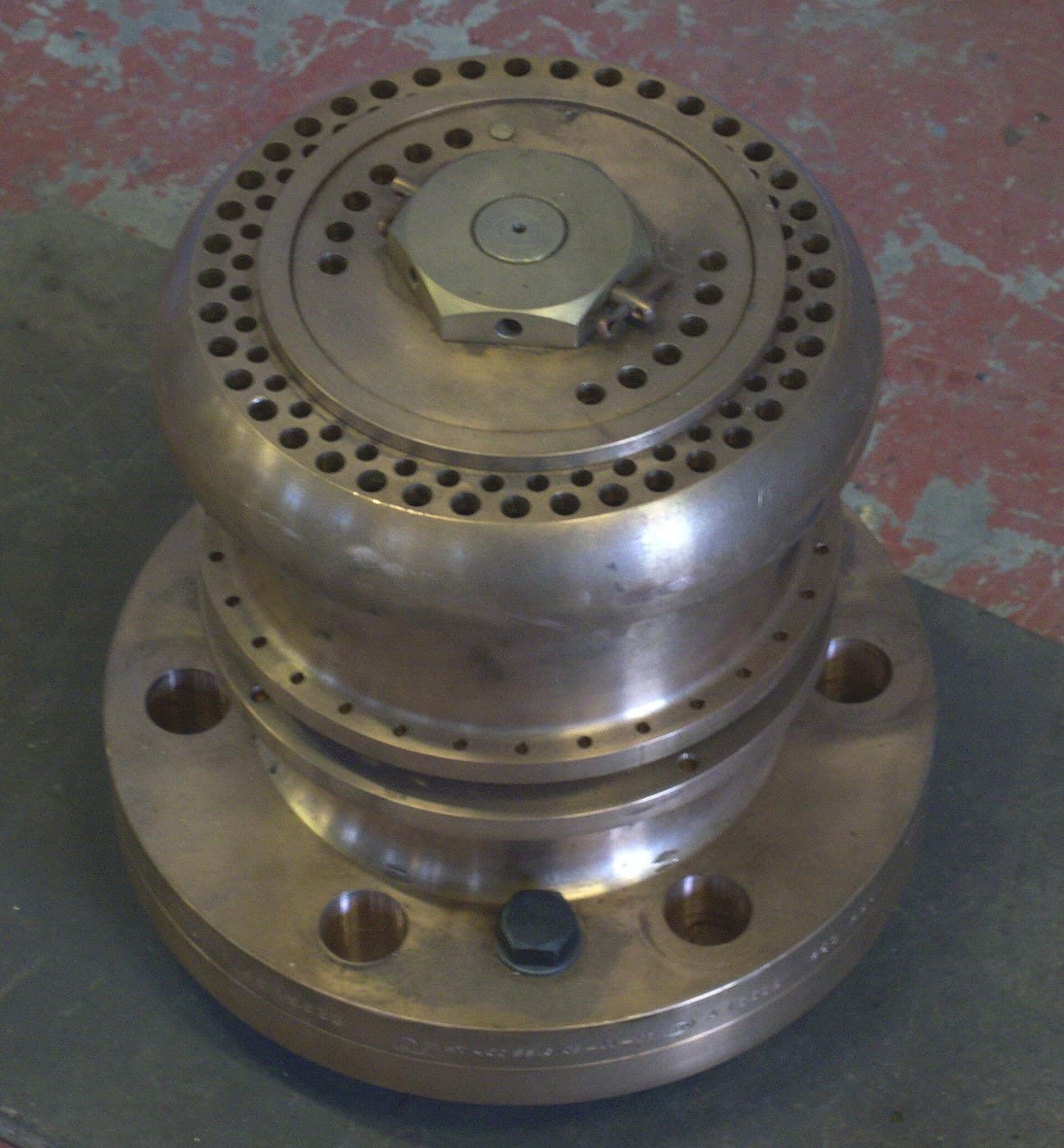
The pressure cooker is Papin's digester made for the kitchen. The embedded blueprint shows the original and its safety valve.
4
4
Measure a cooker's working temperature
Measure a cooker's working temperature
With a modern pressure cooker in good order — gasket supple, valves clean, filled only to the marked level with water — bring it to pressure following its instructions and hold it steady for five minutes. Turn off the heat and let it depressurise fully by itself; never force it open.
Open it and immediately read the water temperature with a kitchen thermometer: it will have dropped, so this is a lower bound. Better: before sealing, put a maximum-reading thermometer or a thermocouple probe rated for the temperature in a sealed jar of water inside. Compare the maximum with the notebook's boiling point for the cooker's rated pressure.
Материалы для этого шага:
 Вода2 литров
Необходимые инструменты:
 Кухонный термометр
 Термопара с индикатором
 Секундомер
 Кожаные рабочие перчатки
 Скороварка
5
5
A pressure cooker not coming to pressure, or venting
A pressure cooker not coming to pressure, or venting
Pressure cooker problems. Never force a lid open.
Flow
Loading...
6
6
History and honest limits
History and honest limits
**Alfred Vischer Jr.** filed **US 2,282,011** on 18 November 1938, assigned to the Vischer Products Company of Chicago; granted 5 May 1942. He showed his Flex-Seal Speed Cooker in New York in 1938; other makers followed, and pressure cookers became common kitchen appliances after the Second World War.
**Honest limits.** The Antoine constants are a fit valid from 99 to 374 °C; the altitude pressures are approximate standard-atmosphere values. A pressure cooker is a pressure vessel: use only one in good condition, as its maker directs, and never modify its valves or lid.
Требуемые инструменты
5- Заполнитель
- Заполнитель
- Заполнитель
- Заполнитель
- Заполнитель
По этому чертежу делают
Связанные чертежи
Эти чертежи делятся знаниями — техники, материалы или принципы

CC0 Общественное достояние
Этот чертёж выпущен под лицензией CC0. Вы можете свободно копировать, изменять, распространять и использовать эту работу в любых целях без запроса разрешения.
Поддержите мейкера, покупая товары через его чертёж, где он получает Комиссию мейкера установленную продавцами, или создайте новую итерацию этого чертежа и включите его как связь в свой чертёж для распределения дохода.