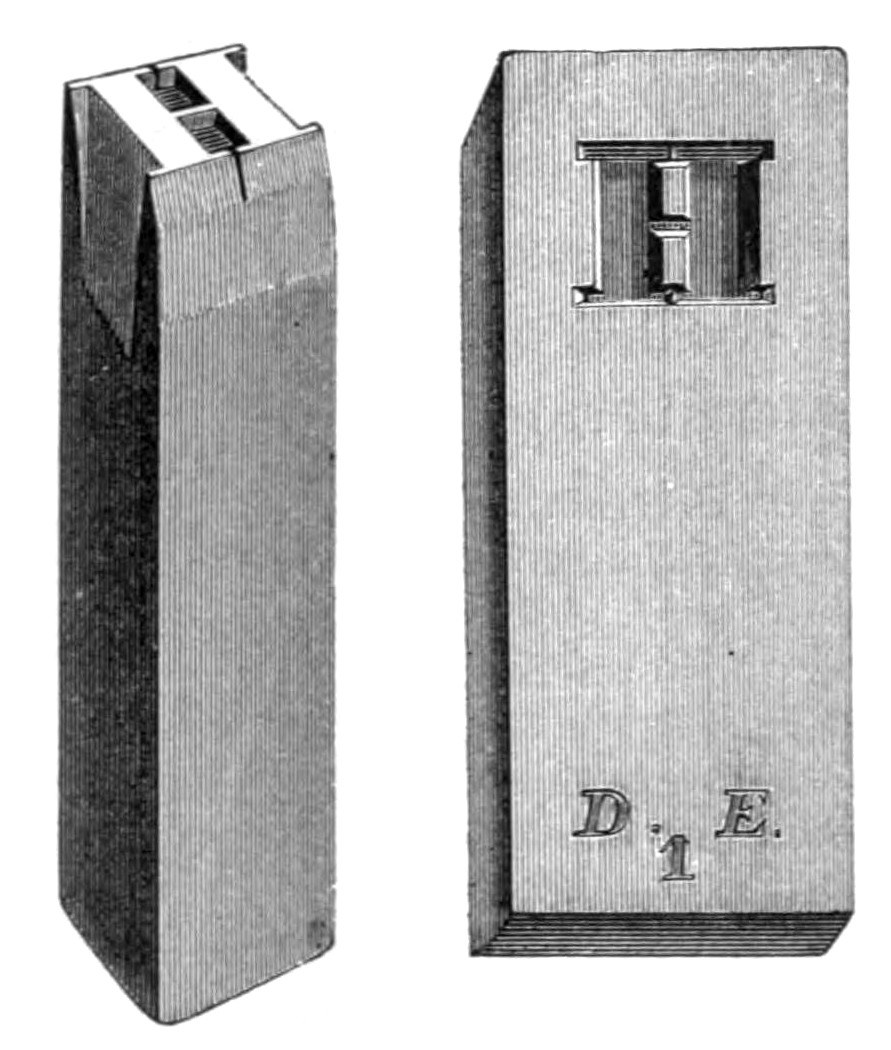


The Type Mould
Movable type was not the invention. China had it four centuries earlier, in clay and in wood. The thing that made European printing explode was a tool for manufacturing type — and it is a piece of precision metalwork, not a printing device at all.
The problem is brutal in its specificity. A page needs thousands of letters. Every single one must be exactly the same height, because any letter even fractionally tall will print black and punch through the paper while its neighbours print grey. They must be exactly the same depth front-to-back so lines sit square. And they must be different widths, because an i is not an m.
So you need identical in two dimensions and variable in the third, thousands of times, cheaply.
The answer is a three-stage chain. A punch — a letter cut in relief on hard steel, once, by a skilled hand. It is struck into soft copper to sink a matrix, a negative of that letter. The matrix drops into the base of an adjustable hand mould: two L-shaped halves that slide against each other, so the cavity's width changes while its height and depth cannot.
Pour molten alloy, open, drop out a letter, close, pour again. One craftsman, a few seconds each, all day.
The mould is what turned printing from a craft into a manufacturing process.
Инструкции
Prove why height is the unforgiving dimension
Prove why height is the unforgiving dimension
Take a set of stamps or blocks and deliberately make one 0.5 mm taller than the rest — a shim under it will do. Ink them all and press a sheet against the whole set with even pressure.
Expect the tall one to print heavily and possibly emboss or tear, while its neighbours print faintly or not at all.
Measure how little difference it took.
Type height is held to a few hundredths of a millimetre across thousands of pieces. That tolerance, not the letterforms, is the manufacturing problem — and it is why the mould controls height rigidly and lets nothing else vary it.
Необходимые инструменты:
 Цифровой штангенциркуль 6 дюймов
Cut a punch and strike a matrix
Cut a punch and strike a matrix
Cut a simple letter or shape in relief on the end of a hard steel bar — file and graver, working in mirror image. Harden it.
Strike it squarely into a piece of annealed copper to sink an impression.
Expect the copper to bulge around the strike; the matrix must then be filed flat and square, or every letter cast from it will sit crooked.
Note what has just happened: one difficult act of skill has been converted into a reusable tool. The punchcutter's hours become a matrix that will cast letters for decades.
Материалы для этого шага:
 Медная труба1 штука
 Стальной пруток-заготовка1 штука
Необходимые инструменты:
 Напильник по металлу
 Слесарные тиски
Build the mould that varies one dimension only
Build the mould that varies one dimension only
Make two L-shaped halves that slide against each other to form a rectangular cavity. Arrange them so sliding changes the cavity's width while the height and depth are fixed by the fixed faces.
Set the matrix in the base.
Test it: set it narrow, measure the cavity; set it wide, measure again. Height and depth must not move.
That constraint is the invention. Most of the mould's cleverness is in what it refuses to let you change.
Необходимые инструменты:
Цифровой штангенциркуль 6 дюймовFind the alloy the job actually needs
Find the alloy the job actually needs
Cast the same shape in pure lead and in a lead-tin-antimony type metal, and compare.
Expect the pure lead casting to be soft, rounded at the corners, and slightly shrunken; the type alloy to be crisp and dimensionally faithful.
Antimony is the reason, and it is unusual: it expands slightly as it solidifies, pressing the metal into the fine detail of the matrix instead of pulling away from it. Tin adds toughness, lead keeps it fluid and cheap.
An alloy that grows on freezing is exactly the wrong property for most casting and precisely the right one here.
Lead alloys: ventilate, no food nearby, wash hands. Do not melt in a kitchen.
Cast a handful and measure the spread
Cast a handful and measure the spread
Cast ten letters from the same setting. Measure the height of each with the caliper and compute the spread between highest and lowest.
Then set the mould to a different width and cast ten more. Measure heights again.
Expect the heights to match across both batches, despite the widths differing.
Now stand all twenty on a flat surface and lay a straightedge across the tops. Any letter that shows light under the edge would print wrong. This measurement is the entire quality-control system of a type foundry, and it is why the mould, not the punch, decided whether a printing house could work.
History & Context
History & Context
What Gutenberg actually invented. Not the press, which was a wine press. Not the idea of movable type, which existed in China and Korea — Bi Sheng's clay type predates him by four hundred years, and Korea was casting metal type earlier. Gutenberg's contribution was the adjustable hand mould, together with an ink and an alloy that suited it: a way to mass-produce identical letters. The system, not the concept.
Why it mattered more in Europe than in Asia. An alphabet needs a few dozen characters, each reused constantly. Chinese script needs thousands, most of them rare. Movable type therefore repaid the investment enormously in Latin and barely at all in Chinese, where carving a whole page as a woodblock stayed competitive. The same invention, two writing systems, two entirely different economics — and it explains a divergence often misattributed to inventiveness.
The tool outlived every machine that used it. Hand moulds cast type into the nineteenth century, and the punch-matrix-mould chain survived into hot metal composition: Linotype and Monotype are machines that carry matrices and cast from them automatically. Even now, digital typefaces are drawn from designs whose proportions were set by what a punchcutter could cut in steel.
It is a general manufacturing idea. Sink a master's shape into a durable negative, then reproduce from the negative. That is injection moulding, die casting, vinyl pressing, coin striking and semiconductor photomasks. Every one of them separates one act of extreme skill from many acts of cheap repetition, which is the move that turns a craft into an industry.
Honest limits. Punchcutting was a rare and slow skill, and a full typeface meant hundreds of punches in every size — sizes could not simply be scaled, each was cut separately and designed to look right at that size. Type wears: soft alloy rounds off after a few thousand impressions, which is why stereotyping was invented to save the forme. And the metal is toxic, which the trade knew and largely lived with.
Материалы
2- 1 штукаЗаполнитель
- 1 штукаЗаполнитель
Требуемые инструменты
3- Заполнитель
- Заполнитель
- Заполнитель
По этому чертежу делают

CC0 Общественное достояние
Этот чертёж выпущен под лицензией CC0. Вы можете свободно копировать, изменять, распространять и использовать эту работу в любых целях без запроса разрешения.
Поддержите мейкера, покупая товары через его чертёж, где он получает Комиссию мейкера установленную продавцами, или создайте новую итерацию этого чертежа и включите его как связь в свой чертёж для распределения дохода.