UBUHANZI
UBWIZA N'UBUZIMA
UBUKORIKORI
UMUCO N'AMATEKA
IMYIDAGADURO
IBIDUKIKIJE
IBIRIBWA N'IBINYOBWA
UBWUBATSI BUSUBIRA INYUMA
UBUMENYI
SIPORO
IKORANABUHANGA
IBYAMBARWA
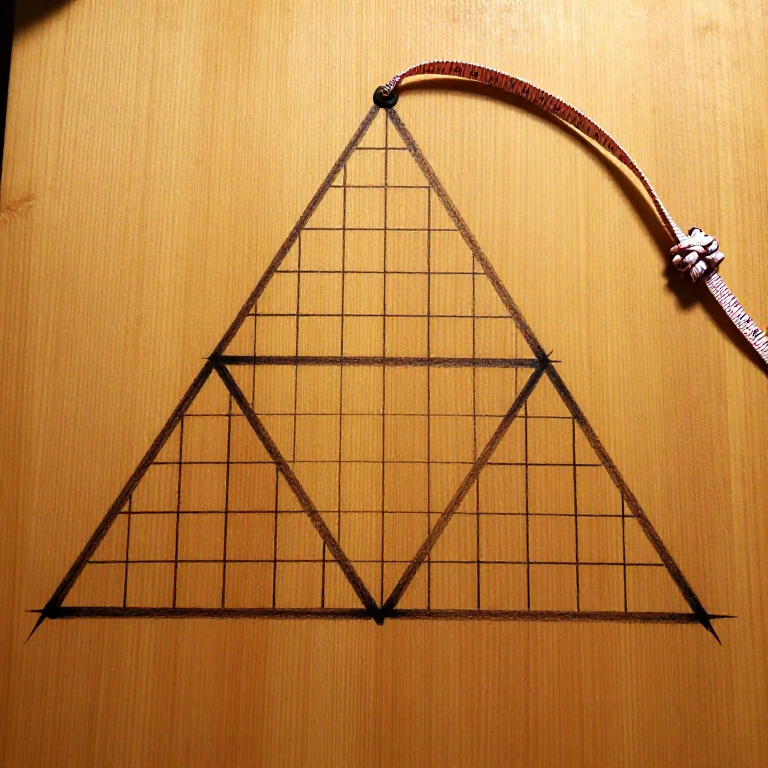


Proving the Pythagorean Theorem by Cutting Squares — a² + b² = c²
The most famous rule in geometry says that in any right-angled triangle, the square built on the longest side equals the two squares on the shorter sides added together: a² + b² = c². The school of Pythagoras proved it around 530 BC. This blueprint proves it the maker's way — with a knotted cord, three cut squares, and a dissection you can hold in your hands. Seeing the pieces of the two small squares fit exactly into the big one is a proof that needs no algebra, and it doubles as the ancient builder's test for a true square corner.
Utangiye
2
Amabwiriza
1
1
State the theorem
State the theorem
In a right-angled triangle, name the two short sides a and b and the longest side (the hypotenuse) c. The theorem says the square on c has exactly the same area as the squares on a and b together: a² + b² = c². You will prove this by area, not algebra.
2
2
Make a right angle with a cord
Make a right angle with a cord
Knot a loop of cord into twelve equal spaces. Peg it out as a triangle with sides of 3, 4 and 5 spaces; the corner between the 3 and 4 sides is a perfect right angle. This 3-4-5 trick is how builders have squared corners for thousands of years.
Ibikoresho bikenewe:
 Umugozi w'ipamba wo mu gikoni
3
3
Lay out a right triangle
Lay out a right triangle
Using that right angle, mark a right triangle with legs 3 and 4 units on a board. Its hypotenuse comes out to exactly 5 units — a whole-number right triangle to make the areas easy to count.
Ibikoresho by'iyi ntambwe:
 Ikibaho cy'Igiti Gikomeye1 igice
Ibikoresho bikenewe:
 Umugozi w'ikaramu y'umweru
4
4
Cut the three squares
Cut the three squares
Cut a square on each side of the triangle: 3×3, 4×4 and 5×5. Rule each into unit squares — 9, 16 and 25 of them. These three squares are the whole proof, made physical.
Ibikoresho bikenewe:
 Umucumita w'Intoki
 Icyuma
5
5
Count the areas
Count the areas
Count: the small squares hold 9 and 16 unit squares, together 25 — exactly the number in the big square on the hypotenuse. 9 + 16 = 25 is a² + b² = c² in plain counting.
6
6
Prove it by dissection
Prove it by dissection
Now cut the two smaller squares into pieces and lay them inside the largest square. They tile it exactly — no gaps, no overlaps. Because the pieces fit for reasons of shape, not luck, this works for every right triangle, not only 3-4-5.
Ibikoresho bikenewe:
Icyuma7
7
Test other triangles
Test other triangles
Repeat with other right triangles: the square on the hypotenuse always equals the sum of the other two. Change the corner so it is no longer a right angle, and the fit fails — which is exactly why the same rule can TEST whether a corner is truly square.
8
8
See why it matters
See why it matters
This single relationship underlies distance, surveying, navigation and building ever since. Any time you find a straight-line distance from two measurements at right angles, you are using Pythagoras — a 2,500-year-old proof you just held in your hands.
Ibikoresho
2- 1 igiceUmwanya
- Umwanya
Ibikoresho bikenewe
4- Umwanya
- Umwanya
- Umwanya
Blueprint zijyanye
Izi blueprint zisangira ubumenyi — uburyo, ibikoresho cyangwa amahame
CC0 Umurenge rusange
Iyi blueprint yasohowe munsi ya CC0. Ushobora gukoporora, guhindura, gukwirakwiza no gukoresha nta kwemererwa.
Shyigikira Umuremyi ugura ibicuruzwa binyuze muri Blueprint ye Komisiyo y'Umuremyi byashyizweho n'Abacuruzi, cyangwa kora verisiyo nshya y'iyi Blueprint ukayinjiza nk'isano muri Blueprint yawe kugira ngo musangire inyungu.