Ubufatanye
UBUHANZI
UBWIZA N'UBUZIMA
UBUKORIKORI
UMUCO N'AMATEKA
IMYIDAGADURO
IBIDUKIKIJE
IBIRIBWA N'IBINYOBWA
UBWUBATSI BUSUBIRA INYUMA
UBUMENYI
SIPORO
IKORANABUHANGA
IBYAMBARWA
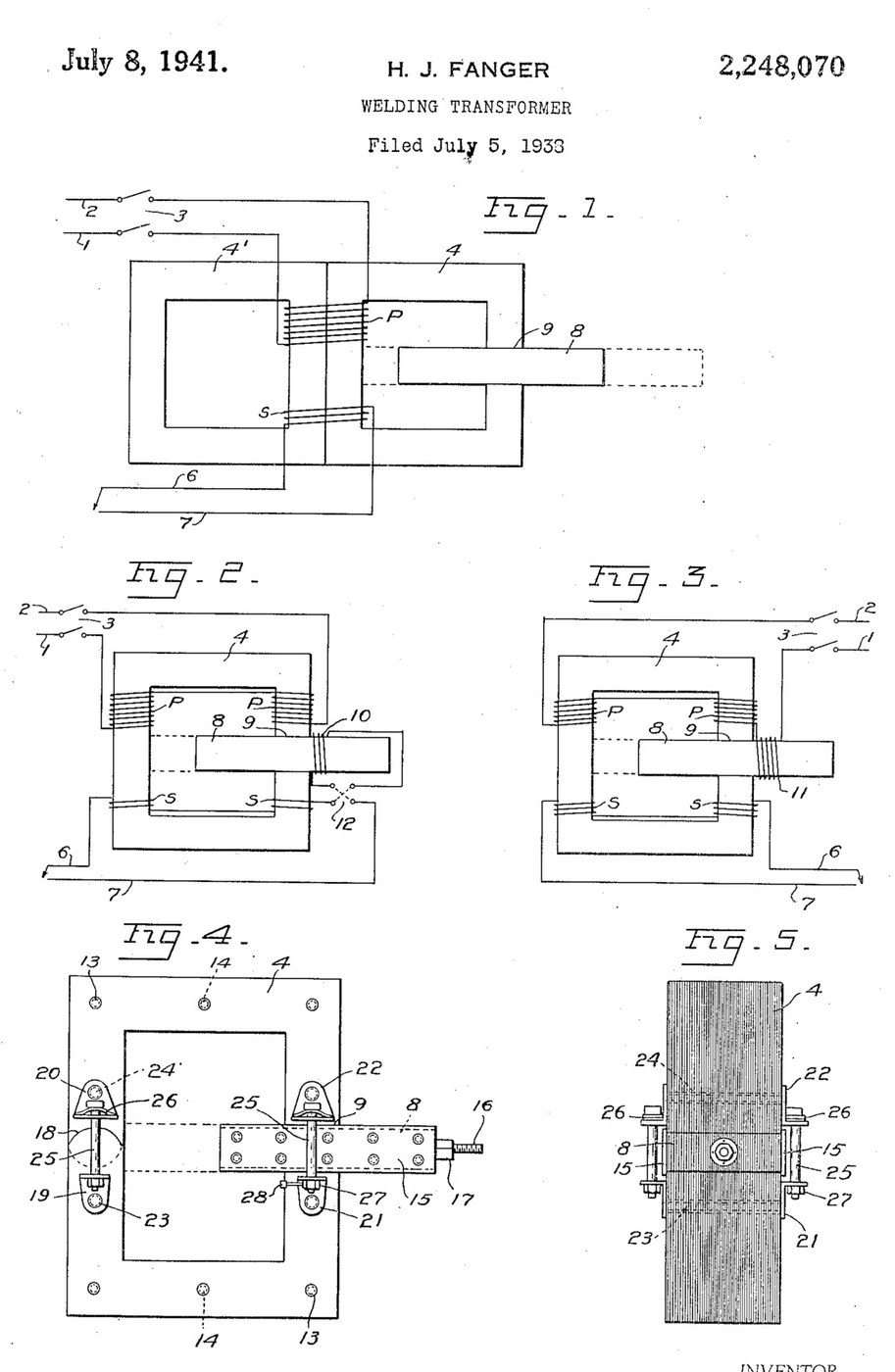


Arc Welder: AC Transformer with a Sliding Shunt Core (Fanger, US 2,248,070)
An AC arc welder is a step-down transformer whose current can be turned up and down. H. J. Fanger (US 2,248,070, 1941) cuts a gap through one leg of a laminated ring core and slides a laminated iron shunt bar through it: pushed in, it carries flux past the secondary and lowers the welding current; pulled out, the current rises.
For arc welding he gives about 60 to 68 volts open circuit, 15 to 200 amps, dropping to 38 or 40 volts at the working arc, with a small coil on the shunt bar in series with the secondary.
Source: H. J. Fanger, "Welding Transformer", US Patent 2,248,070 (filed 1938, granted 1941). Picture: its Figs. 1-5.
Hejuru
Unknown
Amabwiriza
1
1
Read Fanger
Read Fanger
"With arc welding, infinite control of the volume of the secondary current, between maximum and minimum is obtained by adjustment of the slidable shunt core without altering the welding characteristics of the current, also better ignition of the arc is had at a given voltage, and greater stability of the arc".
2
2
Stack the core
Stack the core
Build a single rectangular ring core of insulated iron laminations, held together with brass (or insulated) bolts or rivets in insulating tubes (Fig. 4). Cut a gap straight through one leg, accurately machined and finished, and make a circular joint through the opposite leg with the segments staggered to overlap in successive laminations. Core size, lamination iron and thickness are not given (ours: the tools).
Ibikoresho by'iyi ntambwe:
 Icyuma kitazwi1 iron laminations
 Icyegeranyo cy'inyuzi z'impande esheshatu1 brass bolts
 Ibikoresho bikumira amashanyarazi bitazwi1 insulating tubes
Ibikoresho bikenewe:
 Ibyuma bikata ibyuma bisanzwe
 Icyuma Cyivumbura Gihagaze
 Ibyuma Byinshi byo Gucukura
 Amakariso (Ikariso ry'Intoki)
 Ingano zitazwi
3
3
Make the shunt bar
Make the shunt bar
Make the sliding shunt section of the same laminated iron, a snug fit in the gap with its laminations edge-to-edge with the core's, and long enough to fill the gap at every position. Sheath both sides with a slightly wider plate of Bakelite that overlaps the edges of the gap to guide it. Fit a threaded rod on its outer end, working in a nut fixed to the section (or move it by hand, with calibration marks along one edge).
Ibikoresho by'iyi ntambwe:
Icyuma kitazwi1 shunt laminations Bakelite2 side platesIcyegeranyo cy'inyuzi z'impande esheshatu1 brass bolts
 Inkoni ifite imirongo1 igice
 Umupira w'Impande Esheshatu1 igice
Ibikoresho bikenewe:
Icyuma Cyivumbura GihagazeIbyuma Byinshi byo GucukuraAmakariso (Ikariso ry'Intoki)4
4
Wind the coils
Wind the coils
Wind the primary and secondary windings on both legs of the core (Fig. 2), in series or in parallel to suit the line voltage and the current wanted. Wind a small auxiliary coil round the shunt bar's path, fixed so the bar slides through it, and connect it in series with the secondary through a reversing switch (some jobs weld better with the current through it one way). Turns and wire sizes are not given.
Ibikoresho by'iyi ntambwe:
 Insinga y'Umuringa1 insulation and size not given
Ibikoresho bikenewe:
Ingano zitazwi5
5
Spring the joints
Spring the joints
On both sides of the gap and of the circular joint fit pairs of confronting angle plates, held by brass bolts in insulating sleeves and drawn together by spring bolts whose heads rest on slightly arched spring plates, so the joints close snugly on the sliding bar. A small lever on the gap-joint nut gives a half turn to release the bar for moving. The angle-plate material is not given.
Ibikoresho by'iyi ntambwe:
 Ibikoresho bitazwi4 angle platesIcyegeranyo cy'inyuzi z'impande esheshatu1 brass and spring boltsIbikoresho bikumira amashanyarazi bitazwi1 sleeves
 Umurongo w'icyuma cya sipringi1 arched spring platesUmupira w'Impande Esheshatu4 ibice
Ibikoresho bikenewe:
Icyuma Cyivumbura GihagazeIbyuma Byinshi byo Gucukura Isupana ihinduka
6
6
Connect and set
Connect and set
Connect the primary to the line through a line switch, and the secondary leads to the electrode holder and the work. Pull the shunt bar out for more current, push it in for less: Fanger gives about 60-68 volts open circuit and 15-200 amps, dropping to 38-40 volts at the arc.
Ibikoresho by'iyi ntambwe:
 Switch yo gucana no kuzimya1 line switch
Ibikoresho bikenewe:
Isupana ihindukaIbikoresho
10- 1 shunt laminationsUmwanya
- 1 brass and spring boltsUmwanya
- Umwanya
- 2 side platesUmwanya
- 1 igiceUmwanya
- 5 ibiceUmwanya
- 1 insulation and size not givenUmwanya
- 4 angle platesUmwanya
- 1 arched spring platesUmwanya
- 1 line switchUmwanya
Iki gishushanyo gikora

CC0 Umurenge rusange
Iyi blueprint yasohowe munsi ya CC0. Ushobora gukoporora, guhindura, gukwirakwiza no gukoresha nta kwemererwa.
Shyigikira Umuremyi ugura ibicuruzwa binyuze muri Blueprint ye Komisiyo y'Umuremyi byashyizweho n'Abacuruzi, cyangwa kora verisiyo nshya y'iyi Blueprint ukayinjiza nk'isano muri Blueprint yawe kugira ngo musangire inyungu.