
Ubufatanye
UBUHANZI
UBWIZA N'UBUZIMA
UBUKORIKORI
UMUCO N'AMATEKA
IMYIDAGADURO
IBIDUKIKIJE
IBIRIBWA N'IBINYOBWA
UBWUBATSI BUSUBIRA INYUMA
UBUMENYI
SIPORO
IKORANABUHANGA
IBYAMBARWA
Five-Foot Bait-Casting Rod: Hand-Tapered Dagame Stick, Cork Grasps and Agate Guides (Boy Mechanic, 1915)
Woody

Yaremwe na

Woody

13. Ugushyingo 2026NO
1
0
0
0
0

Five-Foot Bait-Casting Rod: Hand-Tapered Dagame Stick, Cork Grasps and Agate Guides (Boy Mechanic, 1915)

Stillman Taylor's first rod for a beginner, from The Boy Mechanic, Book 2 (1915): a one-piece 5 ft bait-casting rod planed by hand from a 5/8 in square stick of dagame to his calipered taper (1/2 in at the grasp to 1/8 in at the tip), with a double cork grasp around the reel seat, two agate guides and an agate tip, whipped in silk and varnished. He made it with "a saw, plane, jackknife, file, and sandpaper".
Hagati
About 2 weeks (glue and varnish drying)

Amabwiriza

1

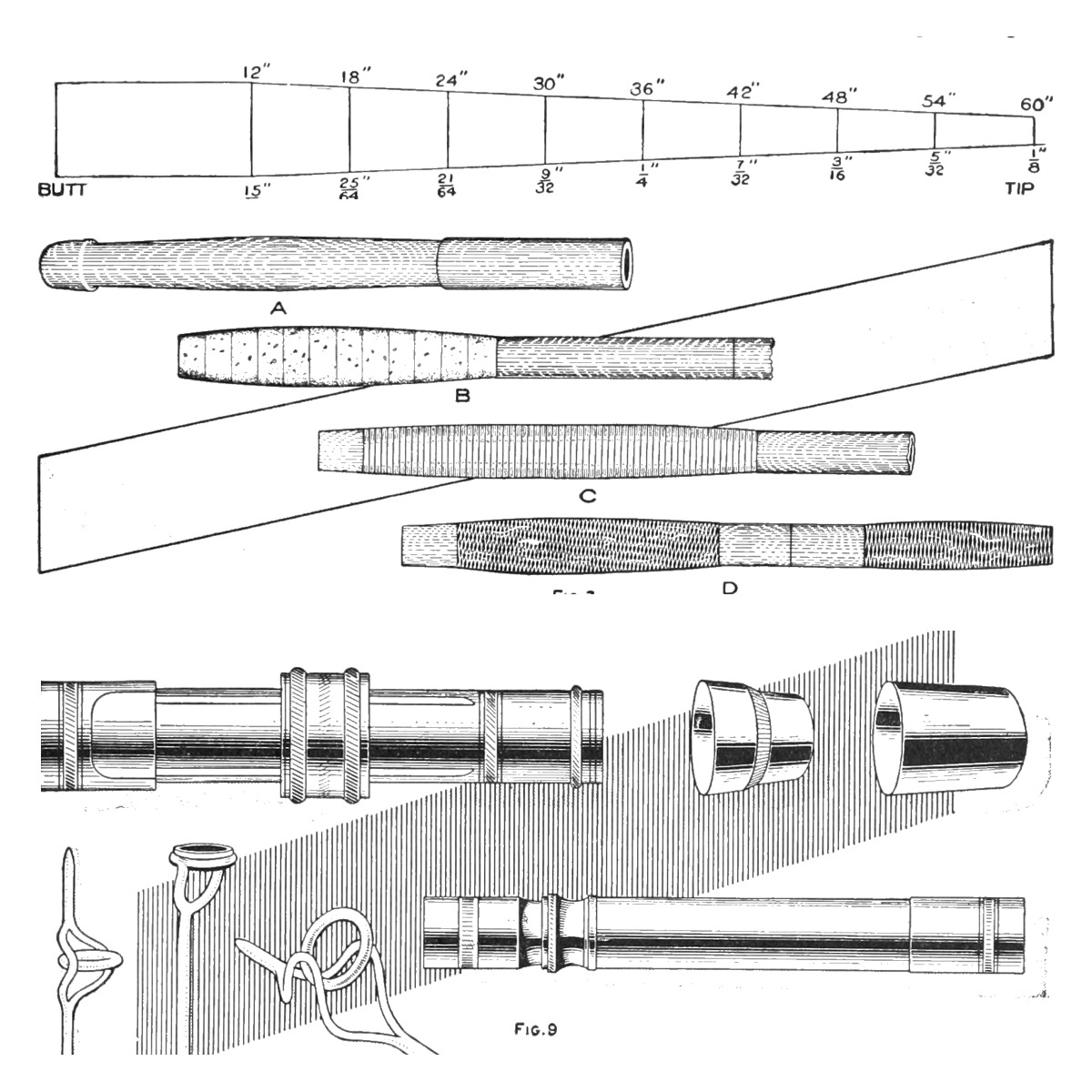
Fig. 5: the taper, station by station

Gupakira ikaye ya Jupyter…
2

Read The Boy Mechanic, Book 2

"The short one-piece bait-casting rod with but one ferrule is the easiest rod to make." His materials: 1 dagame or greenheart stick, 5 ft long and 5/8 in square; 1 reel seat with straight hood, 3/4 in; 1 butt cap, 1 in; 1 taper, small end 15/32 in; 1 offset agate top, 3/32 in, and 2 narrow agate guides, 1/2 in, all in German silver; 2 doz. corks, 1-1/4 by 1-1/8 in; two 50 yd spools of silk, red and green, 00 size.
3

Make the gauge and grooved board

On a strip of paper draw the rod full length: a 1/2 in line for the butt, a centre line 60 in long, a 1/8 in line at the tip, and join the ends. From 12 in, mark a crossline every 6 in and write his diameters on them (see the notebook). File nine slots in a thin strip of brass to these diameters as a gauge. Plane a groove, gradually shallower toward one end, in a 5 ft tongue-and-groove pine board about 1 in thick, and nail it to the bench edge, groove up.

Ibikoresho by'iyi ntambwe:

Urupapuro rw'Umuringa w'UmuhondoUrupapuro rw'Umuringa w'Umuhondo1 igice

Ikibaho cy'igiti cya pinusiIkibaho cy'igiti cya pinusi1 igice
ImisumariImisumari1 igice

Ibikoresho bikenewe:

Impapuro z'ikigina zo gupfunyikaImpapuro z'ikigina zo gupfunyika
Ikaramu ya penisileIkaramu ya penisile
Amakariso (Ikariso ry'Intoki)Amakariso (Ikariso ry'Intoki)
Ifatiro ry'AmezaIfatiro ry'Ameza
Kalipe ya VernierKalipe ya Vernier
Ikoresho cyo gusiga ibitiIkoresho cyo gusiga ibiti
InyundoInyundo
Umugozi wo GupimaUmugozi wo Gupima
4

Plane the stick square and tapered

Plane along each side and from both ends of a 5/8 in square dagame strip to find the grain. Drill two holes about 1/4 in from the butt end and hook them over a brad in the bench corner, so you plane with the grain. Plane it straight and true to 1/2 in square, evenly from all sides, ignoring kinks. Knife-mark the hand grasp 12 in from the butt (11 in for a single grasp). Then plane an even taper from butt to tip, checking with caliper and gauge at every 6 in mark and planing the thick spots lightly. Bend the tip on the floor: if it stays bent, the wood needs a few weeks' seasoning in a warm place.

Ibikoresho by'iyi ntambwe:

Dagame WoodDagame Wood1 igice
ImisumariImisumari1 igice

Ibikoresho bikenewe:

Ikoresho cyo gusiga ibitiIkoresho cyo gusiga ibiti

Ikiryabyo gitoIkiryabyo gito
Ibuye ryo gutyazaIbuye ryo gutyaza
Igikoresho cyo gutobora gikoreshwa n'intokiIgikoresho cyo gutobora gikoreshwa n'intoki
Kalipe ya VernierKalipe ya Vernier
Icyuma cy'UbukorikoriIcyuma cy'Ubukorikori
InyundoInyundo
5

Round the rod

Lay the rod in the grooved board, a corner up, and take each corner off with a finely set small plane to make it eight-sided, calipering every 6 in mark and keeping the eight sides even, until it is almost round and tapers evenly from the grasp mark to the tip. File grooves across the edge of a cabinetmaker's steel scraper with a round file, sharpen them, and scrape the rod perfectly round; sandpaper it smooth. Tie on the tip and guides and string the reel on to try a few casts, then smooth it with No. 0 sandpaper.

Ibikoresho by'iyi ntambwe:

Urupapuro rwo GusyaUrupapuro rwo Gusya1 igice

Ibikoresho bikenewe:

Ikiryabyo gitoIkiryabyo gito

Igikanda cy'icyumaIgikanda cy'icyuma
Amakariso (Ikariso ry'Intoki)Amakariso (Ikariso ry'Intoki)
Kalipe ya VernierKalipe ya Vernier
6

Build the lower grasp and reel-seat sleeve

Cut a hole in the corks with a sharpened tube turned like a wad cutter. Cut the butt off square about 1 in from the end, to remove the holes. Glue on a cork with hot glue, then cork after cork, about 10, for a grasp a trifle over 5 in long. For the reel-seat sleeve, bore a 15/32 in hole through white pine about 3/4 in thick and 5 in long, plane the outside to slip inside the reel seat, taper one end to match it, and make it about 1/4 in shorter than the reel seat. Glue it down on top of the last cork and leave the glue a day or two.

Ibikoresho by'iyi ntambwe:

Cork RingsCork Rings10 ibice
Ifatanyo ry'inyamaswaIfatanyo ry'inyamaswa1 igice
Ikibaho cy'igiti cya pinusiIkibaho cy'igiti cya pinusi1 igice

Ibikoresho bikenewe:
Umuheha w'umuringaUmuheha w'umuringa
Amakariso (Ikariso ry'Intoki)Amakariso (Ikariso ry'Intoki)
Umucumita w'IntokiUmucumita w'Intoki
Igikoresho cyo gutobora gikoreshwa n'intokiIgikoresho cyo gutobora gikoreshwa n'intoki
Ikiryabyo gitoIkiryabyo gito
7

Fit the butt cap and reel seat

Trim the grasp to about 1-1/16 in diameter (1-1/4 in corks need little trimming), leaving the top cork as a shoulder, and fit the lower corks to the butt cap's taper. Heat the cap moderately, rub melted ferrule cement inside and force it on; when hard, drive a small brass pin or brad through and file it flush. Cut the 4-1/2 in reel seat down to 3-7/8 in and fit it with the hood at the lower end, worked into the cork for a tight joint. Cement the sleeve, push the reel seat home and drive a small pin through the hood into the wood a short way only, not through the rod.

Ibikoresho by'iyi ntambwe:

Rod Butt CapRod Butt Cap1 igice
Reel SeatReel Seat1 igice
Ferrule CementFerrule Cement1 igice

Ibikoresho bikenewe:

Icyuma cy'UbukorikoriIcyuma cy'Ubukorikori
Amakariso (Ikariso ry'Intoki)Amakariso (Ikariso ry'Intoki)
Itara rya PropaneItara rya Propane
InyundoInyundo
8

Build the upper grasp and finish the wood

Cement corks above the reel seat, the first pressed against the seat and turned so the metal enters it, then shape them into a smooth swelled grasp and cement on the winding check. Sand the rod, wet it to raise the grain, and sand again with old paper; for a finer polish rub with pumice and oil and an oiled rag. File the tip to fit the agate top, smear on melted ferrule cement and push the top home. Rub the wood over with a cloth wet with varnish to fill the pores, and wipe off the surplus.

Ibikoresho by'iyi ntambwe:

Cork RingsCork Rings6 ibice
Ifatanyo ry'inyamaswaIfatanyo ry'inyamaswa1 igice
Winding CheckWinding Check1 igice
Rod Tip TopRod Tip Top1 igice
Ferrule CementFerrule Cement1 igice
Urupapuro rwo GusyaUrupapuro rwo Gusya1 igice
Coach VarnishCoach Varnish1 igice

Ibikoresho bikenewe:

Icyuma cy'UbukorikoriIcyuma cy'Ubukorikori
Amakariso (Ikariso ry'Intoki)Amakariso (Ikariso ry'Intoki)
Itara rya PropaneItara rya Propane
9

Whip on the guides

Place the first guide 19-1/2 in from the metal taper above the upper grasp and the second 15-1/2 in further on; round the sharp edges of their bases with a fine file and hold them with a few turns of common thread. Whip with 00 silk using the invisible knot: tuck the end under the first coil, wind tightly by turning the rod, lay a waxed loop of silk about 4 in long under the last turns, wind about 1/8 in beyond the pointed flange, cut the silk and pull its end back under with the loop. About a dozen turns make a winding; edgings of three or four turns go on after, in red with green or yellow.

Ibikoresho by'iyi ntambwe:

Rod GuideRod Guide2 ibice
Rod Winding SilkRod Winding Silk1 igice
Udodo w'igitaniUdodo w'igitani1 igice
IgishasharaIgishashara1 igice

Ibikoresho bikenewe:

Amakariso (Ikariso ry'Intoki)Amakariso (Ikariso ry'Intoki)
Icyuma cy'UbukorikoriIcyuma cy'Ubukorikori
10

Shellac and varnish

Clip any fuzzy ends and give the silk two light coats of white shellac dissolved in grain alcohol, warmed and laid on with a small camel's-hair brush; let it dry a couple of days. Warm the coach varnish in a pot of hot water for five minutes and brush it on evenly with a brush about 1/2 in wide, in a warm place (about 75 deg F). Hang the rod by the tip in a dust-free room; allow three days between coats; two coats protect it, three give complete protection.

Ibikoresho by'iyi ntambwe:

Varinishi ya sherakeVarinishi ya sherake1 igice
Coach VarnishCoach Varnish3 ibice

Ibikoresho bikenewe:
Uburoso bugariUburoso bugari
11

Troubleshooting

Casting rod troubleshooting.

Flow

Loading...
12

History and honest limits

From "Fishing-Rod Making and Angling, Part I -- A One-Piece Casting Rod" by Stillman Taylor, in **The Boy Mechanic, Book 2**, Popular Mechanics, 1915 (Project Gutenberg 44585; checked on the archive.org scan boymechanicbook200chic2, pp. 59-66). His text says about 10 corks for the lower grasp; his list allows 2 dozen for both grasps. The block plane, vernier caliper and other modern tool names, and the metric figures, are ours; his tools were "a saw, plane, jackknife, file, and sandpaper" plus those in his tools section.

Ibikoresho

18

Ibikoresho bikenewe

17

Iki gishushanyo gikora

Blueprint zijyanye

Izi blueprint zisangira ubumenyi — uburyo, ibikoresho cyangwa amahame
CC0 Umurenge rusange

Iyi blueprint yasohowe munsi ya CC0. Ushobora gukoporora, guhindura, gukwirakwiza no gukoresha nta kwemererwa.

Shyigikira Umuremyi ugura ibicuruzwa binyuze muri Blueprint ye Komisiyo y'Umuremyi byashyizweho n'Abacuruzi, cyangwa kora verisiyo nshya y'iyi Blueprint ukayinjiza nk'isano muri Blueprint yawe kugira ngo musangire inyungu.

Ibiganiro

(0)

Injira kugira ngo ujye mu biganiro

Gutegura ibitekerezo...