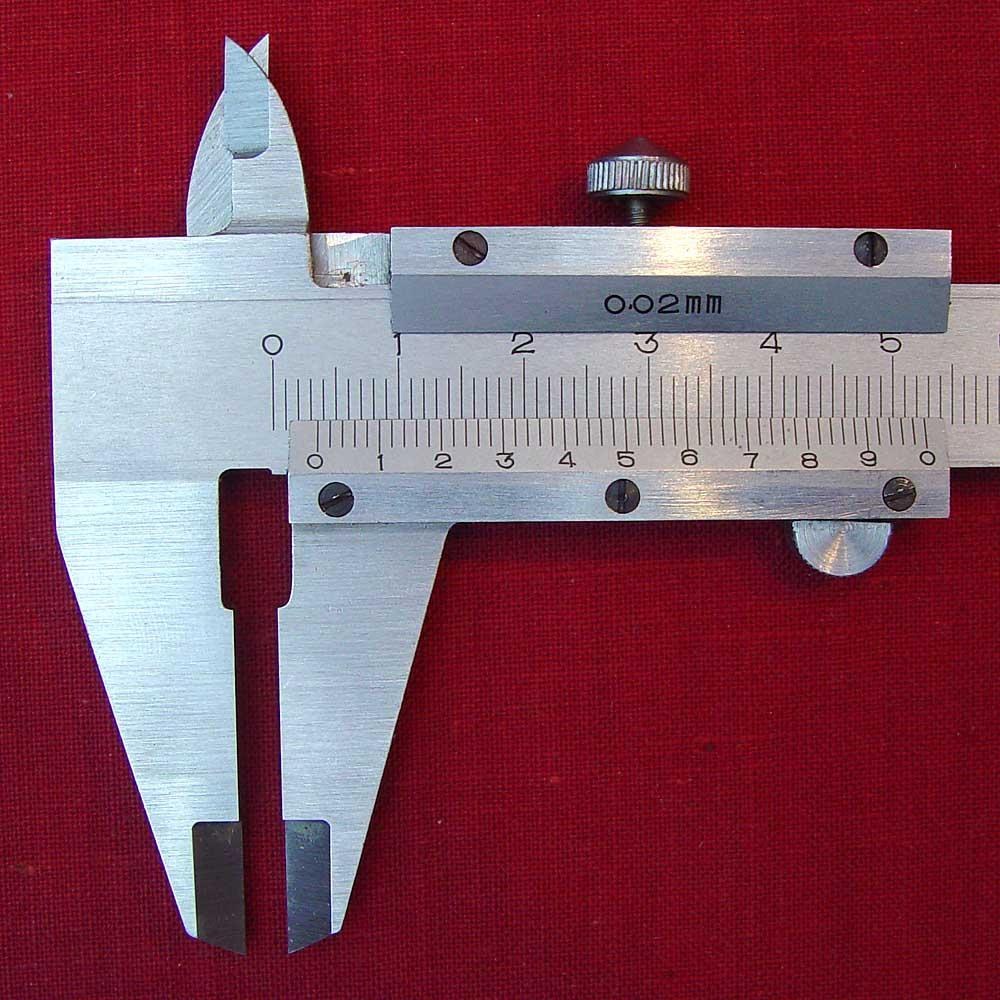


Vernier Caliper
The vernier is a piece of arithmetic you can hold. It reads a fraction of a division without any fine mechanism at all — no screw, no gears, no lens. Two scales of slightly different spacing do the whole job.
Joseph R. Brown of Providence, Rhode Island put a pocket vernier caliper on the market in 1851, reading to one thousandth of an inch. It was the first vernier caliper made in quantity at a price a working machinist could pay, and it is the ancestor of the caliper in every toolbox today.
Two honest qualifications. First, the principle is not Brown's: Pierre Vernier published it at Brussels in 1631, and it was already two centuries old. Second, Brown's caliper is usually described as “later patented”, but no patent number for it can be verified. What is documented is the 1851 commercial circular. The invention that really made it possible was Brown's own dividing engine of 1850 — the machine that could cut accurate graduations in the first place. You cannot sell a precise scale until you can make one cheaply.
Amabwiriza
Write down the trick before you build it
Write down the trick before you build it
The vernier idea in one line: make the second scale's divisions slightly smaller than the first's, and the position where two marks line up tells you the fraction.
Draw a main scale on card
Draw a main scale on card
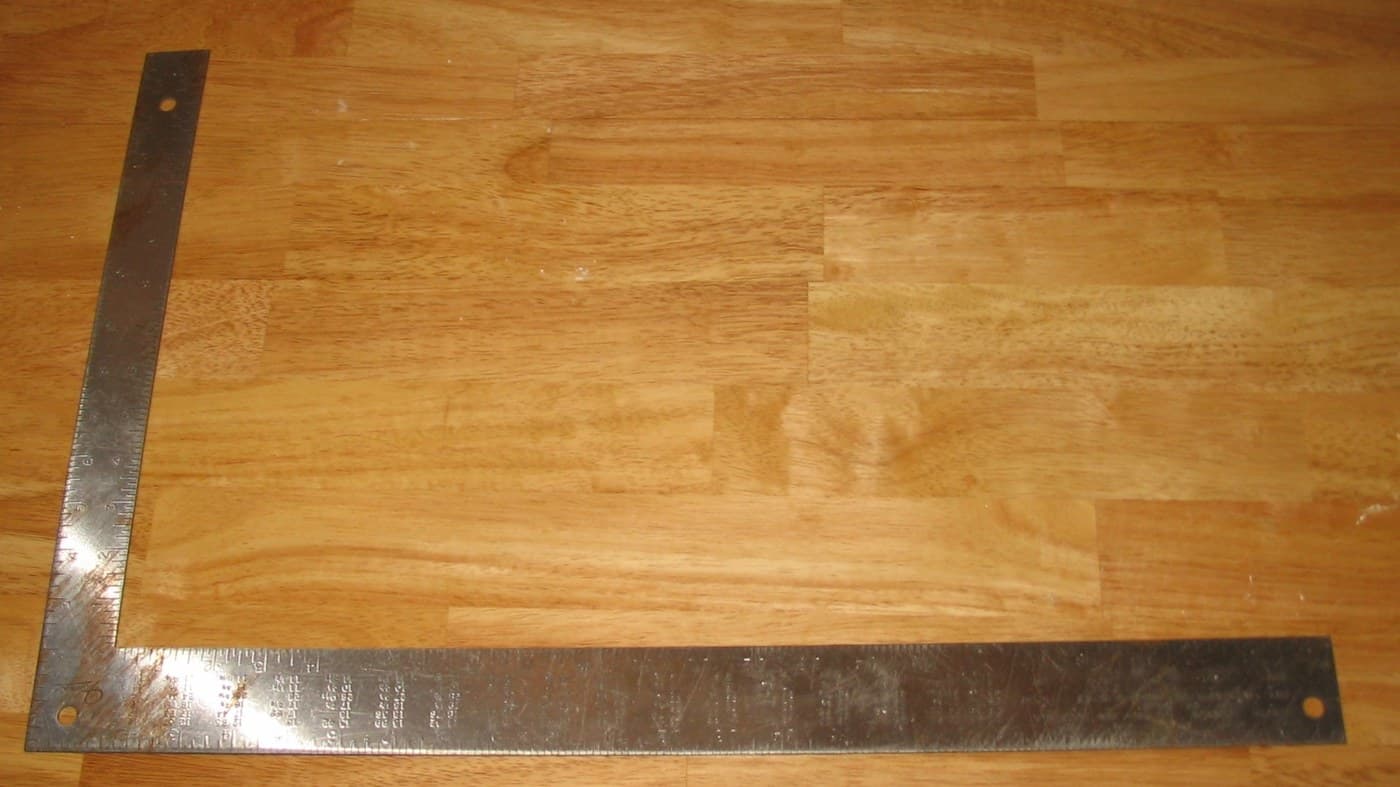
Draw a 200 mm line on card stock and mark it every 1 mm with the steel rule.
Ibikoresho by'iyi ntambwe:
 Impapuro Zikomeye1 urupapuro
Ibikoresho bikenewe:
 Umurongo w'ipima
 Ikaramu Idasibangana
Draw a vernier scale of 9 mm in 10 parts
Draw a vernier scale of 9 mm in 10 parts
On a second card strip, mark a 9 mm length and divide it into 10 equal parts of 0.9 mm.
Ibikoresho by'iyi ntambwe:
Impapuro Zikomeye1 urupapuroIbikoresho bikenewe:
Umurongo w'ipimaIkaramu IdasibanganaCut both strips out
Cut both strips out
Cut the two strips so the vernier strip slides along the main scale.
Ibikoresho by'iyi ntambwe:
Impapuro Zikomeye1 urupapuroIbikoresho bikenewe:
 Umukasi
Read a whole number of millimetres
Read a whole number of millimetres
Slide the vernier zero to 37 mm. The reading is the last main mark passed by the vernier zero — here, 37.
Read the tenth
Read the tenth
Slide the vernier zero to 37.4 mm. Find which vernier mark lines up exactly with a main mark. Its number is the first decimal.
Prove why it works
Prove why it works
Each vernier division is 0.1 mm short of a main division. After n divisions the shortfall is n × 0.1 mm. Alignment at n means the offset is n tenths. Write the algebra out.
Ibikoresho by'iyi ntambwe:
 Urupapuro rw'Imirongo1 urupapuro
Read the real caliper
Read the real caliper
Close the vernier caliper fully. Confirm the two zeros align. If not, note the zero error and subtract it from every reading you take.
Ibikoresho bikenewe:
 Kalipe ya Vernier
Measure a brass rod three ways
Measure a brass rod three ways
Measure the rod with the steel rule, the vernier caliper and the micrometer. Record all three.
Ibikoresho by'iyi ntambwe:
 Umurongo w'Umuringa w'Umuhondo1 igice
Ibikoresho bikenewe:
Umurongo w'ipimaKalipe ya Vernier Mikorometero
Compare against the digital caliper
Compare against the digital caliper
Measure the same rod with the digital caliper. Note that it agrees with the vernier and adds no accuracy — it only removes the reading skill.
Ibikoresho by'iyi ntambwe:
Umurongo w'Umuringa w'Umuhondo1 igiceIbikoresho bikenewe:
 Ikigereranyo cya Digitale cy'Amasentimetero 6
Measure the same rod ten times
Measure the same rod ten times
Take ten independent vernier readings of the rod, releasing fully between each. Record all ten.
Ibikoresho by'iyi ntambwe:
Umurongo w'Umuringa w'Umuhondo1 igiceUrupapuro rw'Imirongo1 urupapuroIbikoresho bikenewe:
Kalipe ya VernierCalculate your spread
Calculate your spread
Subtract the smallest reading from the largest. That spread — not the instrument's stated resolution — is your real measuring uncertainty.
Ibikoresho by'iyi ntambwe:
Urupapuro rw'Imirongo1 urupapuroFeel the force error
Feel the force error
Measure the rod once squeezing hard and once barely touching. The difference is why the micrometer got a friction thimble and the caliper never did.
Ibikoresho by'iyi ntambwe:
Umurongo w'Umuringa w'Umuhondo1 igiceIbikoresho bikenewe:
Kalipe ya VernierMikorometeroMeasure an inside diameter and a depth
Measure an inside diameter and a depth
Use the caliper's inside jaws and depth rod on a cardboard tube or a hole in the board. One tool, three kinds of measurement — that is why it sold.
Ibikoresho by'iyi ntambwe:
 Ikibaho cy'Igiti Kiringaniye1 igice
Ibikoresho bikenewe:
Kalipe ya VernierHistory & Context
History & Context
Pierre Vernier, La construction, l'usage, et les propriétés du quadrant nouveau de mathématiques, Brussels, 1631. The scale is his, and it is 220 years older than the caliper that carries it.
Joseph R. Brown (1810-1876), Providence, Rhode Island. Brown & Sharpe advertised a pocket vernier caliper reading to 0.001 inch in an 1851 circular. Many secondary sources add that it was “later patented”; no number for it can be verified, so this blueprint claims none. The firm's better-documented achievement of the previous year is the dividing engine of 1850, which cut accurate graduations automatically — without it, a cheap accurate scale is impossible, because hand-dividing a scale was skilled work costing more than the tool.
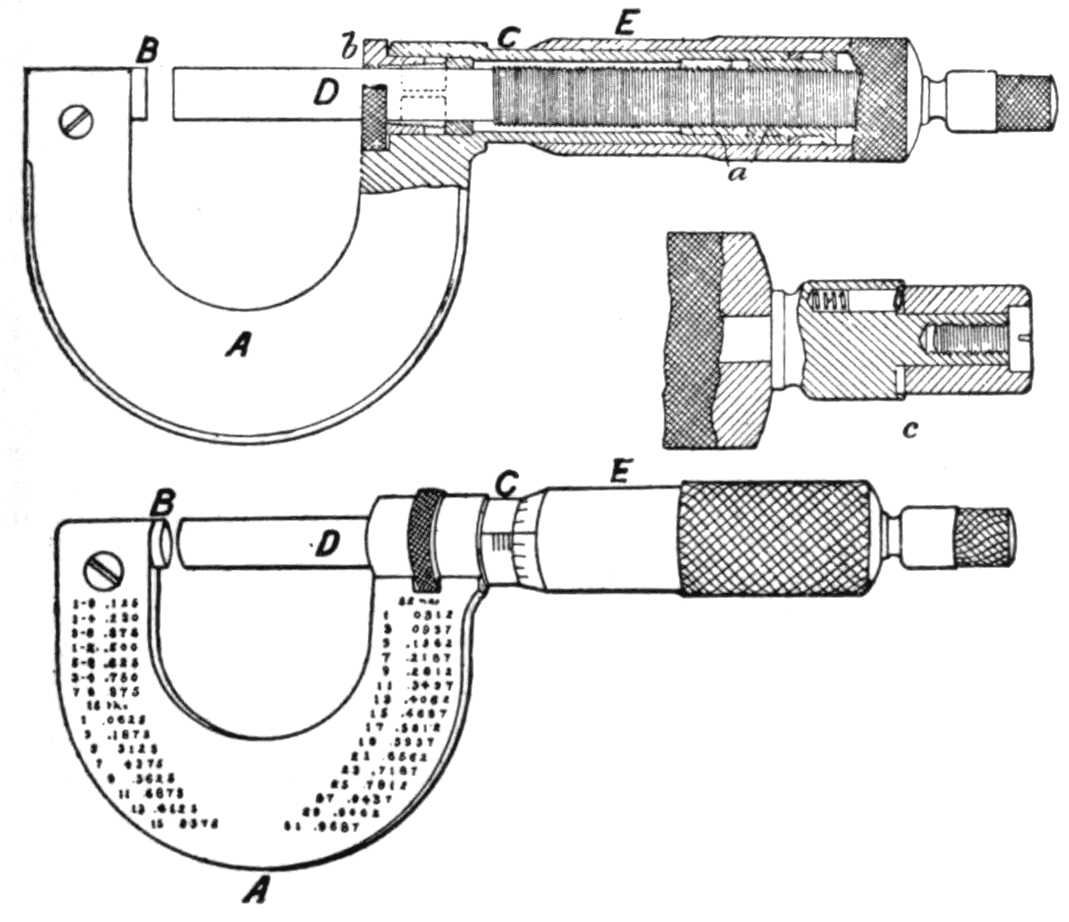
Why a caliper and not a micrometer. A vernier caliper measures outside, inside and depth, over a long range, with no moving screw to wear. A micrometer beats it for resolution and repeatability over a short range. Both were on sale in the same shops by 1870 and neither replaced the other; batch 35's Palmer micrometer is the other half of this pair.
The honest limit of a vernier. Reading to 0.02 mm does not mean measuring to 0.02 mm. Jaw wear, measuring force and the operator's eye all enter, which is exactly what step 11 makes visible. A stated resolution is a property of the scale; accuracy is a property of the whole system including you.
Ibikoresho
4- 1 urupapuroUmwanya
- 1 urupapuroUmwanya
- Umwanya
- 1 igiceUmwanya
Ibikoresho by'Ibishushanyo Bifitanye Isano
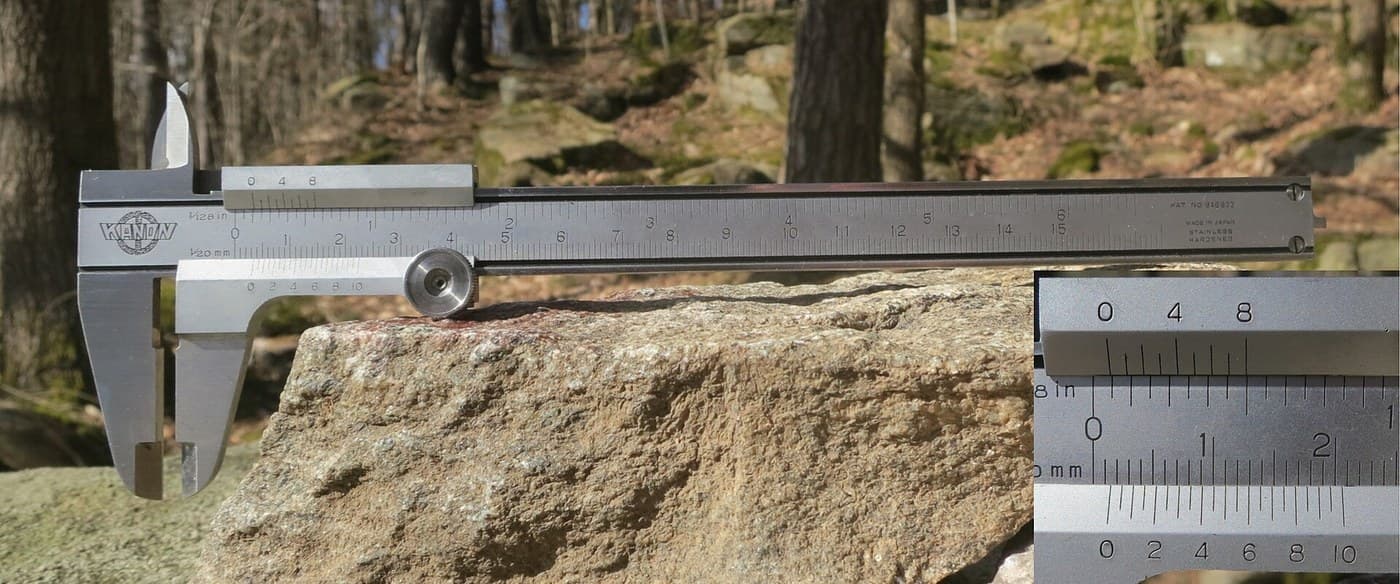


Blueprint zijyanye
Izi blueprint zisangira ubumenyi — uburyo, ibikoresho cyangwa amahame
CC0 Umurenge rusange
Iyi blueprint yasohowe munsi ya CC0. Ushobora gukoporora, guhindura, gukwirakwiza no gukoresha nta kwemererwa.
Shyigikira Umuremyi ugura ibicuruzwa binyuze muri Blueprint ye Komisiyo y'Umuremyi byashyizweho n'Abacuruzi, cyangwa kora verisiyo nshya y'iyi Blueprint ukayinjiza nk'isano muri Blueprint yawe kugira ngo musangire inyungu.