Ubufatanye
UBUHANZI
UBWIZA N'UBUZIMA
UBUKORIKORI
UMUCO N'AMATEKA
IMYIDAGADURO
IBIDUKIKIJE
IBIRIBWA N'IBINYOBWA
UBWUBATSI BUSUBIRA INYUMA
UBUMENYI
SIPORO
IKORANABUHANGA
IBYAMBARWA
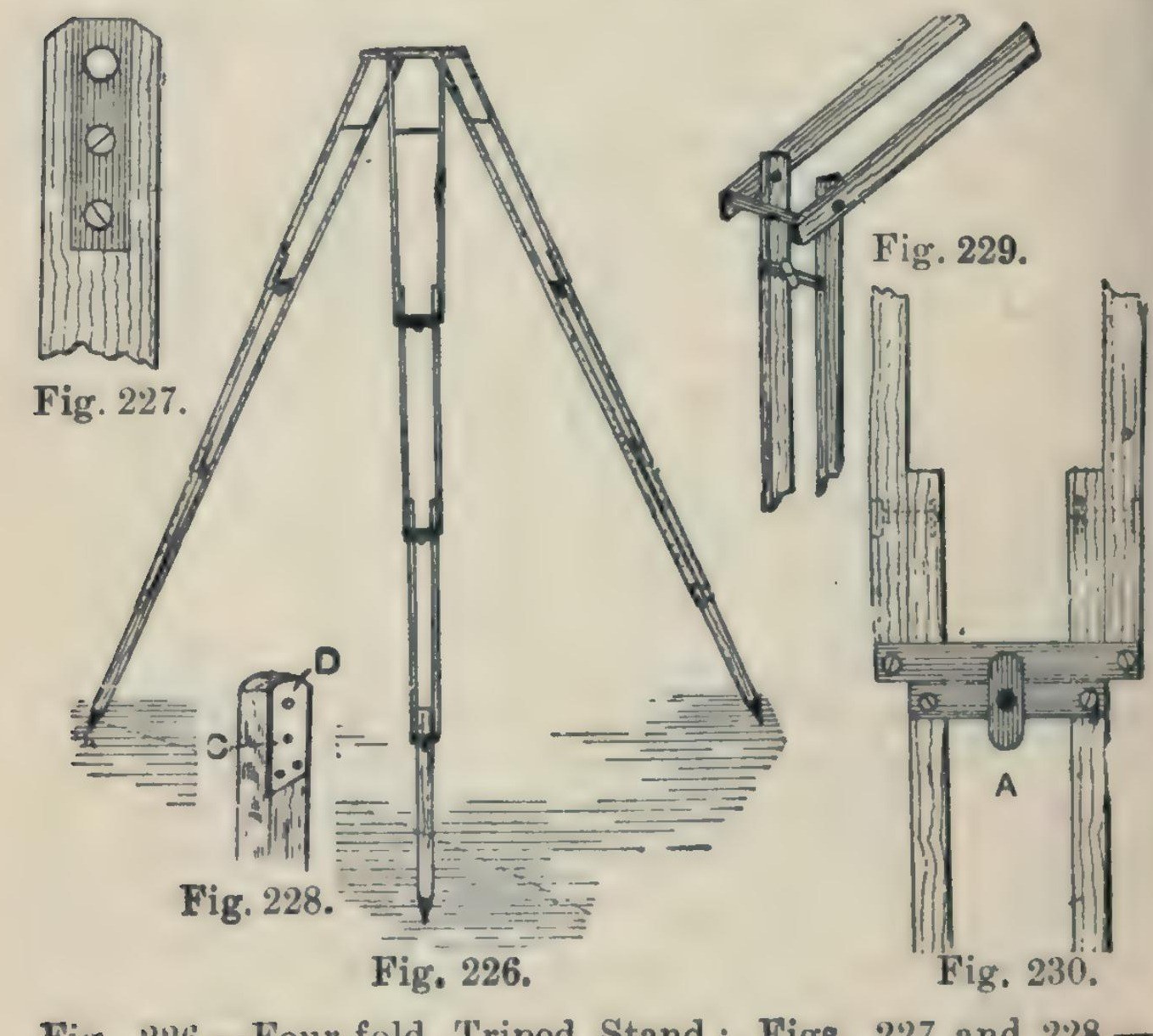


Camera Tripod: a Four-Fold Ash Tripod Stand (Hasluck, 1902)
A light, compact folding camera stand: three legs, each of seven ash laths riveted so it folds in four, locked open by brass buttons, on a triangular ash top with brass pins and a hole for the camera screw.
Hasluck says the same method makes stands that fold in three or two.
Source: Paul N. Hasluck, Photographic Cameras and Accessories (1902), pp. 153-157. Picture: Figs. 226-230 of the book.
Hagati
Unknown
Amabwiriza
1
1
Cut the ash laths
Cut the ash laths
Cut laths of good ash, true and square or the stand won't be rigid, and round the edges slightly: six 17 1/4 x 5/8 x 3/8 in, six 16 x 5/8 x 3/8 in, six 15 1/2 x 5/8 x 3/8 in, and three 14 x 5/8 x 5/8 in.
Ibikoresho by'iyi ntambwe:
 Urubaho rw'igiti cya ash1 21 laths
Ibikoresho bikenewe:
 Umusumeno w'umugongo
 Ikiryabyo gito
2
2
Fit the top ends and stretcher
Fit the top ends and stretcher
On each 17 1/4 in lath let in flush a 1/16 in brass plate, 1 1/4 in long, with a 3/16 in hole 1/4 in from the top, held by two countersunk brass screws; bore the wood to match and take off the top corners. On one lath of each pair cut a groove inside, about 3/16 in deep and 3 1/2 in long, starting 2 in from the top, and hinge a 1/8 in brass rod stretcher in it on a pin. On the other lath cut a curved groove 1 1/2 in long, 3/16 in wide, with a small hole at the bottom where the rod catches.
Ibikoresho by'iyi ntambwe:
 Urupapuro rw'Umuringa w'Umuhondo1 1/16 in plates
 Imisumari y'ibiti1 small brass screws
 Umurongo w'Umuringa w'Umuhondo1 1/8 in stretcher
Ibikoresho bikenewe:
 Uburyo bw'Umucumita w'Ibyuma n'Ibyuma Byawo
 Ikariso ry'Icyuma
 Igikoresho cyo gutobora gikoreshwa n'intoki
 Ibyuma byo kubaza
 Agafuni k'urwasaya rugororotse
3
3
Bore and rivet the legs
Bore and rivet the legs
Bore the rivet holes: in the long laths 1 3/4 in from the lower end, counterbored so the copper rivet head sits flush, then 1/8 in through; in the 16 in and 15 1/2 in laths 1/2 in and 1 3/4 in from the ends; in each 14 in piece 1/2 in from one end, and taper its other end for a pointed iron shoe or a steel point and ferrule. Rivet the 21 laths into three legs with 1/8 in copper rivets and washers: a 16 in lath inside each 17 1/4 in one, a 15 1/2 in lath inside that, the 14 in foot between the last pair. Rivets flush, just tight enough to fold but not loose.
Ibikoresho by'iyi ntambwe:
 Utuma tw'umuringa1 1/8 in, with washers
 Icyuma kitazwi3 iron shoes or steel points
Ibikoresho bikenewe:
 Ivuvuzo ry'ukuboko rifite umutweIgikoresho cyo gutobora gikoreshwa n'intoki
 Inyundo yo gushyira riveti
4
4
Add cross strips and lock buttons
Add cross strips and lock buttons
Screw 1/16 in brass strips across the bottom ends of each pair of laths (Fig. 229). Under them screw strips carrying a small brass button riveted at the centre; turned, the button hooks over the strip above and locks the joint open (Fig. 230).
Ibikoresho by'iyi ntambwe:
Urupapuro rw'Umuringa w'Umuhondo1 cross strips, buttonsImisumari y'ibiti1 igiceIbikoresho bikenewe:
Uburyo bw'Umucumita w'Ibyuma n'Ibyuma ByawoIkariso ry'IcyumaAgafuni k'urwasaya rugororotseInyundo yo gushyira riveti5
5
Make the top
Make the top
Plane ash to 1/2 in and draw an equilateral triangle with 8 1/2 in sides. Bisect the angles; 2 in from each corner draw a line at right angles, go 1/2 in in along the sides, and mark three rectangles 2 7/8 x 3/4 in; cut the outline (Fig. 231). Fix a 3/16 in brass rod, one end tapered, across each rectangle, bored 3/8 in from the outer edge and projecting about 1/2 in, for the legs to hang on. Bore a 1/4 in hole in the centre for the camera screw and glue felt on top.
Ibikoresho by'iyi ntambwe:
Urubaho rw'igiti cya ash1 topUmurongo w'Umuringa w'Umuhondo3 3/16 in pins Ubwoya bw'intama bwashongeshejwe1 igice
 Ifatanyo ry'inyamaswa1 igice
Ibikoresho bikenewe:
Ikiryabyo gitoUmusumeno w'umugongoIvuvuzo ry'ukuboko rifite umutweIgikoresho cyo gutobora gikoreshwa n'intoki6
6
Finish
Finish
Glasspaper and varnish the wood, and lacquer the brass.
Ibikoresho by'iyi ntambwe:
 Varinishi ya sherake1 varnish
 Ibikoresho bitazwi1 brass lacquer
Ibikoresho bikenewe:
 Urupapuro rwo Gusya
Ibikoresho
10- Umwanya
- 1 cross strips, buttonsUmwanya
- 1 igiceUmwanya
- 3 3/16 in pinsUmwanya
- 1 1/8 in, with washersUmwanya
- 3 iron shoes or steel pointsUmwanya
- Umwanya
- 1 igiceUmwanya
- 1 varnishUmwanya
- 1 brass lacquerUmwanya
Ibikoresho bikenewe
10- Umwanya
- Umwanya
- Umwanya
- Umwanya
- Umwanya
- Umwanya
Iki gishushanyo gikora

CC0 Umurenge rusange
Iyi blueprint yasohowe munsi ya CC0. Ushobora gukoporora, guhindura, gukwirakwiza no gukoresha nta kwemererwa.
Shyigikira Umuremyi ugura ibicuruzwa binyuze muri Blueprint ye Komisiyo y'Umuremyi byashyizweho n'Abacuruzi, cyangwa kora verisiyo nshya y'iyi Blueprint ukayinjiza nk'isano muri Blueprint yawe kugira ngo musangire inyungu.