Ubufatanye
UBUHANZI
UBWIZA N'UBUZIMA
UBUKORIKORI
UMUCO N'AMATEKA
IMYIDAGADURO
IBIDUKIKIJE
IBIRIBWA N'IBINYOBWA
UBWUBATSI BUSUBIRA INYUMA
UBUMENYI
SIPORO
IKORANABUHANGA
IBYAMBARWA
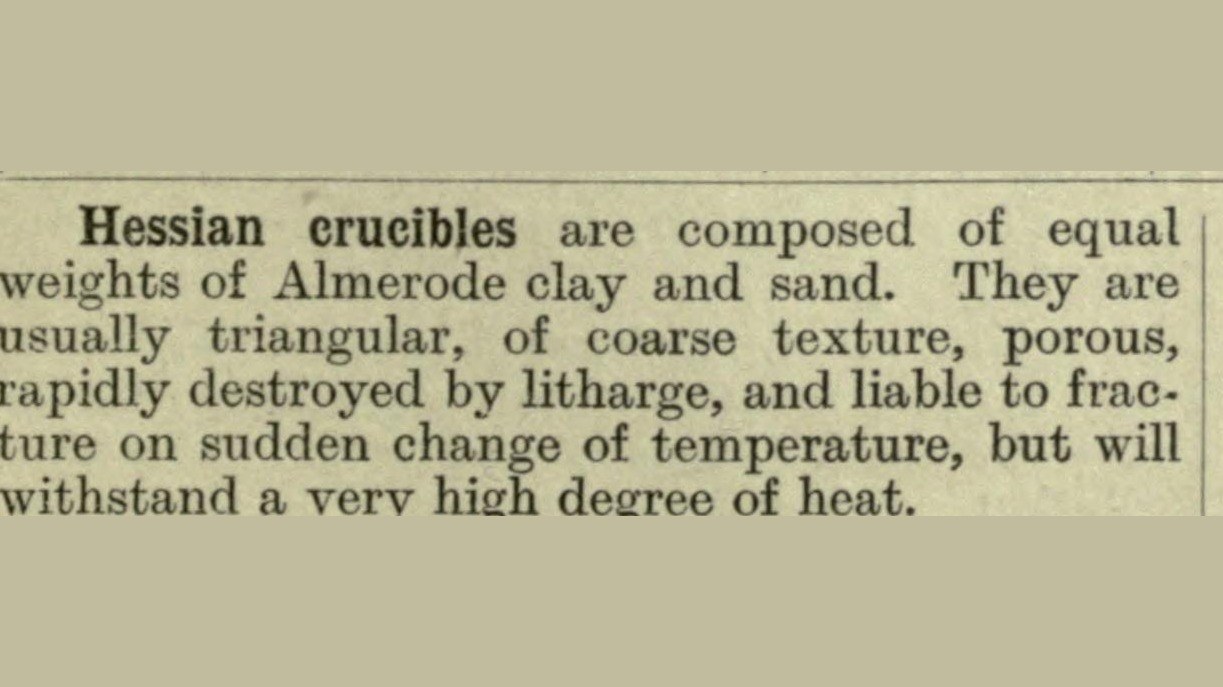


Ceramic Crucible: a Hessian Crucible of Equal Weights of Clay and Sand (Thorpe 1912)
A ceramic crucible is a fired clay pot for melting metal. Thorpe's Dictionary of Applied Chemistry (1912) describes the Hessian crucible: equal weights of clay and sand, usually triangular, coarse and porous; it withstands a very high heat but cracks on sudden changes of temperature and is quickly eaten by litharge.
His general rules for clay crucibles fill in the work: weather the clay, beat it fine to drive out air, mix in the sand, form the crucibles and bake small ones in a kiln. Sizes, forming and baking heat are not given.
Source: Thorpe, Dictionary of Applied Chemistry vol. II (1912), CRUCIBLES, pp. 168-169. Picture: the Hessian paragraph.
Utangiye
Weeks of weathering, then two days
Amabwiriza
1
1
Read Thorpe
Read Thorpe
"Hessian crucibles are composed of equal weights of Almerode clay and sand."
2
2
Weather and clean the clay
Weather and clean the clay
Leave the clay exposed to the air in a moist state for some months; it breaks down, grows more plastic and is easier to clean. Pick out foreign matter, above all iron pyrites, which turns into a flux and leaves cavities, and lime.
Ibikoresho by'iyi ntambwe:
 Ibumba1 half by weight
Ibikoresho bikenewe:
 Amazi
3
3
Beat and mix
Beat and mix
Beat the clay well, as fine as you can get it, to drive out air bubbles. Weigh it, and mix in an equal weight of sand; Berthier warns that the sand should not be too fine, or it combines with the clay and lowers the melting point.
Ibikoresho by'iyi ntambwe:
 Umusenyi wa Kwarutsi1 half by weight
Ibikoresho bikenewe:
 Inyundo y'Igiti
 Iminzani ya Digitale Nyayo
4
4
Form the crucibles
Form the crucibles
Form the crucibles; Hessian crucibles are usually triangular. Thorpe gives no sizes and no forming method (unknown).
Ibikoresho bikenewe:
 Umutwe w'ibikoresho by'ibumba
 Ingano zitazwi
5
5
Bake
Bake
Bake small crucibles in a kiln. Thorpe notes that the higher the baking heat, the more liable the crucible is to crack when heated again; the temperature is not given.
Ibikoresho bikenewe:
 Itanura
 Uturindantoki twihanganira ubushyuhe
6
6
History and honest limits
History and honest limits
Thorpe sets the Hessian crucible beside others of his day: French crucibles of raw and burnt clay, Cornish crucibles for copper assaying, Stourbridge crucibles with old glass-pot grog, and graphite crucibles for melting metals. The sand forms a skeleton that keeps the pot from slumping at heats where the clay alone would soften.
He gives the proportions only; the size, the forming and the baking heat are not given, and plain clay and quartz sand stand for Almerode clay and its sand.
Ibikoresho bikenewe
7- Umwanya
- Umwanya
- Umwanya
- Umwanya
- Umwanya
Iki gishushanyo gikora

Blueprint zijyanye
Izi blueprint zisangira ubumenyi — uburyo, ibikoresho cyangwa amahame
CC0 Umurenge rusange
Iyi blueprint yasohowe munsi ya CC0. Ushobora gukoporora, guhindura, gukwirakwiza no gukoresha nta kwemererwa.
Shyigikira Umuremyi ugura ibicuruzwa binyuze muri Blueprint ye Komisiyo y'Umuremyi byashyizweho n'Abacuruzi, cyangwa kora verisiyo nshya y'iyi Blueprint ukayinjiza nk'isano muri Blueprint yawe kugira ngo musangire inyungu.