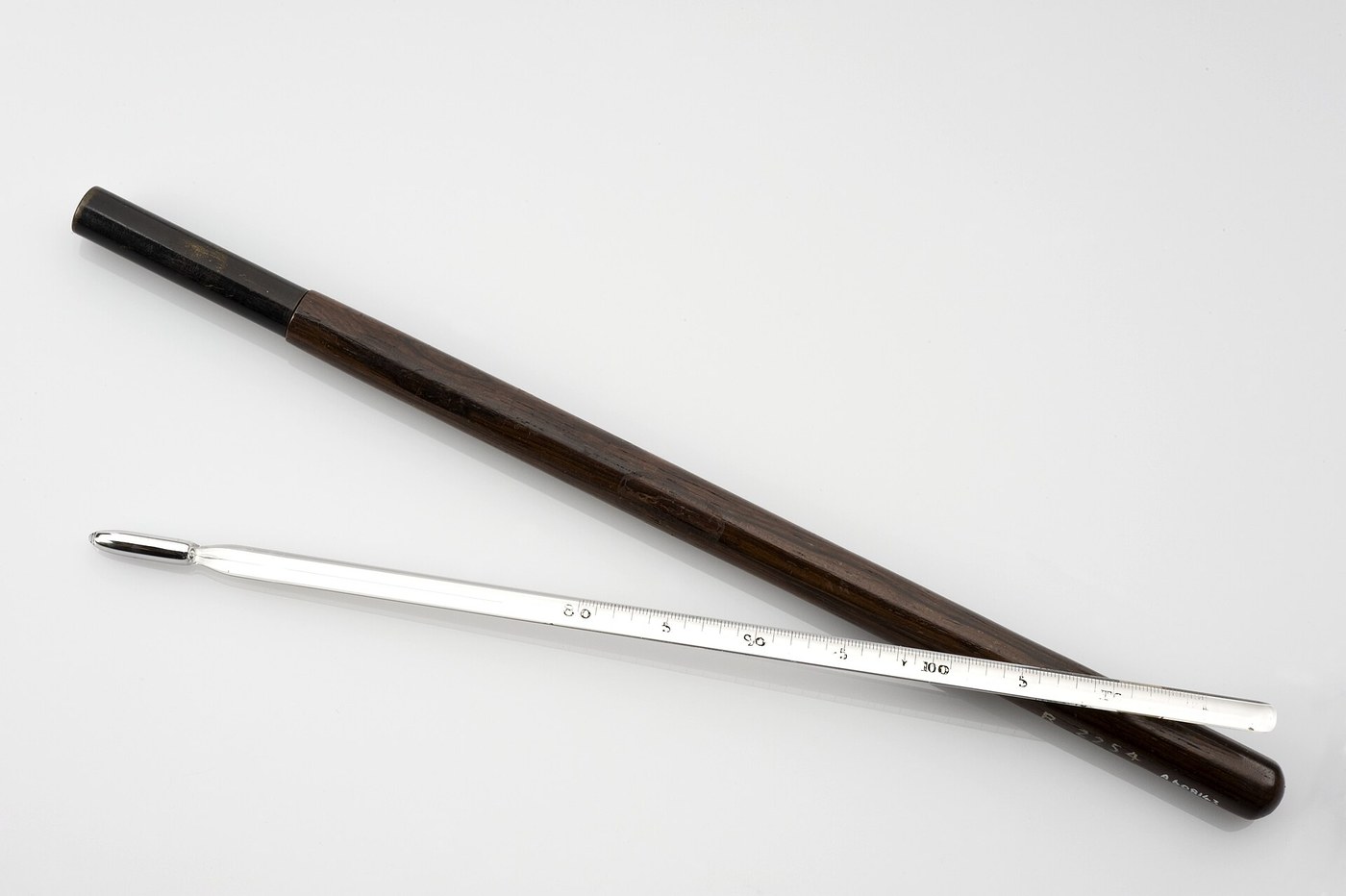


The Clinical Thermometer
A thermometer reads the temperature it is in now. That is exactly the wrong behaviour for measuring a person, because the moment you take it out of the patient it starts reading the room instead — and by the time you have found the light and focused on the scale, the number has gone.
Early clinical thermometers had to be read in situ, took twenty minutes to settle, and were nearly a foot long.
The fix is a piece of glassworking so small it is easy to miss: a constriction in the bore, just above the bulb, where the channel narrows almost to nothing.
Warming up, the mercury expands with enough force to push through the constriction into the stem. Cooling down, the mercury in the bulb contracts and tries to pull the thread back — but it cannot. A liquid column can push hard and cannot pull: surface tension breaks the thread at the narrow point instead. The mercury above stays where the maximum reading left it.
The instrument becomes a maximum-reading device that holds its answer until deliberately reset — which is what the flick of the wrist is for. You are using centrifugal force to throw the stranded thread back down past the constriction.
One narrow point in a glass tube turns a live reading into a stored one.
Amabwiriza
Watch an ordinary thermometer forget
Watch an ordinary thermometer forget
Warm a standard laboratory thermometer in your hand until it stabilises, then take it out and watch the reading.
Time how long before it has fallen by a full degree.
Expect seconds.
Now imagine reading it accurately, in poor light, on a ward, while it does that.
This is the design problem, and it is not about accuracy or sensitivity. It is about when you are allowed to read the answer.
Ibikoresho bikenewe:
 Igipima Ubushyuhe
Find the constriction
Find the constriction
Hold a clinical thermometer up to a bright light and look carefully at the bore just above the bulb, using a loupe.
Find the point where the channel pinches almost shut.
Compare with a laboratory thermometer, whose bore runs straight through.
That single feature is the entire difference between the two instruments. Everything else — the scale, the bulb, the liquid — is the same idea. Note how small it is, and how completely it changes the behaviour.
Show that a liquid pushes but cannot pull
Show that a liquid pushes but cannot pull
Fill a syringe fitted with a very fine tube. Push the plunger: liquid moves out easily. Now pull it back gently with the tip in air.
Expect the column to break rather than drag the liquid back.
Repeat with a wider tube and note that it is harder to make it break.
A liquid transmits compression perfectly and tension hardly at all — surface tension gives way first, and the narrower the passage the more readily it does. The clinical thermometer is engineered around that asymmetry.
Ibikoresho bikenewe:
 Ibikoresho by'urushinge rw'inshinge
Demonstrate the hold and the reset
Demonstrate the hold and the reset
Warm a clinical thermometer to a reading, remove it, and watch for a minute.
Expect the reading to stay put.
Now shake it down firmly and watch the thread retreat past the constriction.
Note what the shake actually is: you are accelerating the instrument so the stranded mercury has enough force to be driven back through the narrow point. It is not a ritual — it is the reset mechanism, and a thermometer that has not been shaken down will simply repeat its previous maximum and read as a fever that is not there.
Find the errors that survive a perfect instrument
Find the errors that survive a perfect instrument
Take a reading after 30 seconds, then after 1, 2, 3 and 5 minutes without removing the thermometer, and plot the curve.
Expect it to still be climbing well past the first minute.
A maximum-reading thermometer records the highest temperature it reached — which is only the body's temperature if it was left in place long enough to equilibrate.
Then note the second error: temperature differs by site, and by time of day. The instrument can be flawless and the measurement still wrong, because the number depends on where you put it and how long you waited. That is a lesson about every sensor, not just this one.
History & Context
History & Context
It became clinically useful when it became portable and quick. Thermometers existed for two centuries before they were used routinely on patients — Galileo's thermoscope and Celsius's fixed points are elsewhere in this corpus. The obstacles were practical: the instruments were long, slow and had to be read in place. Thomas Clifford Allbutt is credited with the short six-inch clinical thermometer that could be carried in a pocket and read in about five minutes, and that is the moment temperature became a routine measurement rather than an experiment.
Measuring temperature created the fever chart. Once a number could be taken reliably several times a day, a patient's course could be plotted. Patterns in that line — the sawtooth of malaria, the step of typhoid — became diagnostic in themselves. The instrument did not just answer a question; it made a new kind of question askable, which is what good instruments do.
The constriction is a mechanical memory. Storing a peak value so it can be read later, by a device with no power and no moving parts, is the same idea as the maximum-minimum garden thermometer, the peak-hold on a meter, and the crash recorder. Latching a maximum is a distinct engineering problem from measuring one, and this is one of the neatest solutions to it ever made.
Mercury has largely gone, and for good reason. A broken clinical thermometer released a toxic metal that vaporises at room temperature, in exactly the settings — hospitals, homes with children — where that is least acceptable. Galinstan and coloured-alcohol versions replaced it in liquid instruments, and digital thermistors replaced it almost everywhere. The digital ones solve the storage problem trivially, in software, and most people never learn that it was ever a problem.
Honest limits. Slow — minutes, not seconds. It must be shaken down, and forgetting is a real clinical error. Glass and mercury are a poor combination in a hospital. And it measures where it is placed: oral, axillary and rectal readings differ systematically, so a number without a site is not a measurement.
Ibikoresho bikenewe
2- Umwanya
Ibikoresho by'Ibishushanyo Bifitanye Isano


CC0 Umurenge rusange
Iyi blueprint yasohowe munsi ya CC0. Ushobora gukoporora, guhindura, gukwirakwiza no gukoresha nta kwemererwa.
Shyigikira Umuremyi ugura ibicuruzwa binyuze muri Blueprint ye Komisiyo y'Umuremyi byashyizweho n'Abacuruzi, cyangwa kora verisiyo nshya y'iyi Blueprint ukayinjiza nk'isano muri Blueprint yawe kugira ngo musangire inyungu.