UBUHANZI
UBWIZA N'UBUZIMA
UBUKORIKORI
UMUCO N'AMATEKA
IMYIDAGADURO
IBIDUKIKIJE
IBIRIBWA N'IBINYOBWA
UBWUBATSI BUSUBIRA INYUMA
UBUMENYI
SIPORO
IKORANABUHANGA
IBYAMBARWA
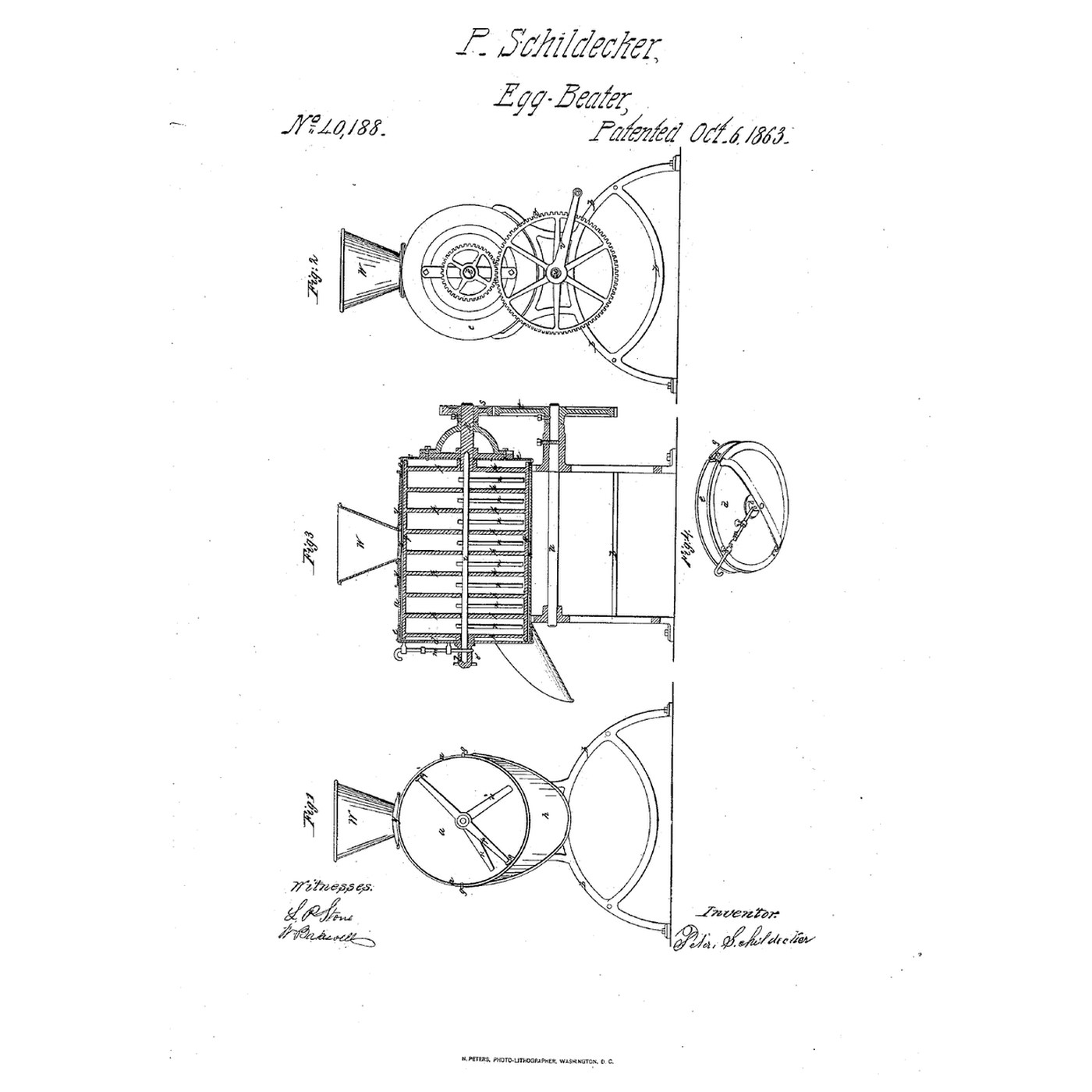


Comb-Cylinder Egg Beater: Bars Turn Between Fixed Arms
Every beater so far turned through a liquid that nothing held still.
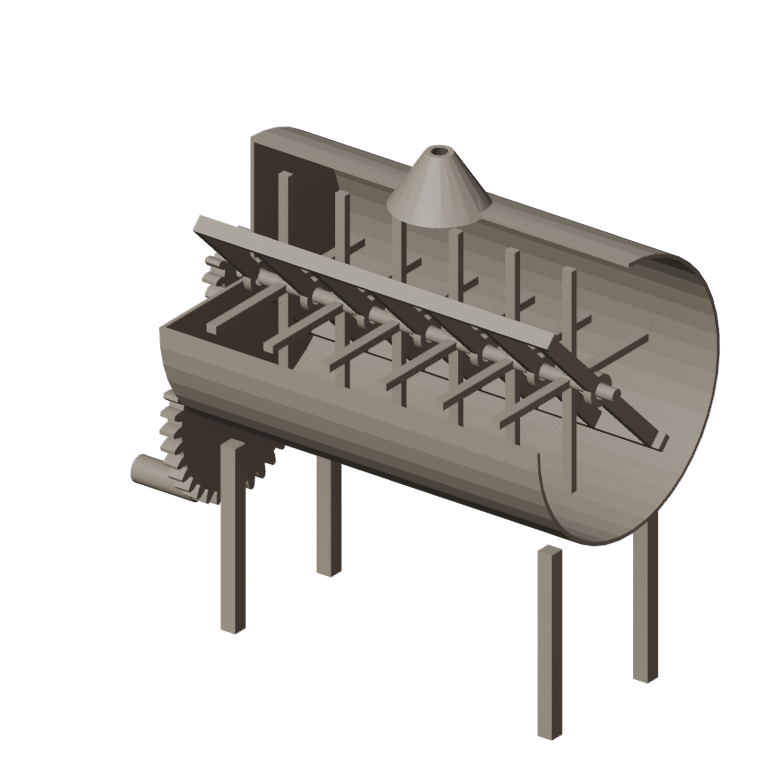
Peter Schildecker of Pittsburgh received US 40,188, dated 6 October 1863, for an egg beater: a horizontal cylinder on a light frame, with a still shaft along its axis carrying arms set in pairs at right angles, and a frame of parallel bars that turns round the shaft so that "each bar p will come between a pair of arms"; a funnel on a slide fills it, and a cap held by slots over pins opens it to pour out through a spout.
This rung works out the passes per second, then prints the bar frame and arm comb, builds the cylinder and gearing, and times a beating.
Hejuru
About 6 hours, plus printing
Amabwiriza
1
1
Passes per second
Passes per second
Gupakira ikaye ya Jupyter…
2
2
Breaking the swirl before it
Breaking the swirl before it
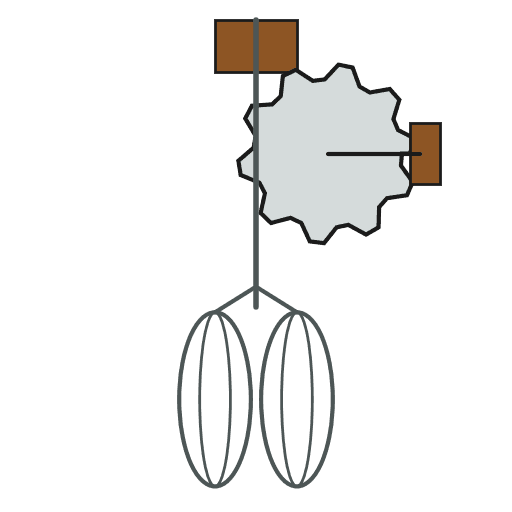
The embedded blueprint breaks a propeller's swirl with rocking arms. Schildecker holds his arms still and turns the bars past them.
3
3
Read US 40,188
Read US 40,188
"The beater consists of a frame composed of a number of parallel bars, p, placed at uniform distances apart, so that each bar p will come between a pair of arms, n n', when in place in the cylinder a."
"My improved egg-beater is designed to beat up the white of eggs or eggs mixed with sugar, and by the use of it I am enabled to accomplish the result more effectually and in a much shorter space of time than by hand or by the use of any contrivances for a similar purpose with which I am acquainted."
4
4
Print the bars and arms
Print the bars and arms
Print the bar frame and the arm comb on its shaft. Print in PETG at 0.2 mm layers, 30 % infill, 4 walls.
Ibikoresho by'iyi ntambwe:
 Fibere ya PETG1 igice
Ibikoresho bikenewe:
 Imashini icapa 3D ikoresha umugozi (FDM)
5
5
Print the bar frame
Print the bar frame
The bar frame, printed as step 4 describes.
6
6
Print the arm comb on its shaft
Print the arm comb on its shaft
The arm comb on its shaft, printed as step 4 describes.
7
7
Make the cylinder
Make the cylinder
Cut 160 mm of 100 mm PVC pipe. Close one end with a plywood disk and silicone; make a plywood cap for the other end that twists onto two screws. Saw a 30 mm filling hole on top and fit a funnel over it.
Ibikoresho by'iyi ntambwe:
 Umuyoboro wa PVC1 igice
 Urupapuro rw'ibiti byometse1 igice
 Igifunga cya silikone1 igice
 Uruganda rw'igiti #8 x 1"1 igice
Ibikoresho bikenewe:
 Umucumita w'Ibyuma
 Umucumita w'Imigororwa
 Ibyuma byo gucamo utwenge
 Icyuma Cyivumbura Kidafite Insinga
8
8
Shaft, frame and gearing
Shaft, frame and gearing
Fix the arm comb's shaft through the cap so it cannot turn. Slide the bar frame onto it so its bars fall between the arms, and couple its end ring to a 5 mm crank shaft through the closed end, with a 12-tooth pinion and a 36-tooth wheel and crank on a plywood stand.
Ibikoresho by'iyi ntambwe:
 Umurongo Uzengurutse w'Icyuma Cyoroshye1 igice
 Epoksi y'Ibice Bibiri1 igice
 Igihimba cy'Igiti Gikomeye1 igice
 Ibitorezo by'imashini1 igice
 Umupira w'Impande Esheshatu1 igice
 Uruziga Rurambuye1 igice
Ibikoresho bikenewe:
Icyuma Cyivumbura Kidafite Insinga Ibyuma Byinshi byo Gucukura
 Isupana ihindurwa
 Ikusanyirizo ry'ibitorezi
9
9
The patent drawing
The patent drawing
US 40,188 drawing sheet, public domain (expired patent).
10
10
Beat egg whites with sugar
Beat egg whites with sugar
Fill through the funnel with two egg whites and a spoon of sugar. Crank about once a second; time to stiff peaks, then twist the cap off and pour.
Ibikoresho by'iyi ntambwe:
 Igi2 ibice
 Isukari y'utuntu1 igice
Ibikoresho bikenewe:
 Ibakure rinini ryo kuvanga ry'icyuma kitagira ingese
 Isaha yo Guhagarika
11
11
Bars that hit the arms, a shaft that turns
Bars that hit the arms, a shaft that turns
Comb-cylinder egg beater troubleshooting.
Flow
Loading...
12
12
History and honest limits
History and honest limits
**Peter Schildecker** of Pittsburgh received US 40,188, dated 6 October 1863. His cylinder is tin on a light framework; the cap's rim has two L-shaped slots over pins on the cylinder; a pin through the cap holds the arm shaft still; the bar frame's end bar has a square box flange that takes the crank shaft's square end; a pinion on the crank shaft is driven by a larger cog wheel with a crank; the funnel slide opens or closes the filling hole.
**Honest limits.** FDM prints hold food in their layer lines, so wash well and replace when worn. PVC pipe and plywood stand in for tin, and printed parts for his bars and arms. Your times are the result.
Ibikoresho
13- 1 igiceUmwanya
- 1 igiceUmwanya
- 1 igiceUmwanya
- 1 igiceUmwanya
- 1 igiceUmwanya
- Umwanya
- 1 igiceUmwanya
- 1 igiceUmwanya
- 1 igiceUmwanya
- 1 igiceUmwanya
- 1 igiceUmwanya
- 2 ibiceUmwanya
- 1 igiceUmwanya
Ibikoresho bikenewe
10- Umwanya
- Umwanya
- Umwanya
- 1 vendor sell this, none ship to you yetUmwanya
- Umwanya
- Umwanya
- Umwanya
- Umwanya
Dosiye z'igishushanyo
2Iki gishushanyo gikora
Blueprint zijyanye
Izi blueprint zisangira ubumenyi — uburyo, ibikoresho cyangwa amahame
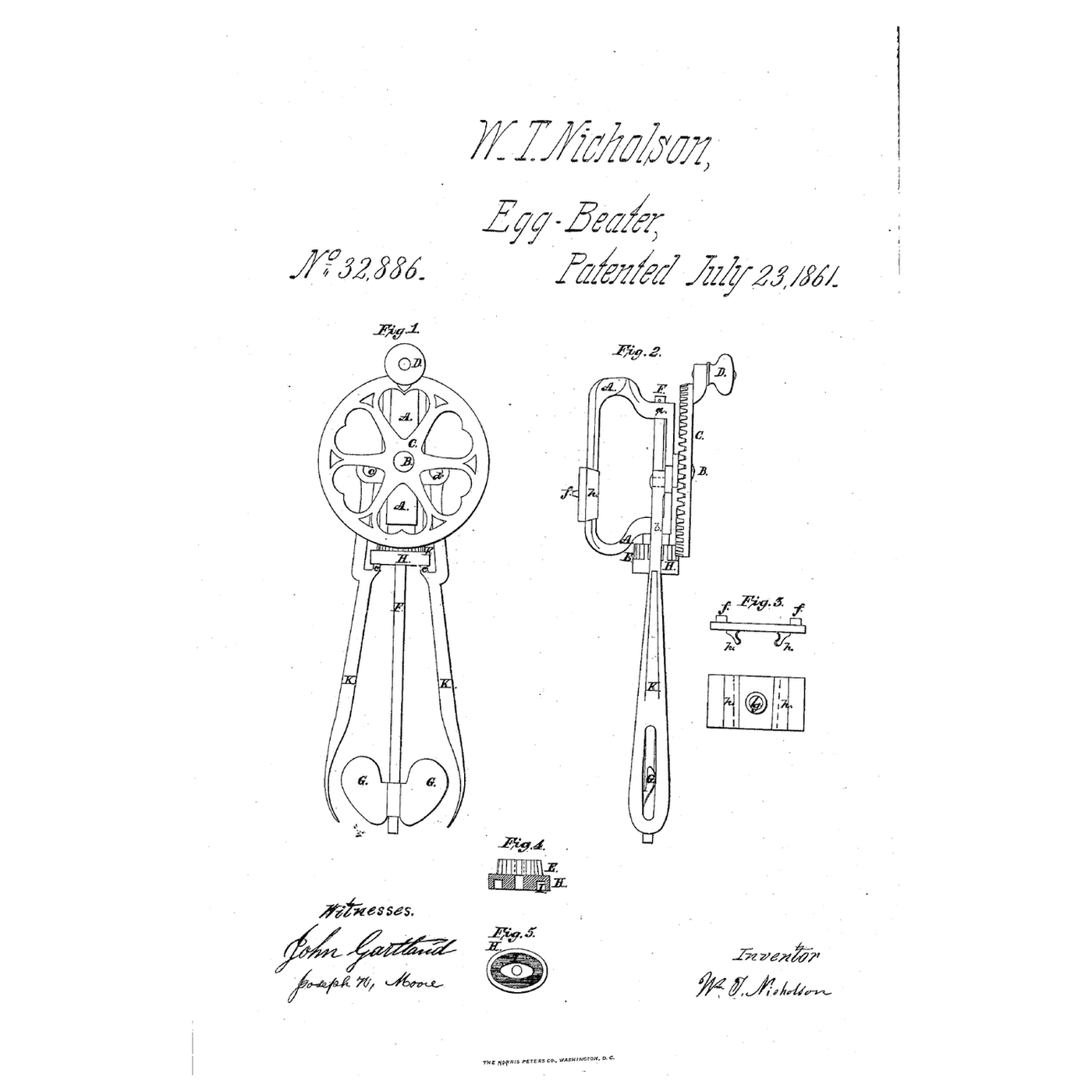
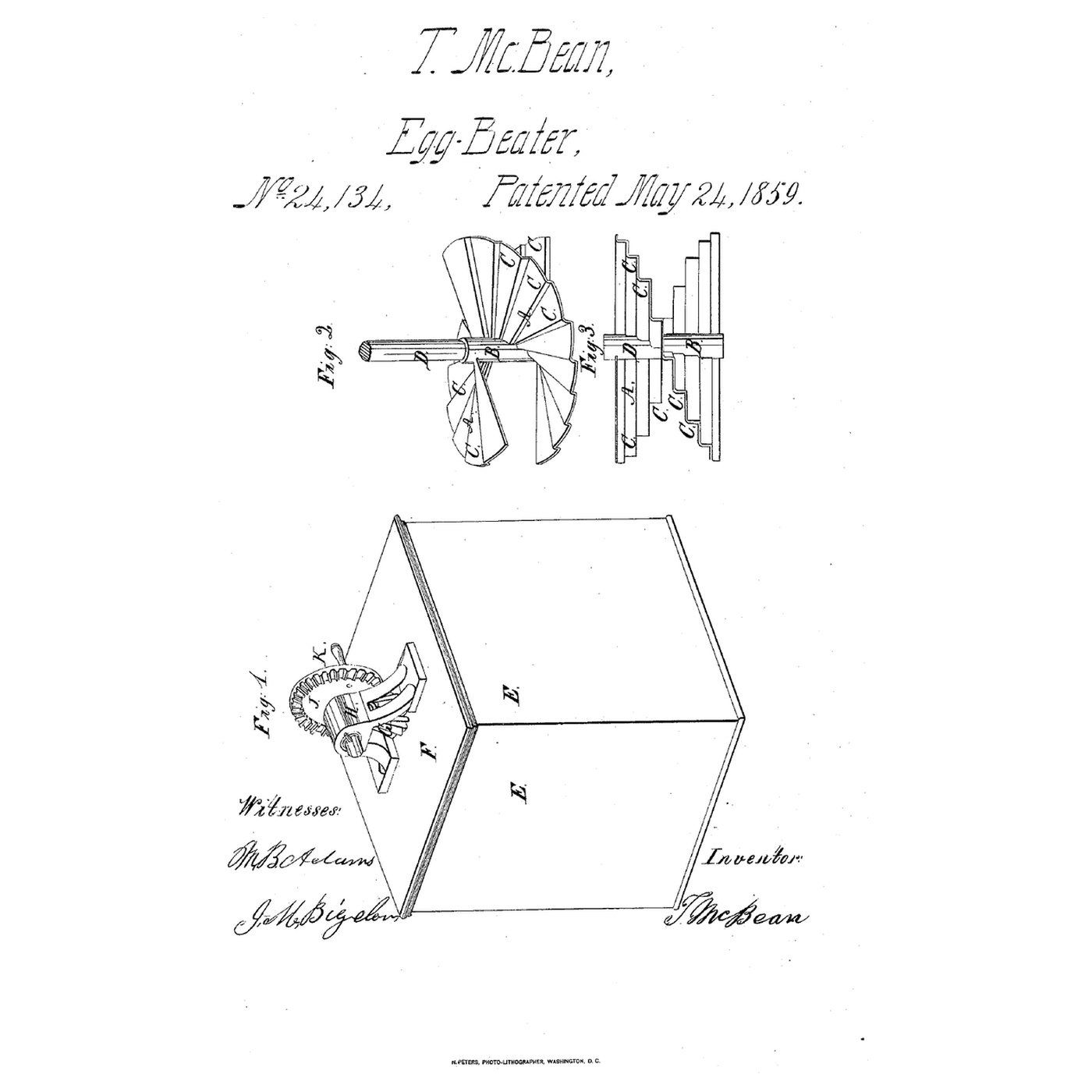

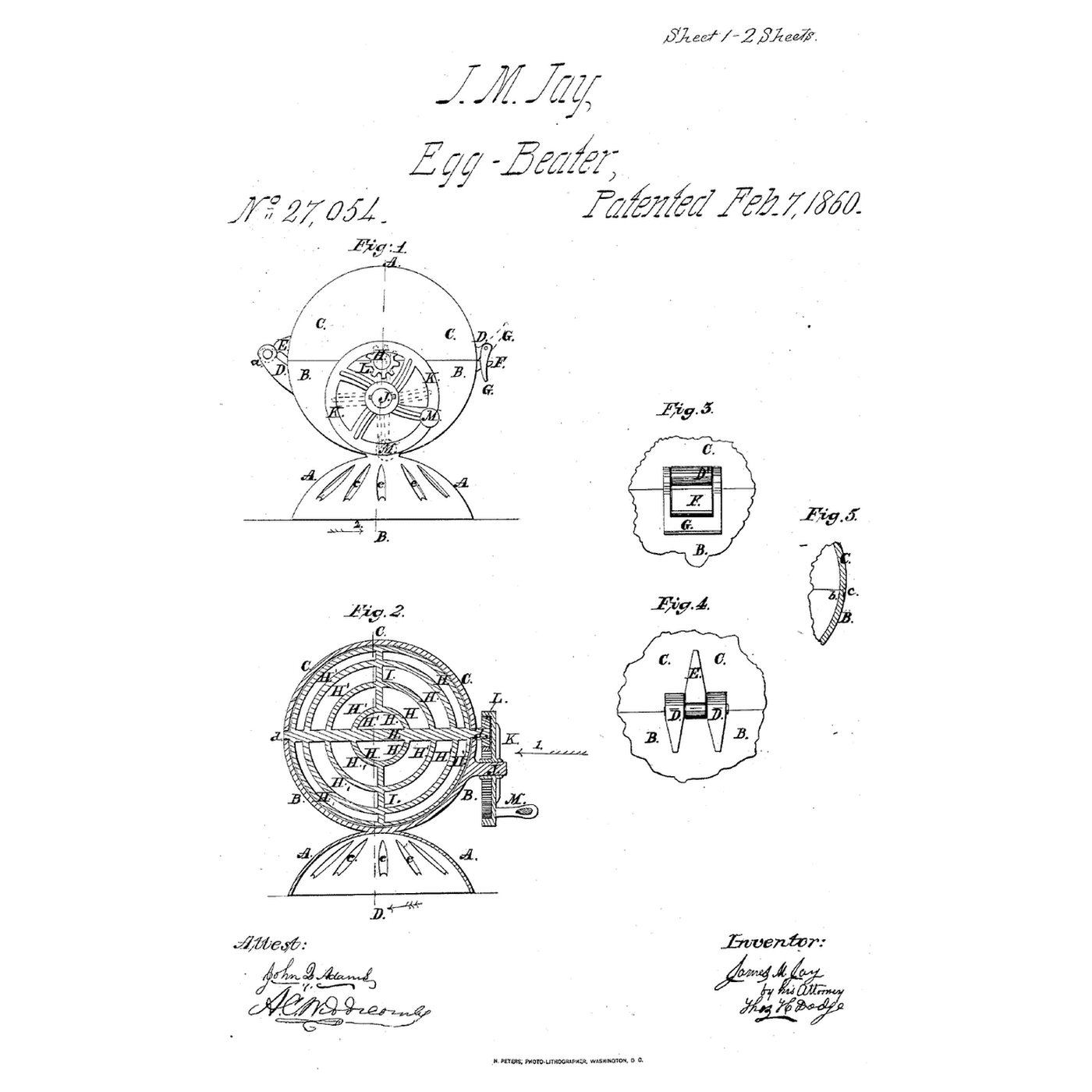
CC0 Umurenge rusange
Iyi blueprint yasohowe munsi ya CC0. Ushobora gukoporora, guhindura, gukwirakwiza no gukoresha nta kwemererwa.
Shyigikira Umuremyi ugura ibicuruzwa binyuze muri Blueprint ye Komisiyo y'Umuremyi byashyizweho n'Abacuruzi, cyangwa kora verisiyo nshya y'iyi Blueprint ukayinjiza nk'isano muri Blueprint yawe kugira ngo musangire inyungu.