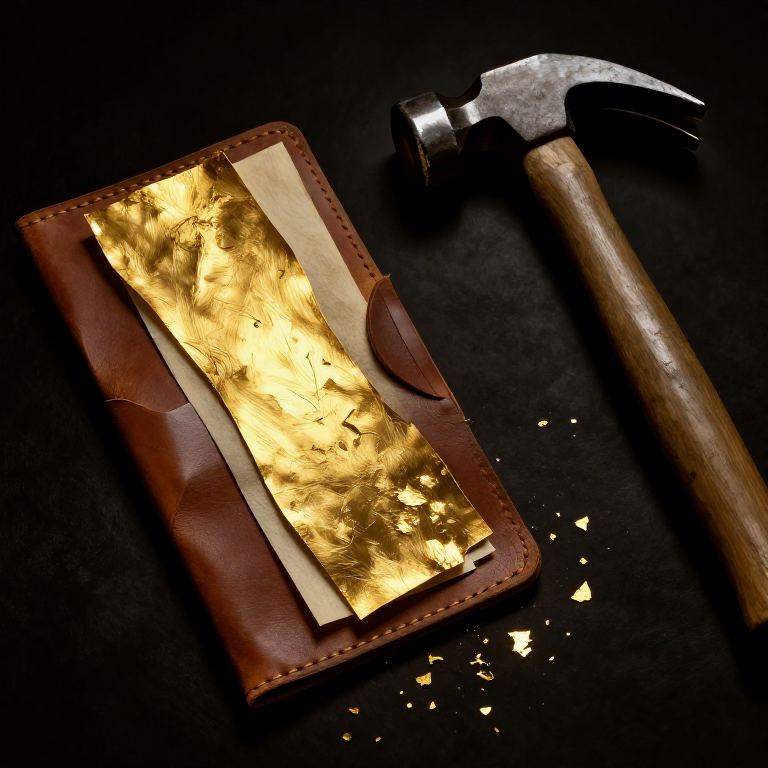


Egyptian Gold Leaf — Beating Gold Leaf for Gilding
Amabwiriza
Prepare the Gold Starting Piece
Prepare the Gold Starting Piece
Begin with a small piece of high-purity gold, ideally 22-24 karat (91.7-99.9% pure). Higher purity gold is softer and more malleable, which allows thinner beating. If starting with a thicker piece, first roll or hammer it into a flat ribbon approximately 0.5 mm thick and 2-3 cm wide. Gold is the most malleable of all metals — a single gram can be beaten into a sheet covering approximately one square meter. Ancient Egyptians obtained gold primarily from mines in the Eastern Desert and Nubia, and prized it as the flesh of the gods, particularly associated with Ra, the sun deity. The gold must be clean and free of any oxide or debris that could puncture the thin leaf during beating.
Ibikoresho by'iyi ntambwe:
 Zahabu5-10 g g
 Urupapuro rw'uruhu rw'inyamaswa50-100 sheets, approx 10x10 cm igice
 Uruhu rwo Kwandikaho50 sheets for initial beating igice
Ibikoresho bikenewe:
 Inyundo y'umucuzi w'izahabu
 Ingoyi
 Icyuma cyo gushyiraho zahabu
 Umukino w'ukorera muri zahabu
First Beating — Cutch Stage
First Beating — Cutch Stage
Place the thin gold ribbon between sheets of parchment paper stacked in a pack approximately 3-4 cm thick. This initial beating pack is called the cutch. Hammer the pack with steady, overlapping blows using the broad-faced goldbeater's hammer, working systematically across the entire surface. The gold spreads laterally with each blow while the parchment prevents adjacent pieces from welding together. Continue beating until the gold has expanded to approximately four times its original area and become semi-transparent at the edges. Remove the gold, cut it into quarters with a sharp knife, and restack the quarters between fresh parchment sheets. Repeat this beating-quartering-restacking cycle 2-3 times until the gold is too thin for parchment to protect it effectively.
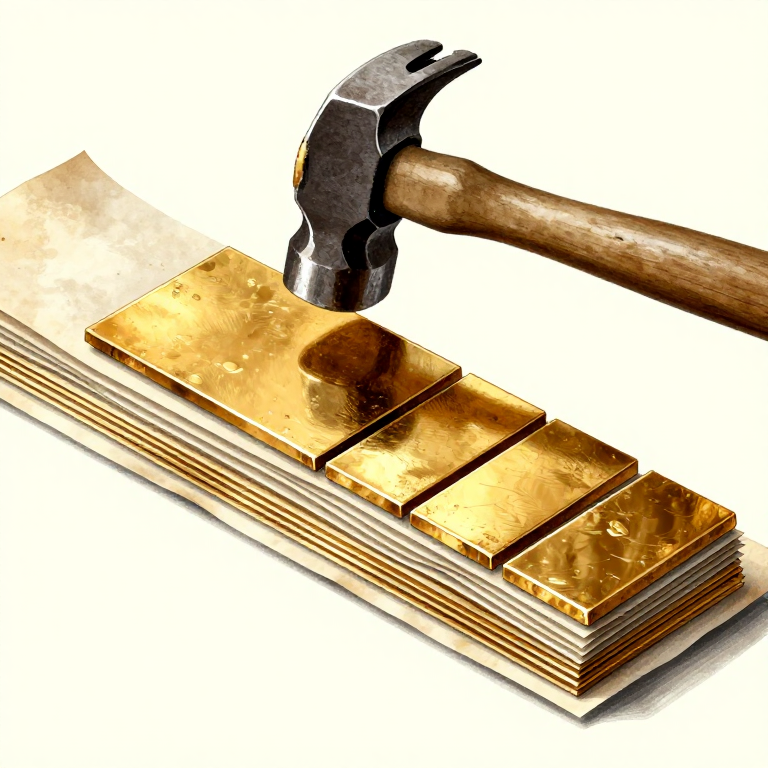
Second Beating — Shoder Stage
Second Beating — Shoder Stage
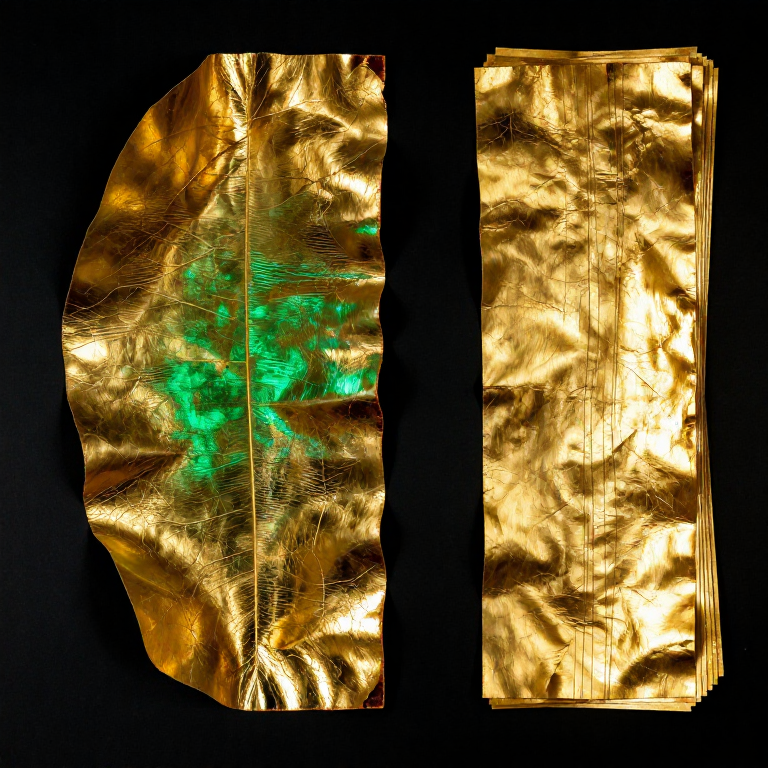
Transfer the thinned gold pieces into a pack of goldbeater's skin — traditionally prepared from the outer membrane of ox cecum (large intestine), which has been stretched, treated, and cut into squares. This material is smoother, more elastic, and thinner than parchment, providing better protection as the gold becomes extremely delicate. The shoder pack contains approximately 150-200 interleaves with gold sheets between them. Beat this pack with lighter, more controlled blows than the cutch stage. The gold is now so thin it becomes translucent, transmitting green light when held up to a bright source. Continue until each piece has expanded to approximately 8-10 cm square. The skill lies in delivering uniform force across the pack without puncturing the increasingly fragile gold.
Final Beating — Mold Stage
Final Beating — Mold Stage
For the final beating, quarter the gold pieces again and place them into a fresh pack of goldbeater's skin called the mold. This pack is beaten with the lightest, most precise blows until the gold reaches its final thickness of approximately 0.1-1 micron — so thin that it is semi-transparent and floats in the slightest air current. At this thickness, gold leaf transmits a blue-green light and appears to have no weight when resting on a surface. A skilled goldbeater can produce approximately 1,000 leaves from a single troy ounce (31.1 g) of gold, each leaf approximately 8x8 cm. Archaeological analysis of gilding on Tutankhamun's funerary mask shows gold leaf of remarkable thinness and uniformity, demonstrating the extraordinary skill of New Kingdom goldbeaters.
Cut and Store the Gold Leaf
Cut and Store the Gold Leaf
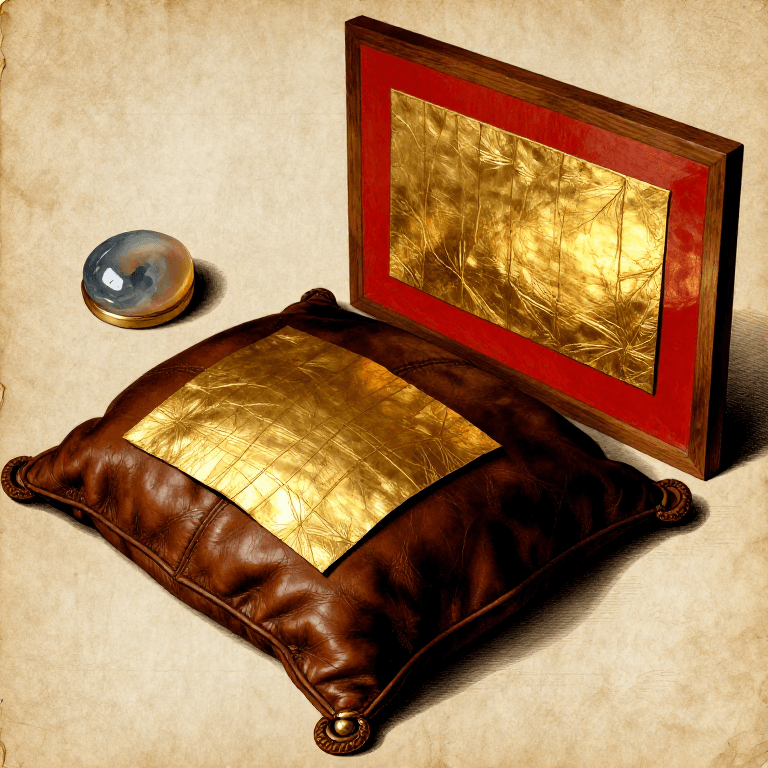
Using a sharp gilding knife (traditionally a cane knife with a straight, smooth blade), carefully cut the beaten gold leaf to uniform squares while still resting on the goldbeater's skin. The knife must be perfectly clean and oil-free, and the cutting motion should be a single smooth slide rather than a sawing action, which would tear the delicate leaf. Transfer each cut leaf onto sheets of tissue paper lightly dusted with fine chalk or rouge to prevent sticking. Stack the finished leaves in a book of 25 sheets (a standard quantity since antiquity). For gilding, the leaf is applied to a surface coated with adhesive size — ancient Egyptians used gum arabic, egg white, or beeswax as gilding adhesives, depending on whether the surface was wood, stone, or metal.
Ibikoresho
3- 5-10 g gUmwanya
- 50 sheets for initial beating igiceUmwanya
- 50-100 sheets, approx 10x10 cm igiceUmwanya
Ibikoresho bikenewe
6- Umwanya
- Umwanya
- Umwanya
- Umwanya
- Umwanya
Ibikoresho by'Ibishushanyo Bifitanye Isano

Iki gishushanyo gikora

Blueprint zijyanye
Izi blueprint zisangira ubumenyi — uburyo, ibikoresho cyangwa amahame
CC0 Umurenge rusange
Iyi blueprint yasohowe munsi ya CC0. Ushobora gukoporora, guhindura, gukwirakwiza no gukoresha nta kwemererwa.
Shyigikira Umuremyi ugura ibicuruzwa binyuze muri Blueprint ye Komisiyo y'Umuremyi byashyizweho n'Abacuruzi, cyangwa kora verisiyo nshya y'iyi Blueprint ukayinjiza nk'isano muri Blueprint yawe kugira ngo musangire inyungu.