

Ferrofluid
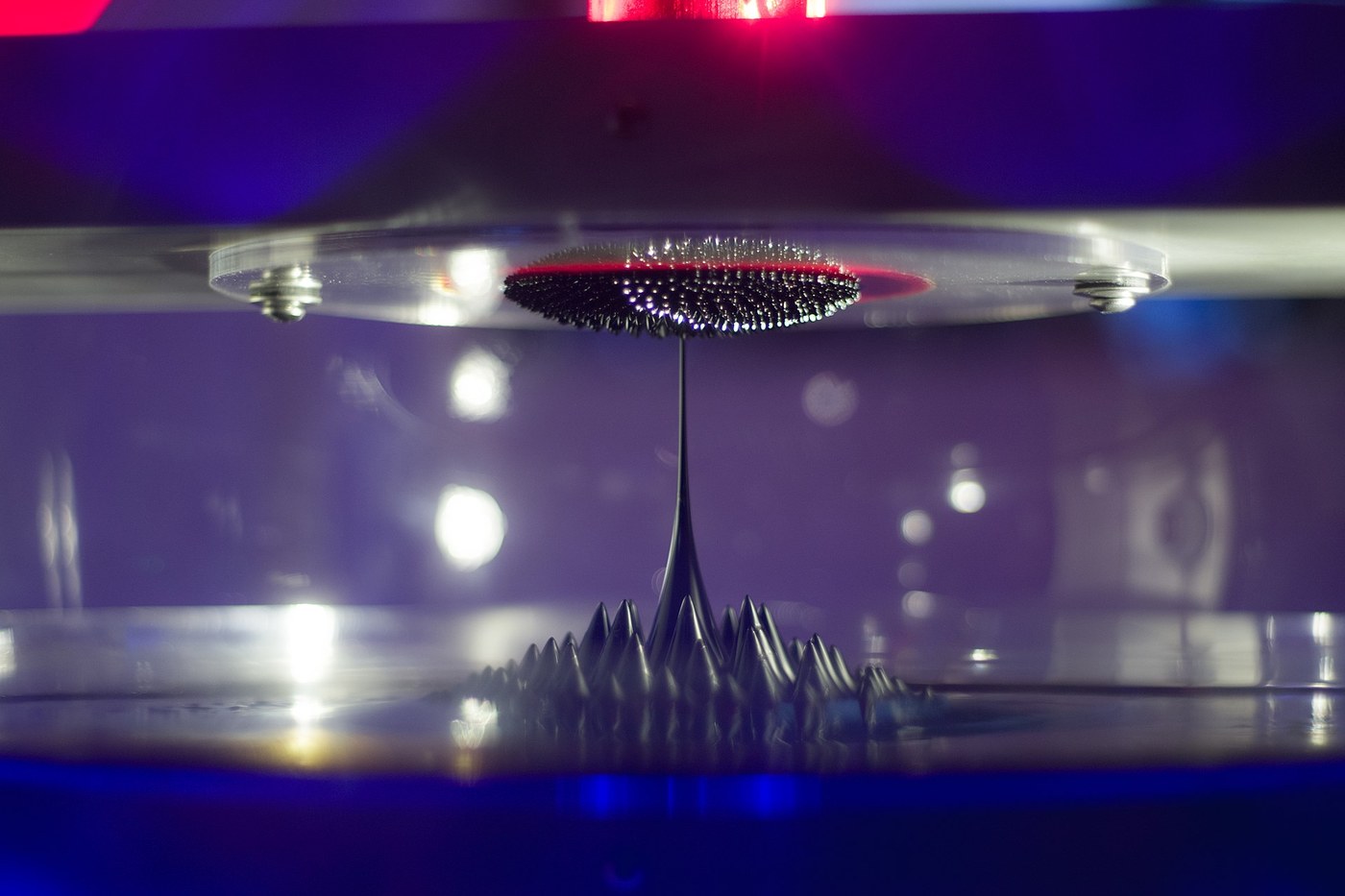
A ferrofluid is a liquid that a magnet can pick up. Not a liquid with iron filings in it that settle out in a minute — a genuine colloid that stays mixed indefinitely, flows like oil, and when a magnet comes near erupts into a field of spikes.
Three things have to be true at once, and each is a real materials problem.
The particles must be extremely small — a few nanometres, typically in the 3-15 nm range. At that size their random thermal motion is vigorous enough to keep them suspended against gravity indefinitely. Bigger particles simply sink, which is why iron filings in oil is not a ferrofluid.
They must be coated with a surfactant. Magnetic particles attract each other, and without a molecular layer holding them apart they clump into lumps that then fall out. The surfactant is doing the same job as the emulsifier in a dressing: preventing the dispersed phase from merging.
And they must sit in a carrier liquid that wets the coating.
The spikes are the payoff and they are not decoration — they are a genuine instability with a name and a theory. Steve Papell invented the material at NASA's Lewis Research Center in 1963, trying to make rocket fuel that a magnet could pull towards a pump in weightlessness.
Amabwiriza
Get magnetite, and get it clean
Get magnetite, and get it clean
Obtain fine magnetite — separated from iron-bearing sand with a magnet, or as a fine iron oxide powder. Wash it repeatedly with water, drawing the solid down with a magnet and pouring the cloudy liquid off.
Repeat until the wash water runs clear.
Grit and coarse grains are the enemy. Anything you can feel between your fingers is thousands of times too large and will sink out no matter what you do next.
Ibikoresho by'iyi ntambwe:
 Ibara ry'oxyde y'icyuma50 g
Ibikoresho bikenewe:
 Rukuruzi
 Igikombe cy'Ikirahure
Coat the particles
Coat the particles
Warm the wet solid with a small quantity of oleic acid and stir thoroughly, keeping it below boiling. The mixture should darken and become greasy rather than gritty.
Work in ventilation.
This is the step that decides whether you get a ferrofluid or a sludge. The surfactant has to reach every particle surface, so contact time and stirring matter more than temperature.
Ibikoresho by'iyi ntambwe:
 Amavuta ya elayo asukuye cyane100 ml
Ibikoresho bikenewe:
 Isafuriya y'inkuta ndende
 Igipima Ubushyuhe Gisoma Ako Kanya
Disperse into the carrier and separate what will not go
Disperse into the carrier and separate what will not go
Stir the coated solid into the carrier oil until uniform. Stand a strong magnet against the outside of the vessel for several minutes and pour off the free-flowing liquid, leaving any clumped material behind.
Keep only what pours.
You are separating the true colloid from everything that failed to coat, and discarding the failures is what makes the product stable.
Ibikoresho bikenewe:
 Umutwe w'ibyuma bikurura by'imirongo
Test that it is actually a colloid
Test that it is actually a colloid
Put a sample in a clear tube and leave it upright for a week. Photograph it on day 1 and day 7.
Expect no visible settling and no clear layer at the top.
Then shine a torch through it from the side.
Settling is the definitive test. A suspension separates and a colloid does not, and this single week-long observation is what distinguishes what you made from black oily water.
Ibikoresho bikenewe:
 Itara rya LED ryo kugenzura
Raise the spikes and count them
Raise the spikes and count them
Pour a shallow pool onto a non-porous dish and bring a strong magnet up underneath. Photograph from directly above.
Expect a regular array of spikes, roughly hexagonally packed.
Move the magnet further away and count the spikes and their spacing at three distances.
Expect spacing to change with field strength — the pattern is not arbitrary, it is the fluid solving an energy problem.
Find the threshold
Find the threshold
Bring the magnet in very slowly from far away, watching the surface.
Expect the surface to stay flat and then, at a definite point, break into spikes rather than gradually roughening.
That is the Rosensweig instability, and it has a threshold. Below it, surface tension and gravity keep the surface flat; above it, the magnetic energy saved by spiking exceeds the surface energy spent, and the flat surface stops being the cheapest option.
Compendium — the invention, the physics and the honest warnings
Compendium — the invention, the physics and the honest warnings
It was invented to move rocket fuel. Steve Papell, an engineer at NASA's Lewis Research Center in Cleveland (now Glenn), was working in 1963 on the problem of getting propellant to a pump inlet in weightlessness, where there is no "down" for fuel to settle towards. His answer was to load the fuel with coated iron oxide particles so an electromagnet near the turbopump could draw it in. The application never flew — the particle loading needed is too heavy to be worth carrying — but the material survived. R. E. Rosensweig and colleagues named it ferrofluid, improved the synthesis, found better carriers and worked out the physical chemistry.
Why the particles stay up. A particle a few nanometres across is bombarded so unevenly by the surrounding liquid molecules that it is knocked about continuously — Brownian motion — and that random kicking is more than enough to overcome gravity on something that small. Scale the particle up by a factor of a hundred and its mass goes up by a million while the kicking does not, and it sinks. The entire stability of the material is a consequence of one length scale, which is why it belongs to nanotechnology rather than to chemistry alone.
Why it spikes. In a magnetic field the fluid would rather be where the field is strongest, so it tries to pile up along the field lines. Gravity and surface tension both oppose piling. Below a critical field the flat surface wins; above it, spikes form, and the spacing is set by the balance of magnetic energy against surface tension and gravity. This is the Rosensweig or normal-field instability, and the hexagonal packing is the same pattern-forming logic that gives Bénard convection cells and mud cracks.
Where it is actually used. Ferrofluid seals — a liquid O-ring held in place by a magnet — are standard in hard-disk spindles and vacuum feedthroughs, because a liquid seal has no friction and no wear particles. It damps and cools the voice coils in loudspeakers, holding heat-conducting liquid in the magnet gap. It is used in some MEMS devices and in research on targeted drug delivery and magnetic hyperthermia. The commercial applications all exploit the fact that it can be held in place without a container.
🔴 Handling, honestly. Ferrofluid stains everything permanently — cloth, wood, unglazed ceramic, skin, and porous plastics. Work over a tray, on a non-porous surface, and assume any spill is permanent. Fine iron oxide powder should not be inhaled; keep it damp once it is out of the container and do not brush dry powder about. Oleic acid and warm oil mean ventilation, no naked flames, and no rushing. And keep strong magnets away from cards, phones, hard drives, pacemakers and each other — large neodymium magnets snapping together will break themselves and take a fingertip with them.
Ibikoresho
2- Umwanya
- Umwanya
Ibikoresho bikenewe
6- Umwanya
- Umwanya
- Umwanya
- Umwanya
Ibikoresho by'Ibishushanyo Bifitanye Isano

Iki gishushanyo gikora

Blueprint zijyanye
Izi blueprint zisangira ubumenyi — uburyo, ibikoresho cyangwa amahame

CC0 Umurenge rusange
Iyi blueprint yasohowe munsi ya CC0. Ushobora gukoporora, guhindura, gukwirakwiza no gukoresha nta kwemererwa.
Shyigikira Umuremyi ugura ibicuruzwa binyuze muri Blueprint ye Komisiyo y'Umuremyi byashyizweho n'Abacuruzi, cyangwa kora verisiyo nshya y'iyi Blueprint ukayinjiza nk'isano muri Blueprint yawe kugira ngo musangire inyungu.