Ubufatanye
UBUHANZI
UBWIZA N'UBUZIMA
UBUKORIKORI
UMUCO N'AMATEKA
IMYIDAGADURO
IBIDUKIKIJE
IBIRIBWA N'IBINYOBWA
UBWUBATSI BUSUBIRA INYUMA
UBUMENYI
SIPORO
IKORANABUHANGA
IBYAMBARWA
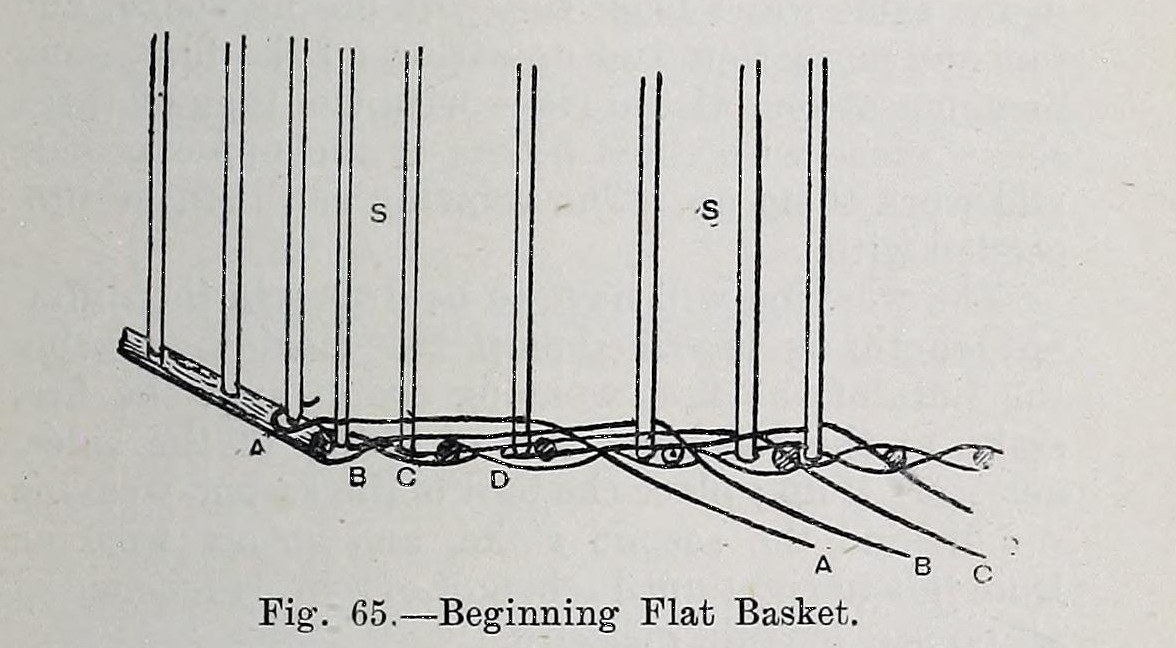


Flat Harvesting Basket: the Willow 3-Peck Fruit Flat (Hasluck, 1903)
The basket-maker's 'flat' for the fruit season: an oblong willow basket with a woven stick bottom about 19 1/2 in wide, straight sides 8 in high, a rope handle at each end and its own flat lid on a bent bow.
Rough brown osiers do for the bottom; eight white ones start the sides.
Source: Paul N. Hasluck, Basket Work of All Kinds (1903), pp. 64-69. Picture: Fig. 65 of the book.
Hejuru
Unknown
Amabwiriza
1
1
Soak the osiers and weave the bottom
Soak the osiers and weave the bottom
Soak the osiers until pliable. Cut eight sticks about 17 in long; set the two thickest in the screw-block 19 1/2 in apart outside, the rest between, and weave the bottom with the roughest osiers as for Hasluck's square basket. Take it out and trim it with the picking knife.
Ibikoresho by'iyi ntambwe:
 Inkoni z'umwitsi zinini kurushaho8 17 in
 Umugozi w'umuvumu w'amazi1 weavers
Ibikoresho bikenewe:
 Amazi
 Umukasi wo gukata amashami
 Ikibaho cy'Igiti Kiringaniye
2
2
Stake up
Stake up
Drive nine stakes into the weaving beside the sticks along each side, and seven through the sticks at each end after opening holes with the bodkin, the eight thickest at the corners. Prick them up and gather them in a hoop.
Ibikoresho by'iyi ntambwe:
 Inkingi z'umwitsi32 9 per side, 7 per end
Ibikoresho bikenewe:
 Urushinge rwinjiza umukandaUmukasi wo gukata amashami
3
3
Upset the sides
Upset the sides
Point eight white osiers. With no foot rim, start by driving four in beside the first stakes at the left of one 19 1/2 in side. Sitting high with the work between your knees, upset with four rods pulled tight into the bend of each stake, each in front of three stakes, behind the fourth and out (Fig. 65). Start the other four at the opposite corner, finish the tops round the corners, then add one more round with three rods.
Ibikoresho by'iyi ntambwe:
Umugozi w'umuvumu w'amazi8 white, upsettingIbikoresho bikenewe:
Umukasi wo gukata amashamiUrushinge rwinjiza umukanda Inyundo
4
4
Weave and add handles
Weave and add handles
Weave with rods in their lengths, each butt behind the next stake, left to right, until the sides are 8 in high all round outside. For each end handle push a stiff rod down beside the third stake, twist it rope-like, push its top through about 1 1/2 in below the top by the fifth stake, leave a bow, and twist it over the bow three times (Fig. 66).
Ibikoresho by'iyi ntambwe:
Umugozi w'umuvumu w'amazi1 weavingUmugozi w'umuvumu w'amazi2 handlesIbikoresho bikenewe:
InyundoUrushinge rwinjiza umukanda5
5
Pair off and border
Pair off and border
Pair off a round with two rods from the back. Make the border by laying down stakes and working them round the corners (Fig. 67), finish by cramming, and trim inside and out.
Ibikoresho by'iyi ntambwe:
Umugozi w'umuvumu w'amazi2 pairingIbikoresho bikenewe:
 Imikasi MininiUmukasi wo gukata amashami
6
6
Make the lid
Make the lid
Notch a bow stick at the corners, bend it to the basket's shape and tie a strainer across to hold the width. Bind in two thick split sticks a little longer than the flat, flat side inward, on four scallom rods lapped round the bow (Figs. 68-69), and weave the lid between them.
Ibikoresho by'iyi ntambwe:
Inkoni z'umwitsi zinini kurushaho3 bow, two lid sticksUmugozi w'umuvumu w'amazi1 scalloms, weaversIbikoresho bikenewe:
Umukasi wo gukata amashamiInyundoIbikoresho
3- 3 bow, two lid sticksUmwanya
- 1 scalloms, weaversUmwanya
- 32 9 per side, 7 per endUmwanya
Ibikoresho by'Ibishushanyo Bifitanye Isano

Iki gishushanyo gikora

CC0 Umurenge rusange
Iyi blueprint yasohowe munsi ya CC0. Ushobora gukoporora, guhindura, gukwirakwiza no gukoresha nta kwemererwa.
Shyigikira Umuremyi ugura ibicuruzwa binyuze muri Blueprint ye Komisiyo y'Umuremyi byashyizweho n'Abacuruzi, cyangwa kora verisiyo nshya y'iyi Blueprint ukayinjiza nk'isano muri Blueprint yawe kugira ngo musangire inyungu.