Ubufatanye
UBUHANZI
UBWIZA N'UBUZIMA
UBUKORIKORI
UMUCO N'AMATEKA
IMYIDAGADURO
IBIDUKIKIJE
IBIRIBWA N'IBINYOBWA
UBWUBATSI BUSUBIRA INYUMA
UBUMENYI
SIPORO
IKORANABUHANGA
IBYAMBARWA
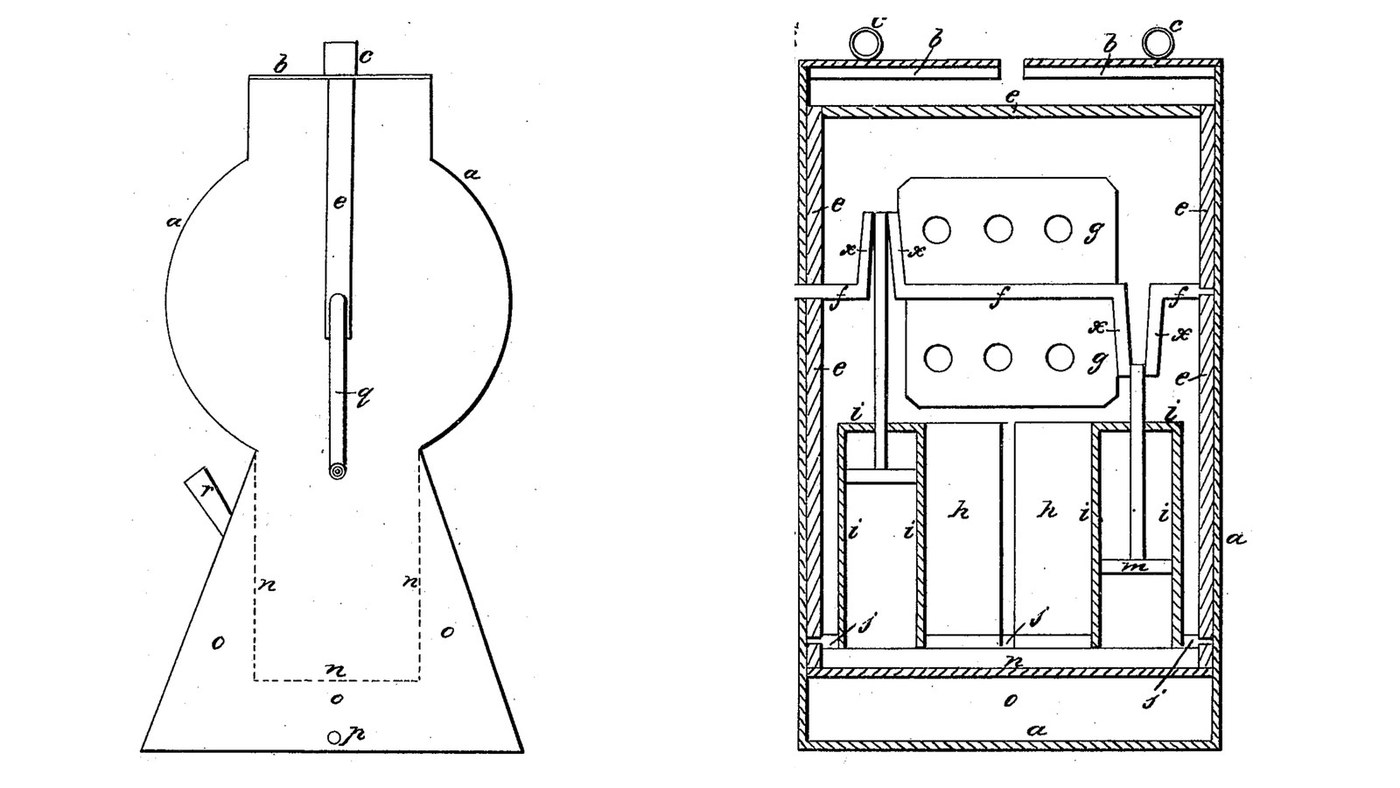

Rocking-Churns Water-Jacket Churn: Two Small Churns Rock and Their Dashers Plunge, Wings Turn Above
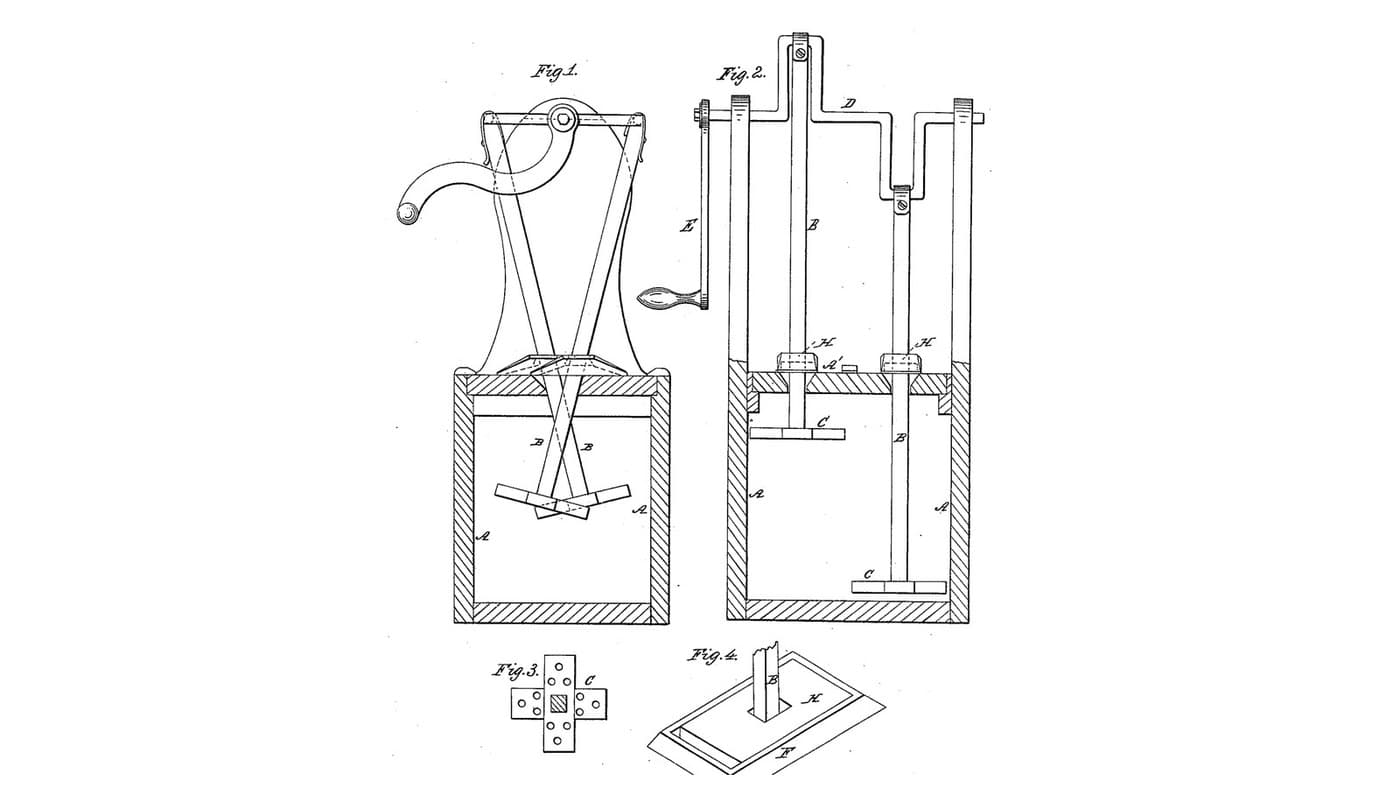
Samuel Gissinger of Allegheny, Pennsylvania, received US 25,502, dated 20 September 1859, for a churn. Inside a case with a water space under its bottom and sides, a lift-out frame holds two shafts. The upper one turns with wings on it and two cranks; from each crank a stem works a dasher inside a small churn hung on the lower shaft, so the dashers plunge while the churns and the wings between them rock. Warm or cold water in the jacket sets the cream's temperature.
The patent gives no sizes; every size here is ours. Its drawing shows the two dashers at different heights; with both churns fixed on one shaft that would bind, so here the cranks are in step.
Hejuru
About 3 days, plus printing
Amabwiriza
1
1
How a stem rocks its churn
How a stem rocks its churn
Gupakira ikaye ya Jupyter…
2
2
A churn with a water chamber, a few weeks before
A churn with a water chamber, a few weeks before
Langdon's box turned round a fixed dash-frame. Gissinger's case stands still with water under and beside it, and the dashers work inside two small churns that rock.
3
3
Read US 25,502
Read US 25,502
"Having all things arranged as represented in Fig. 1 of the drawings, the milk or cream is put in the case (a), and warm or cold water as the case may require is put in the chamber (o) at pipe (r) the exit opening being closed with a suitable stopple. And now by turning crank (q) which will revolve the shaft (f) with its wings (g), and also operate the dashers (m) and give to the churns (i) and their wings (h) an oscillating motion"
4
4
Print the churns i
Print the churns i
A churn 120 mm across and 108 mm deep with a lug under its floor bored 12.6 mm for shaft j and a cross hole for a pin. Print two. PETG, 0.2 mm layers, 40 % infill, 4 walls.
5
5
Print the dashers m
Print the dashers m
A disc 108 mm across and 8 mm thick with six 14 mm holes and a boss bored 8.4 mm for the stem. Print two. PETG, 0.2 mm layers, 40 % infill, 4 walls.
6
6
Print the wings g
Print the wings g
A paddle 60 x 96 x 6 mm with three 20 mm holes on a split hub that clamps round the 12 mm shaft with two M4 screws. Print two. PETG, 0.2 mm layers, 40 % infill, 4 walls.
7
7
Case a, chamber o, lid b
Case a, chamber o, lid b
From 20 mm hardwood make the inner case n 460 x 260 mm and 380 mm deep inside. Build the outer case round it with a 30 mm space under the bottom and along both long sides, sharing the two ends; set a spacer strip under the middle. Close the tops of the side spaces with strips, fit a short brass tube in one as the supply pipe r, and bore a hole low in the other side for a rubber stopper as the exit p. In one end cut a slot 26 mm wide from the top down to 217 mm for the crank shaft. Glue two strips 18 x 20 mm up the inside of each end, 124 mm apart, as the guides. Make the lid in two halves with a handle c on each. Fill the case and the chamber with water overnight so they swell tight, then empty them.
Ibikoresho by'iyi ntambwe:
 Ikibaho cy'Igiti Gikomeye5 ibice
 Ikinyabutabire cy'Ibiti1 igice
 Imisumari y'ibiti40 ibice
 Umuheha w'umuringa1 igice
 Ibipfundikizo by'ikawushu1 igice
 Udukoni tw'ibiti bikomeye1 igice
Ibikoresho bikenewe:
 Ikimasa cyo ku meza
 Umucumita w'Intoki
 Icyuma Cyivumbura Kidafite Insinga
 Ibyuma Byinshi byo Gucukura
 Agasanduku k'ibinyo bipfunyitse
 Icyuma cyo kubaza umwobo w'ihuzo
 Inyundo y'Igiti
 Igifashe cy'inkoni
 Igipimo cy'inguni ya dogere mirongo cyenda
 Umugozi wo Gupima
 Amazi
8
8
Frame e and the two shafts
Frame e and the two shafts
Cut two end plates 122 x 20 mm, 375 mm long, to stand between the guides, and bore each 12.8 mm at 230 mm and 40 mm up. Bend 12 mm stainless rod into the shaft f: two cranks of 40 mm throw, 280 mm apart and pointing the same way, each pin 30 mm long, heating each bend red with the torch; leave one end long enough to pass through the slot and bend it into the crank q, 130 mm long, with a hardwood handle. Cut shaft j from the same rod, 456 mm long.
Ibikoresho by'iyi ntambwe:
Ikibaho cy'Igiti Gikomeye1 igice Agati k'icyuma kitagira ingese2 ibiceUdukoni tw'ibiti bikomeye1 igiceIkinyabutabire cy'Ibiti1 igice
Ibikoresho bikenewe:
Ikimasa cyo ku mezaIcyuma Cyivumbura Kidafite InsingaIbyuma Byinshi byo Gucukura Itara rya Propane
 Ifatiro ry'Ameza
 Inyundo
 Uturindantoki twihanganira ubushyuhe
 Umucumita w'Ibyuma
 Amakariso (Ikariso ry'Intoki)
9
9
Churns, dashers, stems and wings
Churns, dashers, stems and wings
Pin the two churns on shaft j under the cranks, mouths up, and pin a hardwood wing h, 150 x 95 x 20 mm, on j between them. Cut two stems from 8 mm stainless rod, fix each in a dasher's boss, and bend its top into an eye round its crank pin so the pin sits 110 mm above the dasher, closing it with the torch and pliers. Clamp the two wings g on the shaft f between the cranks, pointing opposite ways. Put shafts f and j through the end plates and the dashers into the churns.
Ibikoresho by'iyi ntambwe:
Agati k'icyuma kitagira ingese1 igiceIkibaho cy'Igiti Gikomeye1 igice Ibitorezo by'imashini4 ibice
 Ecrou ifunga ifite umuzingo wa nayiloni4 ibice
 Agashinge gafite amaguru abiri6 ibice
 Fibere ya PETG1 igice
Ibikoresho bikenewe:
 Imashini icapa 3D ikoresha umugozi (FDM)Itara rya PropaneIfatiro ry'AmezaUturindantoki twihanganira ubushyuheUmucumita w'IbyumaIcyuma Cyivumbura Kidafite InsingaIbyuma Byinshi byo Gucukura
 Ikusanyirizo ry'ibitorezi
 Urupapuro rwo Gusya
10
10
The build in 3D
The build in 3D
FreeCAD model of this build, the case cut through its middle: the water space under and beside the inner case, the frame's end plates in their guides, the bent shaft f with its two cranks in step and its wings, the churns on shaft j with the wing between them, and the dashers on their stems. The crank was turned through 24 positions.
11
11
Churn
Churn
Stopper the exit and pour warm or cold water into the chamber through the pipe until the cream will sit at about 15 °C. Lower the frame into its guides, pour in about 22 litres of heavy cream, checking it with the thermometer, and put the lid on. Turn the crank steadily, timing it. When the butter comes, lift the frame out, gather the butter, drain the buttermilk and the chamber, wash the butter in cold water until it runs clear, salt and weigh it.
Ibikoresho by'iyi ntambwe:
 Igice cy'ibinure cy'amata22 l
 Umunyu w'inyanja munini1 igiceAmazi1 igice
Ibikoresho bikenewe:
 Igipima ubushyuhe gifite uruti rusigara mu kintu
 Isaha yo Guhagarika
 Iminzani ya Digitale yo mu Gikoni
 Ibakure rinini ryo kuvanga ry'icyuma kitagira ingese
12
12
Troubleshooting
Troubleshooting
Rocking-churns churn troubleshooting.
Flow
Loading...
13
13
History and honest limits
History and honest limits
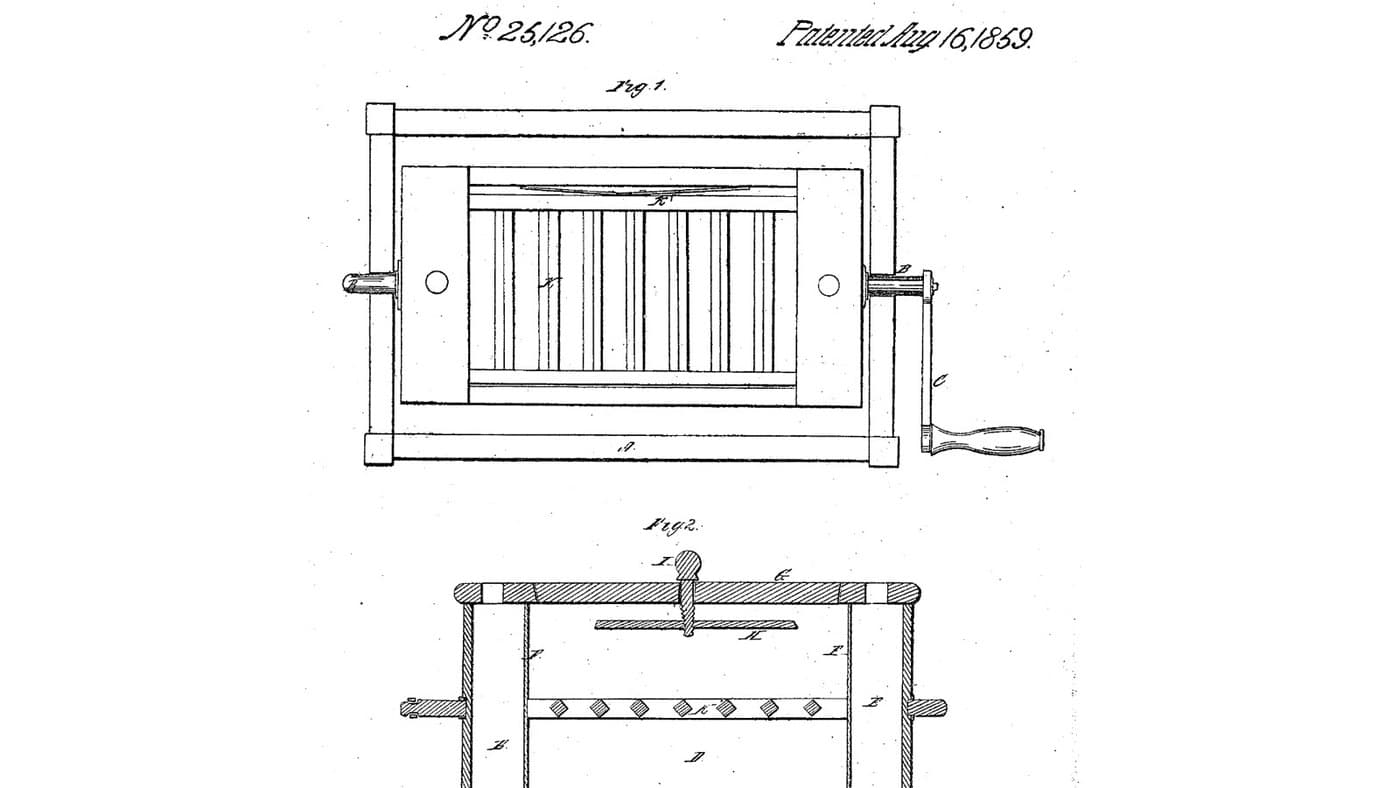
**Samuel Gissinger** of Allegheny, Pennsylvania, US 25,502, 20 September 1859, "Churn". He claimed the arrangement in the movable frame e of the oscillating churns i with dashers m and wings h, in combination with the revolving shaft f and its wings g. The patent gives no sizes; every size here is ours. His Fig. 1 draws the two dashers at different heights, but both churns are "secured to the shaft (j)": cranks out of step would push them opposite ways and bind, so ours are in step. His case is rounded at the ends and the water chamber tapered; ours is square.
Ibikoresho
14- 5 ibiceUmwanya
- 2 ibiceUmwanya
- 40 ibiceUmwanya
- 1 igiceUmwanya
- 1 igiceUmwanya
- 1 igiceUmwanya
- Umwanya
- 4 ibiceUmwanya
- Umwanya
- Umwanya
- 1 igiceUmwanya
- Umwanya
- 1 igiceUmwanya
- 1 igiceUmwanya
Ibikoresho bikenewe
24- 1 vendor sell this, none ship to you yetUmwanya
- Umwanya
- 1 vendor sell this, none ship to you yetUmwanya
- Umwanya
- Umwanya
- Umwanya
- 1 vendor sell this, none ship to you yetUmwanya
- Umwanya
- Umwanya
- Umwanya
- Umwanya
- Umwanya
- Umwanya
- Umwanya
- Umwanya
Dosiye z'igishushanyo
4Iki gishushanyo gikora

Blueprint zijyanye
Izi blueprint zisangira ubumenyi — uburyo, ibikoresho cyangwa amahame
Twin-Crank Slide-Top Churn: Two Dashers on a Bent Crank Shaft, Sliding Plates Keep the Milk In
na Buttercup
Ububaji
2
0
0
0
0
0
Water-Chamber Box Churn: A Turning Box With a Dash-Frame You Lower to Free the Butter
na Buttercup
Ububaji
2
0
0
0
0
0

Churning Butter from Cream — The 5,000-Year-Old Fat Separation
na TheChef
UBUKORIKORI
60
0
0
0
0
0
CC0 Umurenge rusange
Iyi blueprint yasohowe munsi ya CC0. Ushobora gukoporora, guhindura, gukwirakwiza no gukoresha nta kwemererwa.
Shyigikira Umuremyi ugura ibicuruzwa binyuze muri Blueprint ye Komisiyo y'Umuremyi byashyizweho n'Abacuruzi, cyangwa kora verisiyo nshya y'iyi Blueprint ukayinjiza nk'isano muri Blueprint yawe kugira ngo musangire inyungu.