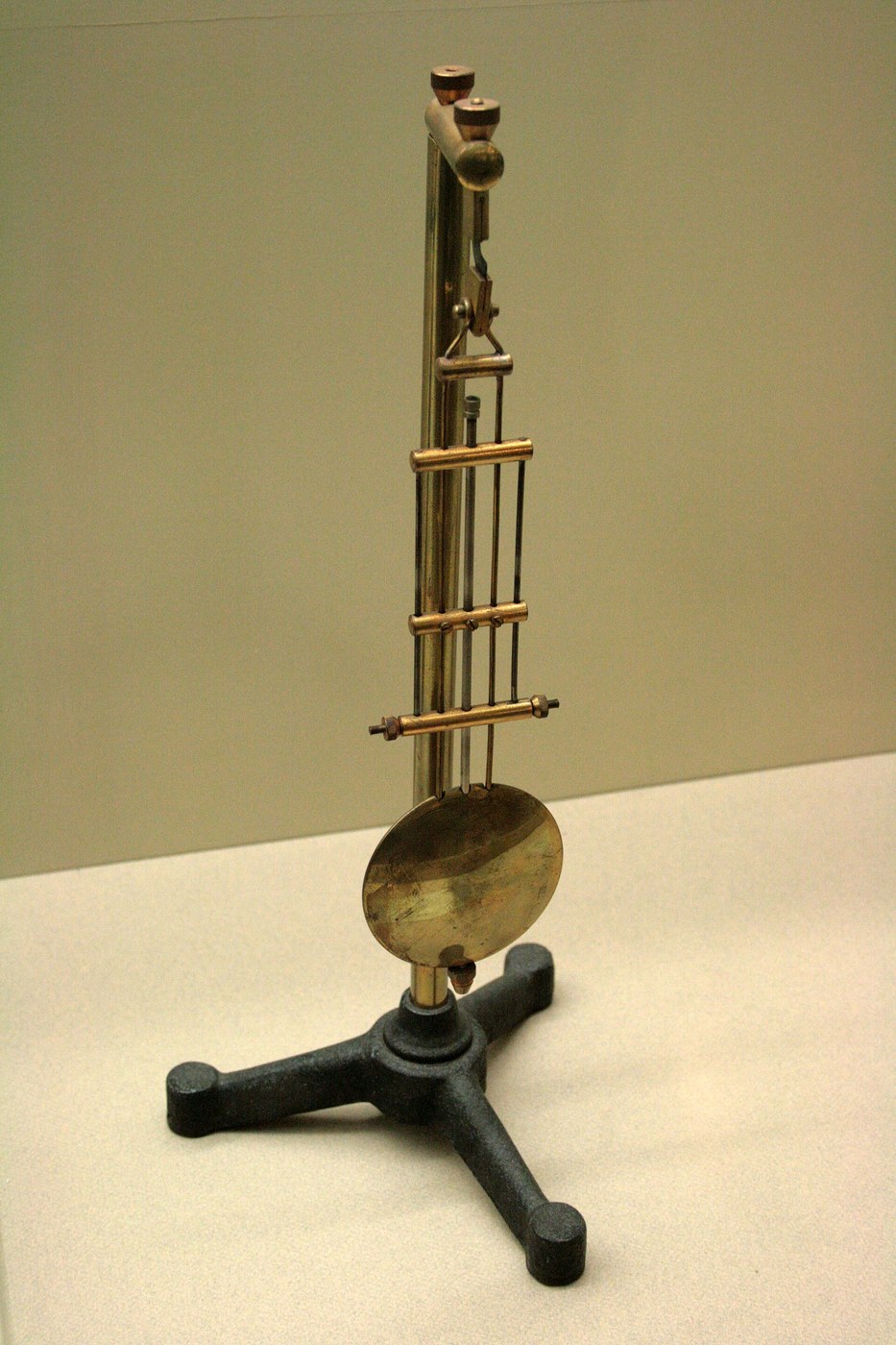


The Gridiron Pendulum
A pendulum's period depends on its length. Metal expands when warmed. Therefore a clock runs slower in summer, and there is nothing the escapement can do about it.
The numbers are worse than they sound. A steel rod expands about 11 parts per million per degree, so a seconds pendulum warmed by 10 °C lengthens by roughly 0.1 mm — and loses about five seconds a day. A regulator good to a second a day is destroyed by a warm afternoon.
You cannot stop metal expanding. So the gridiron does not try. It makes the expansion cancel itself.
Build the pendulum from alternating rods of two metals with different expansion coefficients — steel and brass — connected so that the brass rods push the bob UP while the steel rods carry it DOWN. Brass expands about 19 ppm/°C to steel's 11, so shorter brass rods can exactly offset longer steel ones.
Choose the length ratio so the two effects are equal, and the distance from suspension to bob stops changing. The parts all move; the one dimension that matters does not.
Compensation, not prevention — and a design idea far bigger than clocks.
Amabwiriza
Measure the expansion you are fighting
Measure the expansion you are fighting
Take a metre of steel wire and a metre of brass wire, hang each with a weight, and mark the exact end position. Warm each — a hairdryer, or hot water in a pipe — measuring the temperature rise and the movement.
Compute the coefficient in parts per million per degree.
Expect roughly 11 ppm/°C for steel and 19 for brass.
Then convert to clock error: a 994 mm pendulum, 10 °C warmer, lengthens about 0.1 mm and loses around five seconds a day. Write that figure down — it is the whole reason this blueprint exists.
Ibikoresho by'iyi ntambwe:
 Insinga y'Icyuma Yasizwe Zinki3 m
 Insinga y'Umuringa Yasizwe Enameli3 m
Ibikoresho bikenewe:
 Igipima Ubushyuhe
Show the clock actually cares
Show the clock actually cares
Run a simple pendulum clock in a cold room and then a warm one, for several hours each, comparing against a reliable reference.
Expect it to lose time when warm, by an amount close to your prediction from step 1.
Note that the error is not noise — it is a systematic drift that tracks the weather.
That distinction matters: random error averages away over a long run, and a systematic one does not. A clock that is wrong in a way correlated with the season cannot be fixed by watching it longer.
Get the arithmetic right before you cut anything
Get the arithmetic right before you cut anything
Work out the ratio. For the bob to stay put, the total upward push from the brass must equal the total downward push from the steel: L_brass × α_brass = L_steel × α_steel.
With 19 and 11 ppm/°C that gives brass lengths about 11/19 ≈ 0.58 of the steel lengths.
Now check the trap: it is the total length of each metal in the load path that counts, not the number of rods. A five-rod and a nine-rod gridiron can compensate identically.
Compute the ratio, then choose the rod count for stiffness and looks.
Build the frame so the pushes really oppose
Build the frame so the pushes really oppose
Assemble alternating rods on cross-bars so the steel rods hang from the suspension and carry the bob down, while the brass rods are fixed at their lower ends and push their cross-bars up.
Warm the whole assembly and watch the bob.
Expect it to stay nearly still while every rod in it visibly moves.
If the bob drifts, check the load path rather than the arithmetic: a rod that is not actually carrying the bob contributes nothing, however long it is. The most common gridiron fault is decorative rods that are not in the chain.
Find the residual and the lag
Find the residual and the lag
Run compensated and uncompensated pendulums side by side through a real temperature swing, logging both.
Expect the gridiron to be far better and not perfect.
Then change temperature quickly rather than slowly, and watch what happens during the change.
Expect a temporary error while the two metals are at different temperatures, which settles once they equalise.
That is the honest limit of every compensator: it cancels a steady state, not a transient. Brass and steel have different thermal masses, so the compensation is only correct when nothing is changing — which is why the best regulators were also kept at constant temperature.
History & Context
History & Context
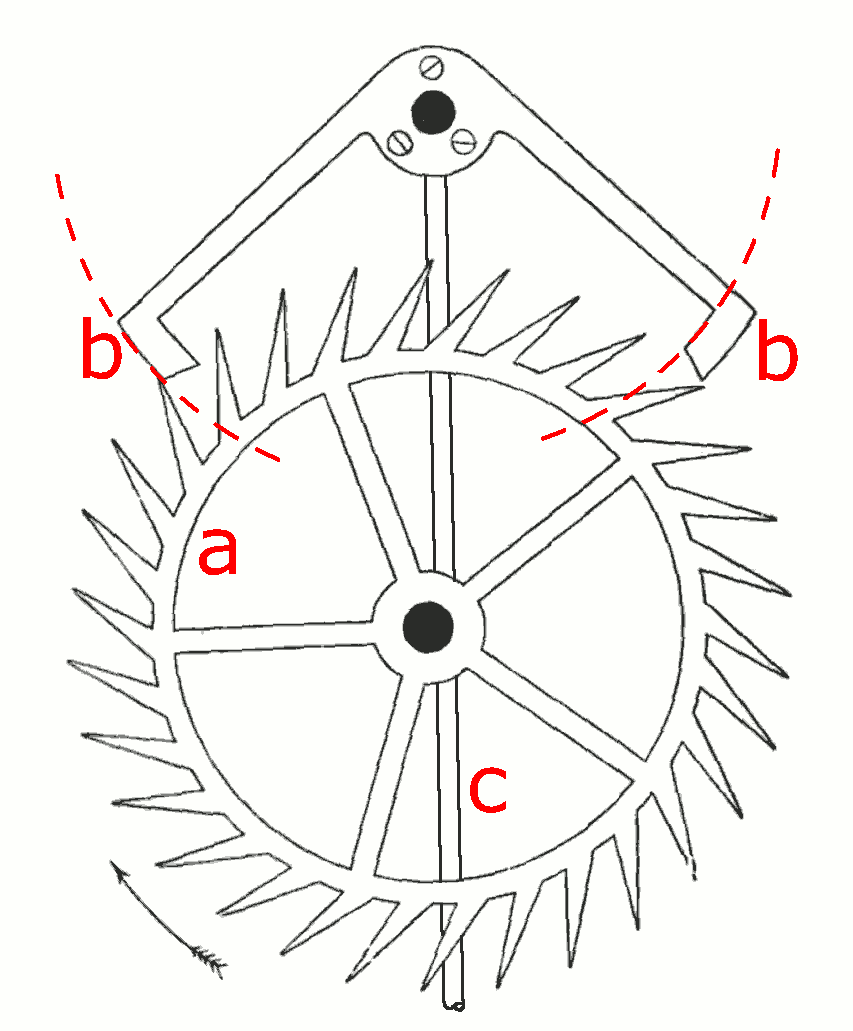
John Harrison invented it in the 1720s, before he was famous, and it belongs to the same run of work as his wooden clocks and the grasshopper escapement. Harrison was a carpenter by trade, self-taught in mechanics, and his instinct throughout was to design the error out of a mechanism rather than to demand better materials or better maintenance.
George Graham reached the same goal by another route. His mercury pendulum used a jar of mercury as the bob: as the steel rod lengthens downward, the mercury expands upward in its jar, and the centre of mass stays put. Same principle, different implementation — and mercury has the advantage of a large expansion in a compact volume, and the disadvantages of being heavy and toxic. Two independent solutions to one problem is the normal shape of invention, not the exception.
Then metallurgy made the whole idea unnecessary. Charles Édouard Guillaume developed Invar, a nickel-steel alloy with an expansion coefficient near zero, and won the Nobel Prize in Physics in 1920 for the work on nickel-steel alloys. An Invar rod does not need compensating because it barely moves. A clever mechanism was replaced by a better material — the same fate as the fusee, and a pattern worth watching for: when a compensator is elaborate, someone is usually about to invent the material that makes it redundant.
The principle outlived the pendulum entirely. Opposing two materials so their thermal errors cancel appears in the bimetallic balance later in this batch, in bimetallic thermostats, in precision measuring instruments, in engine design and in the mounting of large telescope mirrors. Whenever you cannot remove a disturbance, arrange for a second, equal, opposite one.
Honest limits. It compensates a steady temperature and lags during changes. It is heavier and more complex than a plain rod, and the extra joints introduce their own flexure and friction. It corrects length only — it does nothing for the air's changing density and buoyancy, which is a real effect on a precision pendulum and needed a barometric compensator of its own. And it must actually be built with the metals in the load path, which is easy to get subtly wrong.
Ibikoresho
2- Umwanya
- Umwanya
Ibikoresho bikenewe
1- Umwanya
Ibikoresho by'Ibishushanyo Bifitanye Isano
Blueprint zijyanye
Izi blueprint zisangira ubumenyi — uburyo, ibikoresho cyangwa amahame


CC0 Umurenge rusange
Iyi blueprint yasohowe munsi ya CC0. Ushobora gukoporora, guhindura, gukwirakwiza no gukoresha nta kwemererwa.
Shyigikira Umuremyi ugura ibicuruzwa binyuze muri Blueprint ye Komisiyo y'Umuremyi byashyizweho n'Abacuruzi, cyangwa kora verisiyo nshya y'iyi Blueprint ukayinjiza nk'isano muri Blueprint yawe kugira ngo musangire inyungu.