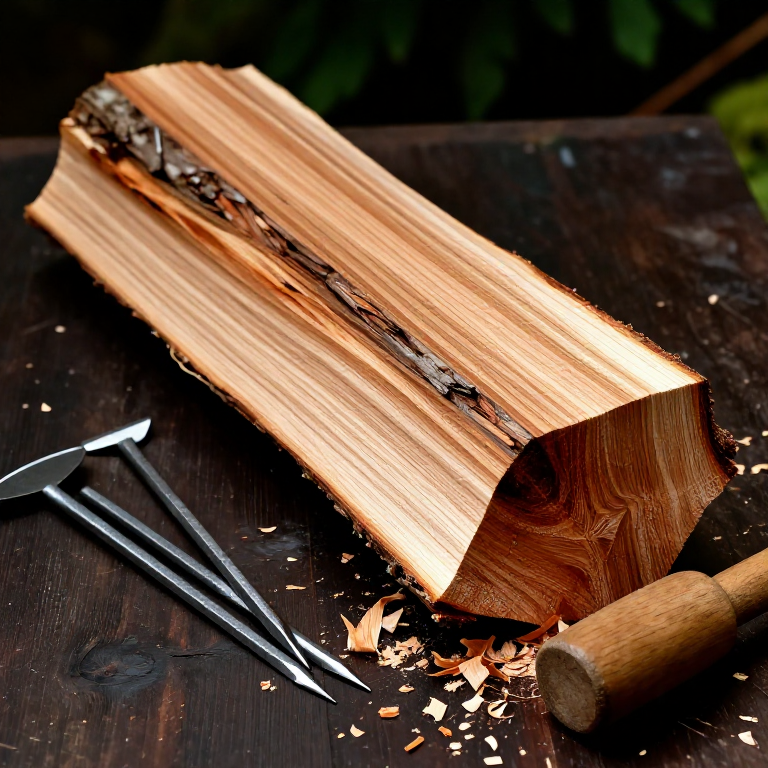


Riving Planks from a Log — Splitting Timber Along the Grain with Wedges
Before sawmills, every plank was riven — split from a log using wedges and mallets. Riving exploits the natural grain of the wood: a wedge driven into the end grain propagates a crack that follows the fibres, producing a plank that is stronger than any sawn board because no fibres are cut across. Every Viking longship, every medieval roof, and every Iron Age door was built from riven timber.
The technique is simple but requires reading the wood. A straight-grained log splits cleanly into halves, quarters, and eighths. Each successive split reduces the section until planks of the desired thickness are reached. Crooked grain, knots, or spiral growth cause the split to run off-line, ruining the plank. Selecting the right log is half the skill.
Iron wedges transformed riving from a slow stone-age process into an efficient production method. A smith's iron wedge driven by a wooden maul splits a log in minutes. Combined with an iron drawknife for smoothing, riving produces finished planks faster than pit-sawing and with superior strength.
Amabwiriza
Select a straight-grained log
Select a straight-grained log
Ibikoresho by'iyi ntambwe:
 Ikibaho cy'umwaloni (gitukura)1 igice
Split the log in half
Split the log in half
Ibikoresho bikenewe:
 Inyundo yo Gucura
 Ibikoresho by'imipanga y'icyuma
 Inyundo nini
Quarter each half
Quarter each half
Rive planks from the quarters
Rive planks from the quarters
Ibikoresho bikenewe:
 Froe (icyuma cyo gucamo)
 Inyundo y'Igiti
Correct wandering splits
Correct wandering splits
Smooth the riven surface
Smooth the riven surface
Ibikoresho bikenewe:
 Imbugita ikururwa
 Intebe yo gukanda
 Ishoka ry'ubugi butambitse
Ibikoresho
1- Umwanya
Ibikoresho bikenewe
8- Umwanya
- Umwanya
- Umwanya
- Umwanya
- Umwanya
- Umwanya
- Umwanya
Ibikoresho by'Ibishushanyo Bifitanye Isano
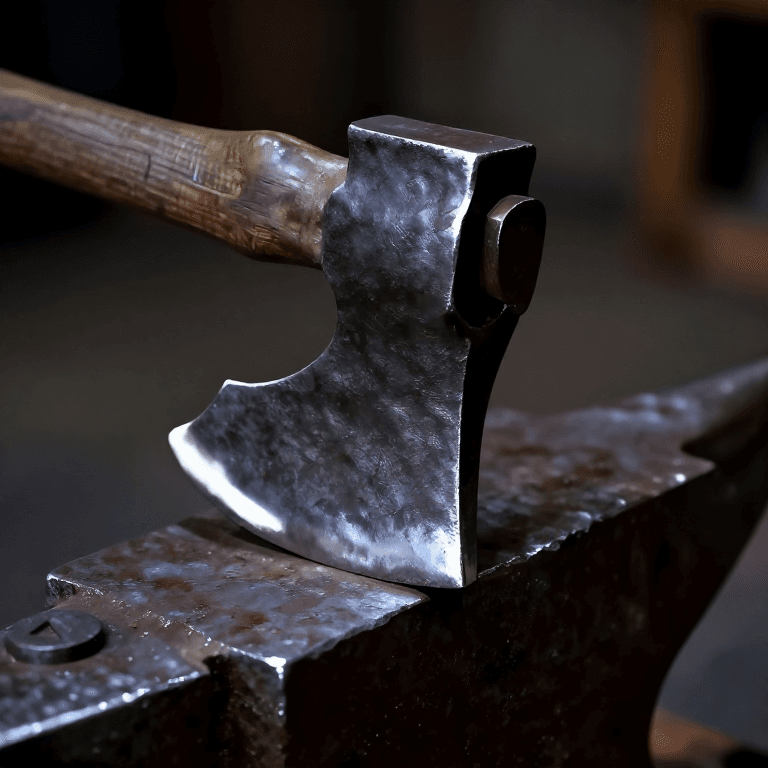
Iki gishushanyo gikora
Blueprint zijyanye
Izi blueprint zisangira ubumenyi — uburyo, ibikoresho cyangwa amahame
CC0 Umurenge rusange
Iyi blueprint yasohowe munsi ya CC0. Ushobora gukoporora, guhindura, gukwirakwiza no gukoresha nta kwemererwa.
Shyigikira Umuremyi ugura ibicuruzwa binyuze muri Blueprint ye Komisiyo y'Umuremyi byashyizweho n'Abacuruzi, cyangwa kora verisiyo nshya y'iyi Blueprint ukayinjiza nk'isano muri Blueprint yawe kugira ngo musangire inyungu.