Ubufatanye
UBUHANZI
UBWIZA N'UBUZIMA
UBUKORIKORI
UMUCO N'AMATEKA
IMYIDAGADURO
IBIDUKIKIJE
IBIRIBWA N'IBINYOBWA
UBWUBATSI BUSUBIRA INYUMA
UBUMENYI
SIPORO
IKORANABUHANGA
IBYAMBARWA
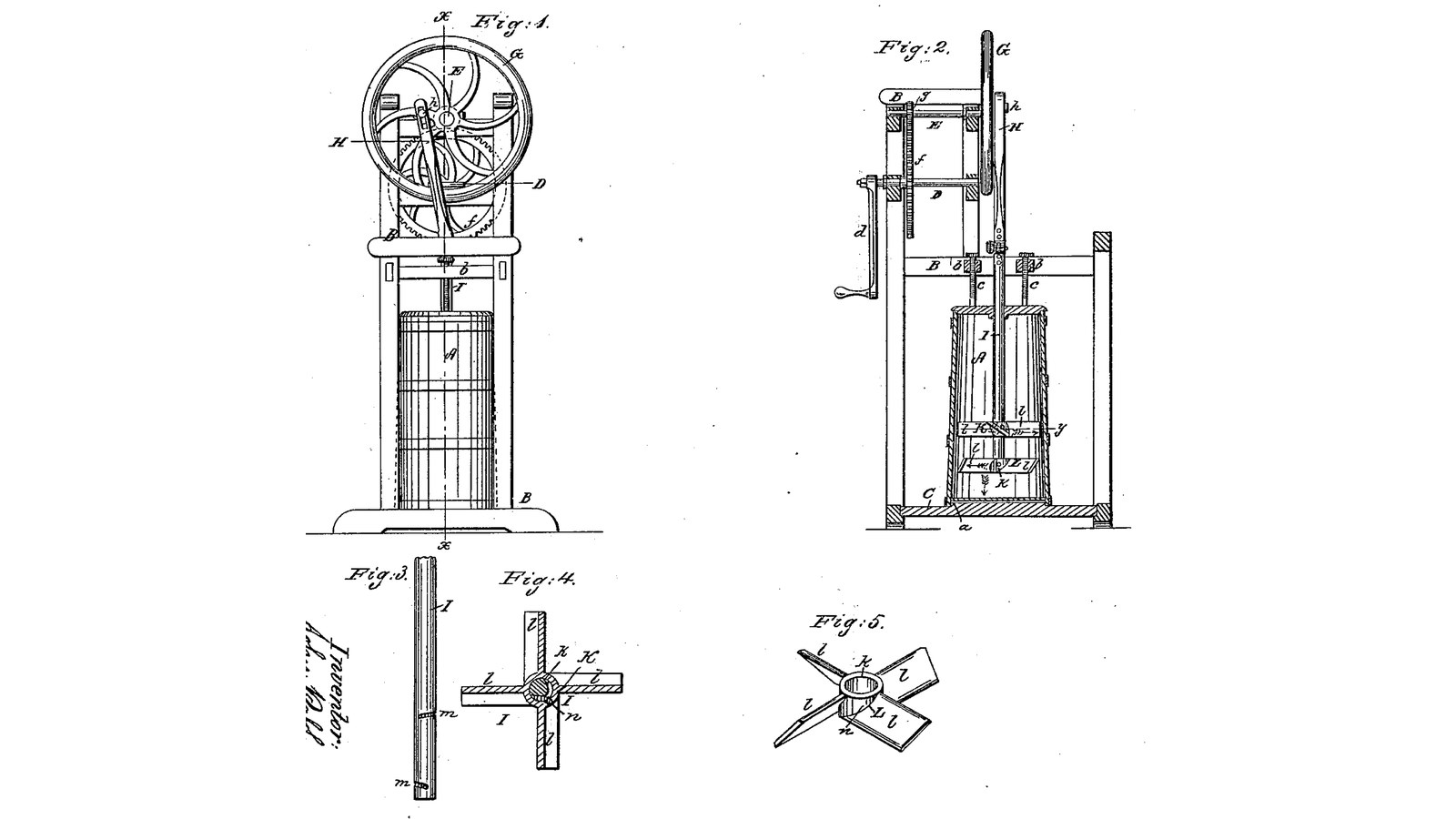

Twin Loose-Dasher Churn: A Flywheel and Pitman Plunge a Rod, Two Winged Dashers Riding Loose on It Turn Opposite Ways
John Paff of Eden, New York, received US 29,189, dated 17 July 1860, for a plunge churn worked by a winch, gears, a flywheel and a pitman. Its rod carries two dashers with sloping wings, the lower sloped one way and the upper the other. They are not fixed: a pin in each hub runs in a short groove round the rod, so the cream pushing on the wings turns the two dashers opposite ways on every stroke, and back on the return. The churn body is held down by two screws.
The patent gives no sizes; every size here is ours.
Hagati
About 3 days
Amabwiriza
1
1
Stroke and the turning dashers
Stroke and the turning dashers
Gupakira ikaye ya Jupyter…
2
2
A dasher turned by its own wings, four months before
A dasher turned by its own wings, four months before
Stanford's one dasher spins freely all the way round. Paff's two are held to a quarter turn by pin and groove, and turn opposite ways.
3
3
Read US 29,189
Read US 29,189
"The dashers being arranged thus loosely on the dasher-rod, and guided and held by means of the grooves m, m, and pins n, n, it will be seen that if they are forced down through the milk or cream, that they will have, in addition to their vertical motion, a horizontal motion imparted to them, by means of the resistance of the fluid on their inclined wings; the lower dasher turning in one direction, while the upper dasher turns in the opposite direction."
4
4
Frame B, bed C, ring a, cross-pieces b and screws c
Frame B, bed C, ring a, cross-pieces b and screws c
Glue up hardwood for a bed C 450 x 420 x 25 mm and two sides 310 mm deep and 900 mm tall, and screw the sides onto the bed 400 mm apart, flush at the back and open at the front. Cut a ring a 20 mm thick, 330 mm outside and 283 inside, and screw it to the bed centred 170 mm from the front, so the bucket's foot just drops into it. Join the sides at the back with a rail 50 mm deep, 400 mm up. Tenon two cross-pieces b, 40 x 50 mm, into the rail, 300 mm apart between centres, reaching forward over the bucket. Let a hex nut into the underside of each over the bucket's rim, and run an M10 threaded rod through it as a screw c, with two nuts locked on top as its head and a washer under its foot. Screw a guide bar 260 x 40 x 25 mm between the cross-pieces over the bucket's centre, with a 29 mm slot open to the front.
Ibikoresho by'iyi ntambwe:
 Ikibaho cy'Igiti Gikomeye4 ibice
 Ikinyabutabire cy'Ibiti1 igice
 Imisumari y'ibiti40 ibice
 Inkoni ifite imirongo1 igice
 Umupira w'Impande Esheshatu6 ibice
 Uruziga Rurambuye2 ibice
Ibikoresho bikenewe:
 Ikimasa cyo ku meza
 Umucumita wa Jigsaw
 Ikirangamurongo
 Ibikoresho by'amasuka y'igiti
 Icyuma Cyivumbura Kidafite Insinga
 Ibyuma Byinshi byo Gucukura
 Agasanduku k'ibinyo bipfunyitse
 Igifashe cy'inkoni
 Ikusanyirizo ry'ibitorezi
 Isupana ihindurwa
 Umugozi wo Gupima
5
5
Body A and cover
Body A and cover
Use a 20-litre food-grade bucket as the body A. Cut a 12 mm HDPE cover to the bucket's top, 304 mm across, with a 32 mm hole in the middle for the rod.
Ibikoresho by'iyi ntambwe:
 Indobo ya Litiro 201 igice
 Urupapuro rwa HDPE1 igice
Ibikoresho bikenewe:
Umucumita wa JigsawAgasanduku k'ibinyo bipfunyitseIcyuma Cyivumbura Kidafite Insinga Amakariso (Ikariso ry'Intoki)
6
6
Print the cog-wheel f
Print the cog-wheel f
The cog-wheel f on the winch shaft D: 60 teeth, module 2.5, 15 mm thick with a hub, 16.2 mm bore. PETG, 0.2 mm layers, 30 % infill, 4 walls.
7
7
Print the pinion g
Print the pinion g
The pinion g on the flywheel shaft E: 20 teeth, module 2.5, 16.2 mm bore. PETG, 0.2 mm layers, 30 % infill, 4 walls.
8
8
Shafts D and E, gears, winch d and flywheel G
Shafts D and E, gears, winch d and flywheel G
Cut two hardwood bearing boards 400 x 340 x 25 mm and screw them between the sides, 80 and 200 mm behind the bucket's centre, their tops flush with the sides, so they stand 560 to 900 mm up. Bore both 16.6 mm at 725 mm up for the shaft E and at 625 mm for the shaft D, over the bucket's centre. Cut stainless rod 16 mm for E, 218 mm long, and D, 255 mm long. Pin the pinion g on E and the wheel f on D behind the back board with split pins, meshing, and hold both shafts with shaft collars. Pin a winch d of mild steel flat bar, 120 mm throw, with a hardwood handle, on D's back end. Cut a flywheel G 300 mm across from two 15 mm hardwood boards glued crossgrain, bore it 16 mm at the centre and 10.4 mm at 45, 60 and 75 mm out, and fix it on E's front end between two shaft collars.
Ibikoresho by'iyi ntambwe:
Ikibaho cy'Igiti Gikomeye2 ibice Agati k'icyuma kitagira ingese1 igice
 Shaft Collar6 ibice
 Agashinge gafite amaguru abiri4 ibice
 Umurongo ugororotse w'icyuma cyoroshye1 igice
 Udukoni tw'ibiti bikomeye1 igiceIkinyabutabire cy'Ibiti1 igiceImisumari y'ibiti16 ibice
 Fibere ya PETG1 igice
Ibikoresho bikenewe:
 Imashini icapa 3D ikoresha umugozi (FDM)Ikimasa cyo ku mezaUmucumita wa JigsawIkirangamurongoIcyuma Cyivumbura Kidafite InsingaIbyuma Byinshi byo Gucukura
 Umucumita w'IbyumaAmakariso (Ikariso ry'Intoki)
 Ifatiro ry'AmezaIgifashe cy'inkoniIkusanyirizo ry'ibitoreziIsupana ihindurwa
9
9
Print the lower dasher K
Print the lower dasher K
Dasher K: a hub 50 mm across and 50 long on a 28.8 mm bore, four wings 210 mm across, 45 wide and 5 thick, all pitched 35 degrees one way, and a 4.2 mm radial hole for its pin n. PETG, 0.2 mm layers, 30 % infill, 4 walls.
10
10
Print the upper dasher L
Print the upper dasher L
Dasher L: the same as K with its wings pitched 35 degrees the other way. PETG, 0.2 mm layers, 30 % infill, 4 walls.
11
11
Dasher rod I, grooves m, pins n and pitman H
Dasher rod I, grooves m, pins n and pitman H
Cut a 28 mm hardwood dowel 440 mm long for the rod I and bore it 10.4 mm across, 15 mm from the top, for the pin i. Mark a groove m 30 mm from the foot and another 120 mm from the foot. Cut each with a gouge 6 mm wide and 4 deep, a quarter of the way round the rod, rising 6 mm as it goes; the two run opposite ways from their starts. Slide the dasher K up the rod to the lower groove and L to the upper, and drive an M5 stainless screw, its point filed round, into each hub's hole until the point rides in the groove without binding: the pins n. Cut a hardwood pitman H 30 x 15 mm, 230 mm long, bored 10.4 mm at both ends 200 mm apart. Bolt its top to the flywheel's 60 mm hole as the pivot h, stand the rod in the bucket through the cover and the guide slot, and bolt the pitman's foot to it as the pin i, with lock nuts and washers.
Ibikoresho by'iyi ntambwe:
Udukoni tw'ibiti bikomeye1 igice Ibitorezo by'imashini2 ibice
 Icyegeranyo cy'inyuzi z'impande esheshatu2 ibice
 Ecrou ifunga ifite umuzingo wa nayiloni2 ibiceUruziga Rurambuye4 ibiceIkibaho cy'Igiti Gikomeye1 igice
Ibikoresho bikenewe:
 Ibikoresho by'ibyuma byo gucukura ibitiIbikoresho by'amasuka y'igitiIkimasa cyo ku mezaIcyuma Cyivumbura Kidafite InsingaIbyuma Byinshi byo GucukuraAmakariso (Ikariso ry'Intoki)Ikusanyirizo ry'ibitoreziIsupana ihindurwaUmugozi wo Gupima
12
12
The build in 3D
The build in 3D
FreeCAD model of this build, the bucket cut open: the frame with its bed, ring, cross-pieces, screws and guide, the winch, gears and flywheel, the pitman, and the rod with the two dashers whose wings slope opposite ways.
13
13
Churn
Churn
Pour about 12 litres of heavy cream at about 15 °C, checked with the thermometer, into the bucket, set it in the ring with the dashers in, put on the cover and turn the screws c down onto it. Bolt the pitman to the rod, and turn the winch steadily, timing it; move the pivot h to the 45 or 75 mm hole for a shorter or longer stroke. When the butter comes, unbolt the pin i, slip the rod forward out of the guide slot, turn back the screws, draw the bucket out and lift out the dashers. Take out the butter, pour the buttermilk into a bowl, wash the butter in cold water until it runs clear, salt and weigh it.
Ibikoresho by'iyi ntambwe:
 Igice cy'ibinure cy'amata12 l
 Umunyu w'inyanja munini1 igice
 Amazi1 igice
Ibikoresho bikenewe:
 Igipima ubushyuhe gifite uruti rusigara mu kintu
 Isaha yo Guhagarika
 Iminzani ya Digitale yo mu Gikoni
 Ibakure rinini ryo kuvanga ry'icyuma kitagira ingeseIsupana ihindurwa
14
14
Troubleshooting
Troubleshooting
Loose-dasher churn troubleshooting.
Flow
Loading...
15
15
History and honest limits
History and honest limits
**John Paff** of Eden, Erie County, New York, US 29,189, 17 July 1860, "Churn". He claimed "the dashers K, and L, provided with inclined wings l, l, as described, secured one above the other, loosely on the dasher-rod I, the connection with said dasher-rod being effected by means of the grooves m, m, and pins n, n". He knew inclined wings fixed to the rod and two fixed dashers had been used before. His body was the usual staved churn, its chimes fitting over a raised circle on the bed; ours is a bucket in a ring round its foot. The patent gives no sizes and does not say how far the grooves run; every size here is ours.
Ibikoresho
20- 4 ibiceUmwanya
- 2 ibiceUmwanya
- 56 ibiceUmwanya
- 1 igiceUmwanya
- 6 ibiceUmwanya
- 6 ibiceUmwanya
- 1 igiceUmwanya
- 1 igiceUmwanya
- Umwanya
- 6 ibiceUmwanya
- Umwanya
- Umwanya
- 1 igiceUmwanya
- 1 igiceUmwanya
- 2 ibiceUmwanya
- Umwanya
- Umwanya
- Umwanya
- 1 igiceUmwanya
- 1 igiceUmwanya
Ibikoresho bikenewe
20- 1 vendor sell this, none ship to you yetUmwanya
- 1 vendor sell this, none ship to you yetUmwanya
- Umwanya
- 1 vendor sell this, none ship to you yetUmwanya
- Umwanya
- Umwanya
- Umwanya
- Umwanya
- 1 vendor sell this, none ship to you yetUmwanya
- Umwanya
- Umwanya
- Umwanya
Dosiye z'igishushanyo
5Iki gishushanyo gikora


Blueprint zijyanye
Izi blueprint zisangira ubumenyi — uburyo, ibikoresho cyangwa amahame
Spiral-Wing Spheroid Churn: A Ball Dasher on Balls Turns Freely on Its Rod, Its Spiral Wings Spinning It Each Stroke
na Buttercup
Ububaji
0
0
0
0
0
0
Geared Crank-Frame Churn: A Frame Over an Ordinary Churn Gears a Hand Crank Up to Drive a Grated Dasher by Pitman
na Buttercup
Ububaji
1
0
0
0
0
0
Twin Inclined-Wing Dasher Churn: Two Geared Dashers With Up- and Down-Sloping Wings Turn Through Each Other, Flat Wings Between
na Buttercup
Ububaji
0
0
0
0
0
0

Churning Butter from Cream — The 5,000-Year-Old Fat Separation
na TheChef
UBUKORIKORI
60
0
0
0
0
0
CC0 Umurenge rusange
Iyi blueprint yasohowe munsi ya CC0. Ushobora gukoporora, guhindura, gukwirakwiza no gukoresha nta kwemererwa.
Shyigikira Umuremyi ugura ibicuruzwa binyuze muri Blueprint ye Komisiyo y'Umuremyi byashyizweho n'Abacuruzi, cyangwa kora verisiyo nshya y'iyi Blueprint ukayinjiza nk'isano muri Blueprint yawe kugira ngo musangire inyungu.