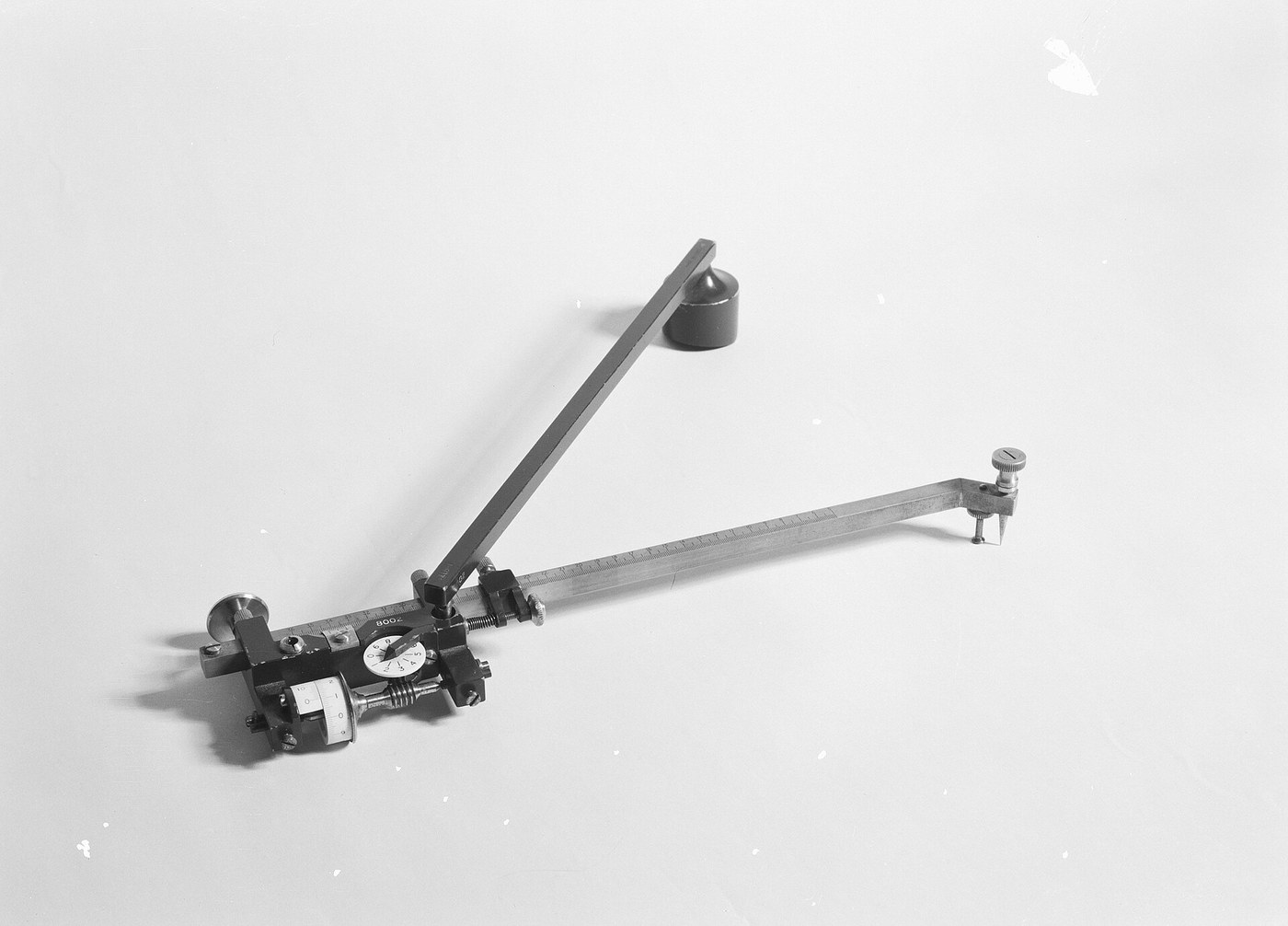


Planimeter
Amabwiriza
Do it the hard way once
Do it the hard way once
Earn the instrument by suffering the alternative.
- Draw an irregular closed shape on graph paper.
- Count the whole squares inside; estimate the partial ones.
- Record your area and how long it took.
Ibikoresho bikenewe:
 Umurongo w'ipima
Make the measuring wheel
Make the measuring wheel
One wheel with one very particular property.
- Mount a small wheel so its axle is fixed rigidly to an arm.
- Roll the arm along the wheel's rolling direction — the wheel turns.
- Slide the arm SIDEWAYS, along the axle direction — the wheel skids and does not turn.
Ibikoresho by'iyi ntambwe:
 Umurongo w'Umuringa w'Umuhondo1 length
 Bearing y'utubumbe1 igice
Assemble the polar linkage
Assemble the polar linkage
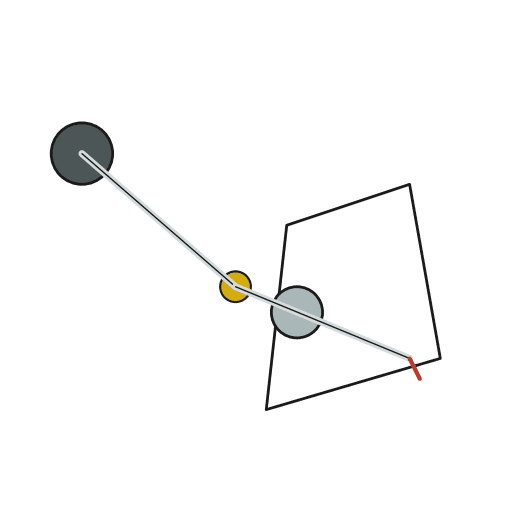
Two arms: one anchored to the table, one carrying the tracer.
- Pin a pole arm to a fixed point on the paper so it can only pivot.
- Hinge a tracer arm to its far end, with the measuring wheel on it.
- Put the tracing point at the end of the tracer arm.
Trace and calibrate
Trace and calibrate
Calibrate on a shape whose area you already know.
- Zero the wheel and trace a rectangle of known area, clockwise, returning exactly to the start.
- Note the wheel reading and compute area per unit reading.
- Now trace your irregular shape and convert.
- Trace it the other way round and note the sign reverses.
Test the surprising part
Test the surprising part
The result depends on area alone, and you can prove it.
- Trace a shape and record the reading.
- Trace a completely different shape of the same area — a long thin rectangle against a square.
- Compare the readings.
History and context
History and context
Jacob Amsler (1823-1912) was a Swiss mathematician who gave up an academic career to make instruments in Schaffhausen. Earlier planimeters existed — Johann Martin Hermann's from 1814, and others by Gonnella and Maxwell — but they were expensive and awkward. Amsler's polar planimeter of 1854 was simple, small, and cheap enough to be standard equipment. His workshop reportedly made tens of thousands of them.
The killer application was the steam engine. An indicator diagram plots pressure inside a cylinder against piston position through a cycle, and the AREA of that closed loop is the work done per cycle. Every engine being tested produced these diagrams, and every one needed its area measured. A planimeter turned an afternoon of square-counting into a minute's tracing, and it did it more accurately.
What it demonstrates about mathematics is more interesting than what it measures. Green's theorem relates an integral over a region to an integral around its boundary. That sounds abstract, and here it is a small brass linkage that a surveyor used without knowing the theorem's name. The same boundary-to-interior relationship underlies Stokes' theorem, the divergence theorem, and a great deal of physics.
Superseded but not obsolete: digitising tablets and image analysis do this work now. Planimeters are still used where a physical drawing must be measured without being digitised, and they remain the clearest teaching demonstration of an integral theorem that exists.
Ibikoresho
2- 1 lengthUmwanya
- Umwanya
Ibikoresho bikenewe
1- Umwanya
Iki gishushanyo gikora
Blueprint zijyanye
Izi blueprint zisangira ubumenyi — uburyo, ibikoresho cyangwa amahame
CC0 Umurenge rusange
Iyi blueprint yasohowe munsi ya CC0. Ushobora gukoporora, guhindura, gukwirakwiza no gukoresha nta kwemererwa.
Shyigikira Umuremyi ugura ibicuruzwa binyuze muri Blueprint ye Komisiyo y'Umuremyi byashyizweho n'Abacuruzi, cyangwa kora verisiyo nshya y'iyi Blueprint ukayinjiza nk'isano muri Blueprint yawe kugira ngo musangire inyungu.