UBUHANZI
UBWIZA N'UBUZIMA
UBUKORIKORI
UMUCO N'AMATEKA
IMYIDAGADURO
IBIDUKIKIJE
IBIRIBWA N'IBINYOBWA
UBWUBATSI BUSUBIRA INYUMA
UBUMENYI
SIPORO
IKORANABUHANGA
IBYAMBARWA
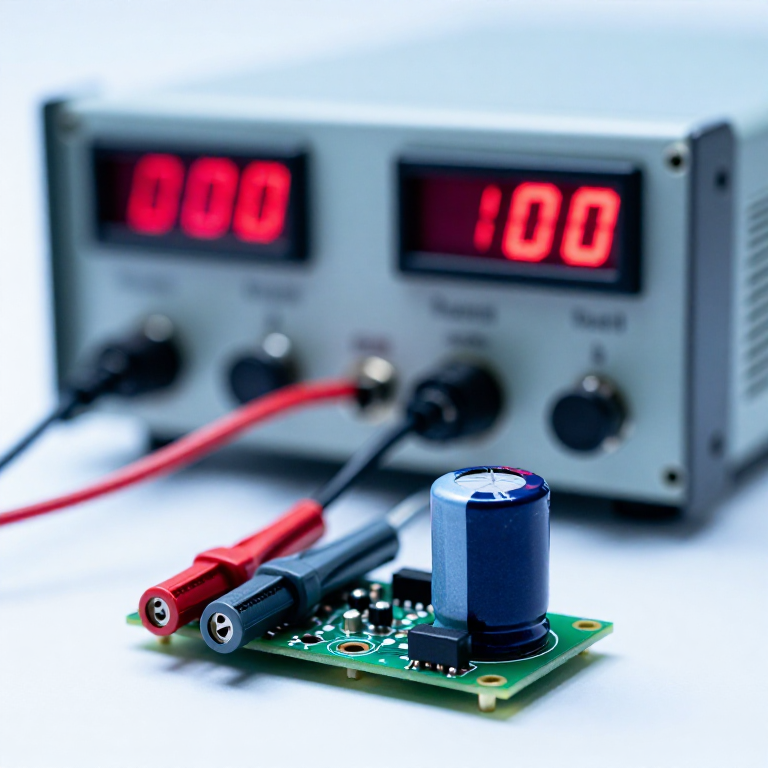


Power: Why It Works on USB and Dies on a Battery
A circuit that works on the bench and misbehaves on batteries is not haunted. It is almost always one of three things: the supply cannot deliver the current, the wiring drops too much voltage on the way, or nothing is smoothing the moment a load switches on.
The symptoms are strange enough to look like software faults — a microcontroller that resets whenever a motor starts, a display that flickers on a keypress, a circuit that is fine until the battery is half used. All three are power.
Which makes power the last rung of this ladder: it is what remains after the joint is sound, the meter is understood, and the fault-finding has ruled out the obvious.
Hagati
3 hours
Amabwiriza
1
1
A supply has an internal resistance, and so does a battery
A supply has an internal resistance, and so does a battery
Gupakira ikaye ya Jupyter…
Ibikoresho bikenewe:
 Isoko ry'Amashanyarazi ryo ku Meza
 Igipimo cy'amashanyarazi kinyuranye
 Ikibariro
2
2
Decoupling: the small capacitor next to every chip
Decoupling: the small capacitor next to every chip
Put a 100 nF ceramic capacitor between the supply and ground pins of every integrated circuit, as physically close to the pins as you can manage.
A digital chip draws current in sharp spikes every time its outputs switch. The supply wiring has inductance and cannot deliver a spike quickly, so the local voltage dips — and the chip sees its own supply flicker. The decoupling capacitor is a tiny local reservoir that supplies the spike from millimetres away instead of from the far end of the board.
This is why it must be CLOSE. A decoupling capacitor at the other end of the board is connected through the very inductance it exists to bypass, and does almost nothing. It is the most-omitted component in beginner circuits and the cause of a great deal of unexplained flakiness.
Ibikoresho by'iyi ntambwe:
 Agafuka k'ibibiko by'amashanyarazi1 igice
Ibikoresho bikenewe:
 Ikibaho cy'Ibizamini
 Osilosikopu
3
3
Bulk capacitance for the things that gulp
Bulk capacitance for the things that gulp
Add a larger electrolytic — a few hundred microfarads — near anything that switches a heavy load: a motor, a relay, a string of LEDs, a servo.
Decoupling handles nanosecond spikes; this handles millisecond gulps. The bulk capacitor charges gently between events and hands the charge over quickly when the load switches, so the rail stays up and the processor survives the motor start.
Mind the polarity — electrolytics are marked with a stripe on the negative side and fitted backwards they heat, swell and eventually vent. That is the single most common way a beginner destroys a component, and the visual check in the fault-finding rung exists largely because of it.
Ibikoresho by'iyi ntambwe:
Agafuka k'ibibiko by'amashanyarazi1 igiceIbikoresho bikenewe:
Ikibaho cy'IbizaminiIgipimo cy'amashanyarazi kinyuranye Indorerwamo Yagura
4
4
Give the motor its own path back
Give the motor its own path back
Run the motor's supply and ground as their own pair of wires back to the source, rather than letting the motor current share the thin wire your sensitive circuit uses for ground.
Ground is not a perfect conductor. An amp flowing down a wire with a tenth of an ohm of resistance lifts one end a hundred millivolts above the other — so the logic's idea of 'zero volts' moves whenever the motor draws current. That shifts every signal referenced to it, which is why an analogue reading wanders exactly when the motor runs.
Joining the two grounds at ONE point near the supply — rather than daisy-chaining through the motor — keeps the noisy current out of the quiet circuit's reference. That is the whole idea behind a star ground, and it is free.
Ibikoresho bikenewe:
Isoko ry'Amashanyarazi ryo ku MezaIgipimo cy'amashanyarazi kinyuranye Igikoresho cyo gukuramo igifuniko cy'insinga
5
5
Measure the sag yourself
Measure the sag yourself
Put the meter across the supply rail AT the circuit and watch it while the load switches on. A meter is slow, so it will understate a brief dip — but a visible drop on a slow instrument means a much deeper one in reality.
An oscilloscope shows the true shape: how far the rail falls, how long it takes to recover, and whether the decoupling is doing anything. If you have one, this is the measurement that turns 'it randomly resets' into a number.
Then add the bulk capacitor and measure again. Seeing the dip shrink is the most convincing argument for decoupling anyone ever gets, and it takes five minutes.
Ibikoresho by'iyi ntambwe:
Agafuka k'ibibiko by'amashanyarazi1 igiceIbikoresho bikenewe:
Igipimo cy'amashanyarazi kinyuranyeOsilosikopuIsoko ry'Amashanyarazi ryo ku MezaIbikoresho bikenewe
7- Umwanya
- 1 vendor sell this, none ship to you yetUmwanya
- Umwanya
- Umwanya
Blueprint zijyanye
Izi blueprint zisangira ubumenyi — uburyo, ibikoresho cyangwa amahame

CC0 Umurenge rusange
Iyi blueprint yasohowe munsi ya CC0. Ushobora gukoporora, guhindura, gukwirakwiza no gukoresha nta kwemererwa.
Shyigikira Umuremyi ugura ibicuruzwa binyuze muri Blueprint ye Komisiyo y'Umuremyi byashyizweho n'Abacuruzi, cyangwa kora verisiyo nshya y'iyi Blueprint ukayinjiza nk'isano muri Blueprint yawe kugira ngo musangire inyungu.