UBUHANZI
UBWIZA N'UBUZIMA
UBUKORIKORI
UMUCO N'AMATEKA
IMYIDAGADURO
IBIDUKIKIJE
IBIRIBWA N'IBINYOBWA
UBWUBATSI BUSUBIRA INYUMA
UBUMENYI
SIPORO
IKORANABUHANGA
IBYAMBARWA
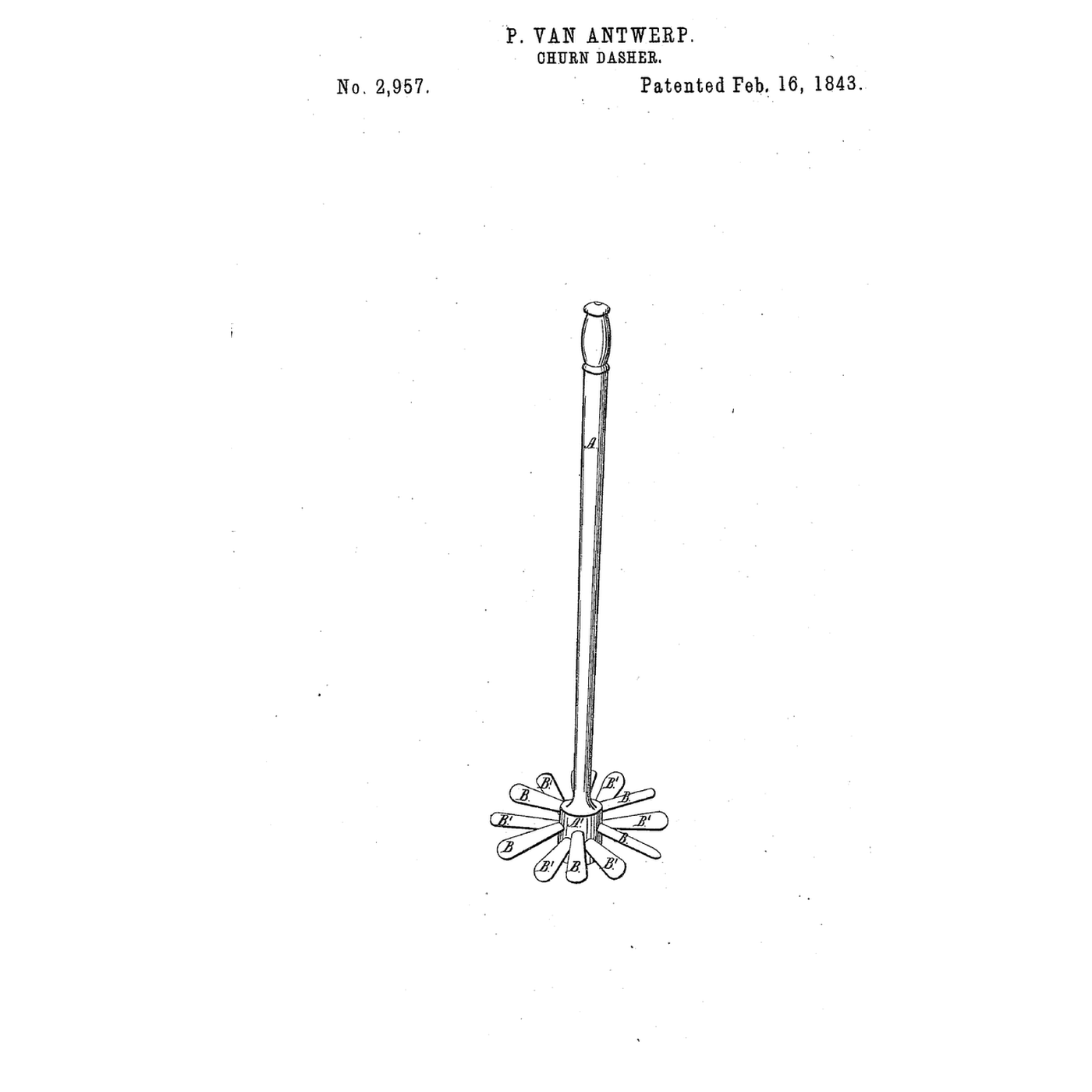


Reacting Churn Dasher: Two Rows of Oars Pitched Opposite Ways
Van Antwerp set out to improve "the common churn or hand dasher," worked up and down in an upright churn.
Peter Van Antwerp of Coeymans, New York, received US 2,957, dated 16 February 1843, for "Van Antwerp's Reacting Churn-Dasher": a knob on the dasher's rod carrying two rows of radial paddles shaped like oars, the upper row pitched one way and the lower row the other, so that "a reaction is also produced in the cream as it is impelled in one direction by the paddles B in the upper series and in the opposite direction by the paddles B' in the lower series." A cork in the end of the knob softens its blow on the churn's bottom.
This rung works out the oars' tilt, then prints the knob and twelve oars, fits them to a rod, and makes butter in a bucket.
Utangiye
About 1 hour, plus printing
Amabwiriza
1
1
Tilt and pitch
Tilt and pitch
Gupakira ikaye ya Jupyter…
2
2
The common dash churn it improves
The common dash churn it improves
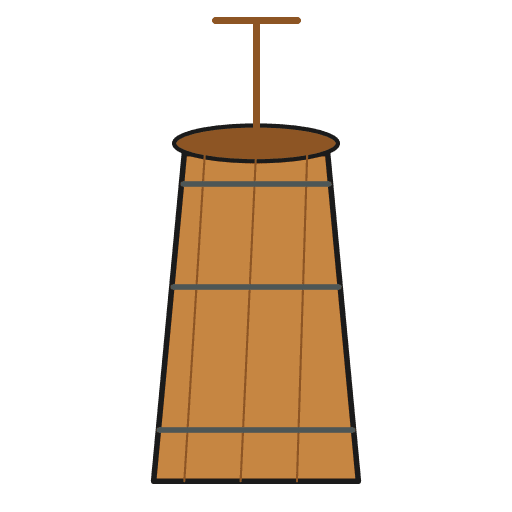
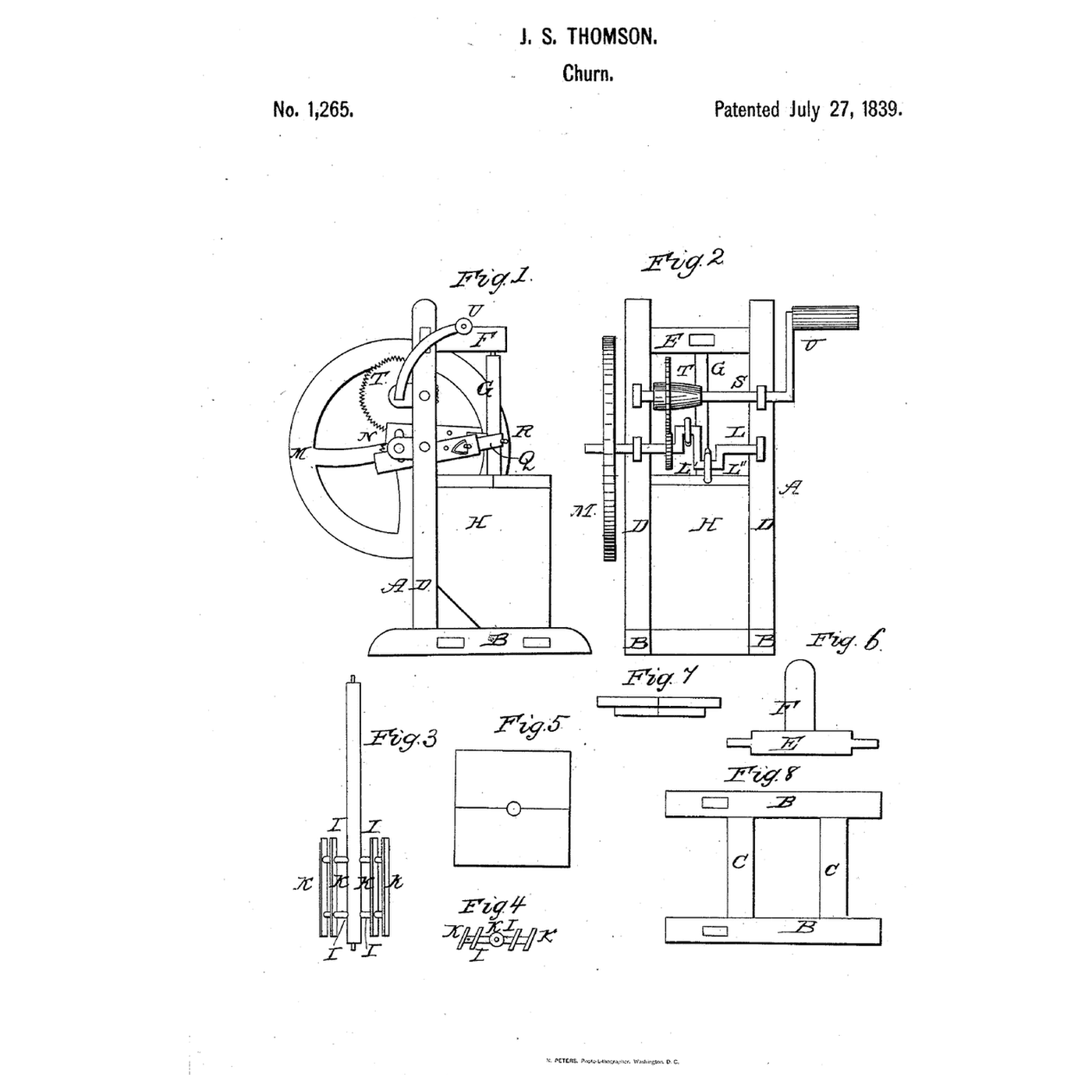
The embedded blueprint makes butter by agitating cream. Van Antwerp's dasher works the same up-and-down way, with pitched oars instead of a flat cross.
3
3
Read US 2,957
Read US 2,957
"This mode of constructing the dasher gives it great advantage over the ordinary churn dasher as by the employment of paddles arranged in the manner stated no vacuum is created interfering with the operation of the churn, consequently there is no mingling of air with the cream to obstruct the gathering of the butter."
4
4
Print the knob and oars
Print the knob and oars
Print the knob upright (/uploads/blueprints/reacting-churn-dasher-knob.stl), with supports in its sockets. Its square sockets are turned 45° so each oar's blade takes its pitch, the upper row one way and the lower row, under the gaps, the other. Print twelve oars flat (/uploads/blueprints/reacting-churn-dasher-oar.stl). Print in PETG at 0.2 mm layers, 30 % infill, 4 walls; wash before first use.
Ibikoresho by'iyi ntambwe:
 Fibere ya PETG1 igice
Ibikoresho bikenewe:
 Imashini icapa 3D ikoresha umugozi (FDM)
5
5
Assemble the dasher
Assemble the dasher
Glue the twelve oars into their sockets. Glue a 12 mm hardwood dowel, as long as the bucket is deep plus 150 mm, into the top of the knob. Press a cork into the seat under the knob so it stands proud of the end.
Ibikoresho by'iyi ntambwe:
 Udukoni tw'ibiti bikomeye1 igice
 Ibipfundikizo by'ikorogo1 igice
 Ikinyabutabire cy'Ibiti1 igice
Ibikoresho bikenewe:
 Umucumita w'Intoki
 Urupapuro rwo Gusya
6
6
Make the churn
Make the churn
Drill a 20 mm hole in the centre of a food-grade 20-litre bucket's lid for the rod.
Ibikoresho by'iyi ntambwe:
 Indobo ya Litiro 201 igice
Ibikoresho bikenewe:
 Icyuma Cyivumbura Kidafite Insinga
 Ibyuma byo gucamo utwenge
7
7
The build in 3D
The build in 3D
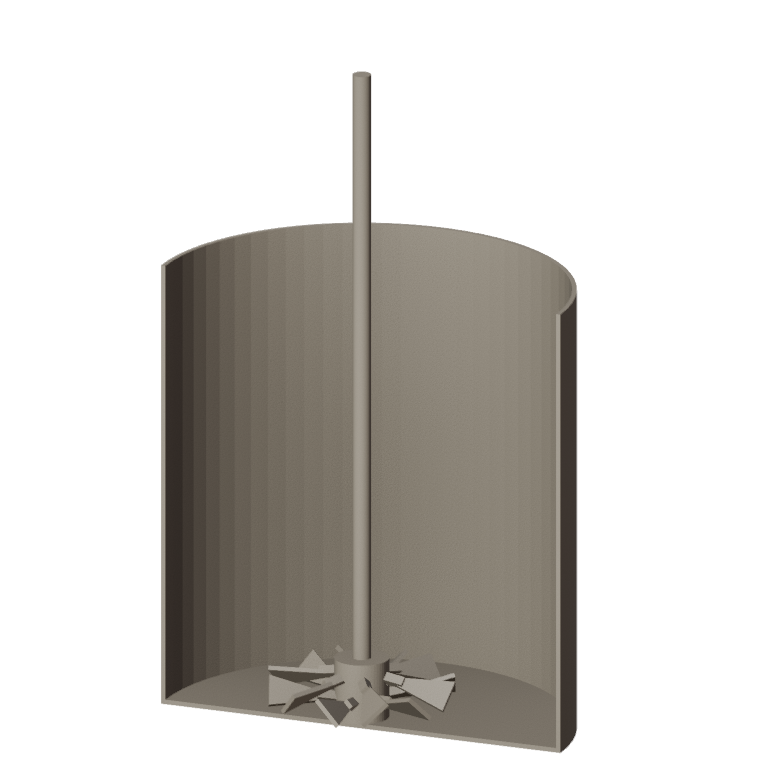
FreeCAD model of this build, not of the patent: the bucket cut away to show the knob on the rod's foot with its upper row of oars tilted down and pitched one way, and the lower row tilted up and pitched the other.
8
8
Dash and make butter
Dash and make butter
Let the heavy cream stand until it reaches about 15 °C, checked with the thermometer. Pour in 1 litre, fit the lid over the rod, and work the dasher up and down like a common dasher. Time until the butter comes. Pour off the buttermilk, add cold water, churn a little and pour off again until it runs clear; work in a pinch of salt and weigh the butter.
Ibikoresho by'iyi ntambwe:
 Igice cy'ibinure cy'amata1000 ml
 Umunyu w'inyanja munini1 igice
 Amazi1 igice
Ibikoresho bikenewe:
 Igipima ubushyuhe gifite uruti rusigara mu kintu
 Isaha yo Guhagarika
 Iminzani ya Digitale yo mu Gikoni
 Ibakure rinini ryo kuvanga ry'icyuma kitagira ingese
9
9
Oars that loosen, a dasher that thumps
Oars that loosen, a dasher that thumps
Reacting churn dasher troubleshooting.
Flow
Loading...
10
10
History and honest limits
History and honest limits
**Peter Van Antwerp** of Coeymans, Albany County, New York, received US 2,957, dated 16 February 1843. The knob was about three inches of the rod's lower end, enlarged; the paddles were "broad and flattened at their outer ends where they project into the cream, tapering from thence to their inner ends"; the centre hole could be filled with cement or putty and closed with cork "or other elastic substance" to keep the churn's bottom from being bruised. He claimed combining with the rod the two series of paddles arranged above each other and operating as described.
**Honest limits.** A printed knob and oars stand in for his wooden ones, and a bucket for his churn. FDM prints hold food in their layer lines, so wash well and replace when worn. Your times and weights are the result.
Ibikoresho
8- 1 igiceUmwanya
- 1 igiceUmwanya
- 1 igiceUmwanya
- 1 igiceUmwanya
- 1 igiceUmwanya
- 1000 mlUmwanya
- 1 igiceUmwanya
- 1 igiceUmwanya
Ibikoresho bikenewe
9- Umwanya
- Umwanya
- 1 vendor sell this, none ship to you yetUmwanya
- Umwanya
- Umwanya
Dosiye z'igishushanyo
1Iki gishushanyo gikora
Blueprint zijyanye
Izi blueprint zisangira ubumenyi — uburyo, ibikoresho cyangwa amahame



CC0 Umurenge rusange
Iyi blueprint yasohowe munsi ya CC0. Ushobora gukoporora, guhindura, gukwirakwiza no gukoresha nta kwemererwa.
Shyigikira Umuremyi ugura ibicuruzwa binyuze muri Blueprint ye Komisiyo y'Umuremyi byashyizweho n'Abacuruzi, cyangwa kora verisiyo nshya y'iyi Blueprint ukayinjiza nk'isano muri Blueprint yawe kugira ngo musangire inyungu.