Ubufatanye
UBUHANZI
UBWIZA N'UBUZIMA
UBUKORIKORI
UMUCO N'AMATEKA
IMYIDAGADURO
IBIDUKIKIJE
IBIRIBWA N'IBINYOBWA
UBWUBATSI BUSUBIRA INYUMA
UBUMENYI
SIPORO
IKORANABUHANGA
IBYAMBARWA
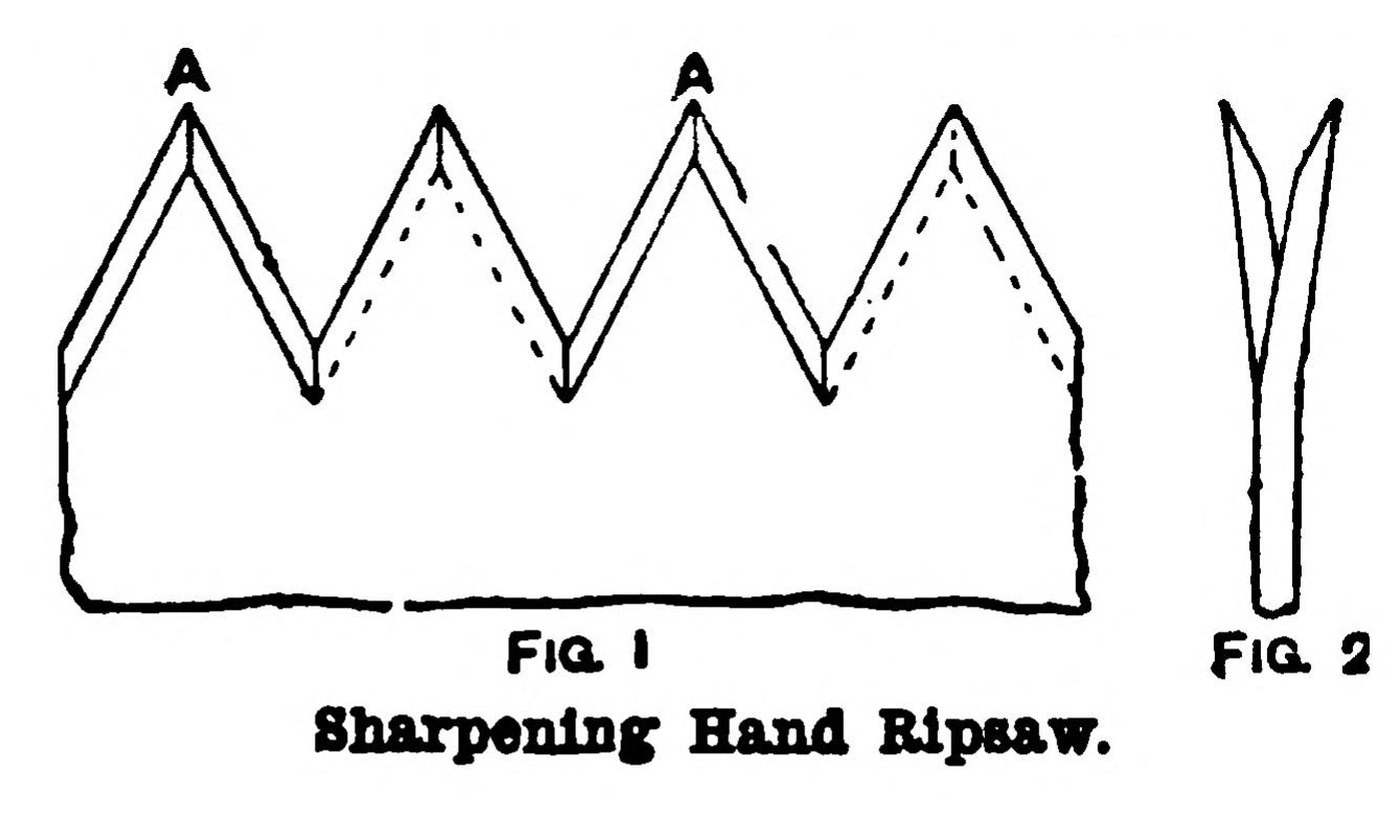


Rip Saw: Diamond-Pointed Teeth Bevelled from One Face (Cassell's Cyclopaedia, 1904)
A less common way to sharpen a hand rip saw, given in Cassell's Cyclopaedia of Mechanics (1904) as one that "answers well in actual practice". Both edges of each tooth are bevelled from the same face, so every tooth comes to a long point like a diamond-pointed wood chisel with a left and a right cutting edge, the teeth alternating from side to side of the blade. Set as usual, with the flat side of each pointed tooth turned outward. Teeth a little longer than an equilateral triangle, with a longer side slope, cut much more sweetly.
Tooth size, bevel angle and amount of set are not given; those are unknown here.
Source: P. N. Hasluck (ed.), Cassell's Cyclopaedia of Mechanics vol. V (1904), p. 122. Picture: its figs. 1 and 2.
Hagati
An hour
Amabwiriza
1
1
Read Cassell's
Read Cassell's
"... both edges of each tooth are bevelled from the same face, to form a long point at A (Fig. 1). In this way each successive tooth resembles a diamond-pointed wood chisel having a left and right cutting edge ..."
2
2
Clamp the saw
Clamp the saw
Clamp the hand saw in the vice with its teeth just above the jaws.
Ibikoresho by'iyi ntambwe:
 Umusumeno w'ababaji1 hand saw
Ibikoresho bikenewe:
 Ifatiro ry'Ameza
3
3
File the long points
File the long points
File alternate teeth from one side of the blade, bevelling BOTH edges of each tooth from that same face so the tooth ends in a long point (A in Fig. 1). Turn the saw and file the other teeth the same way from the other face. Make the teeth slightly longer than an equilateral triangle and the side slope a little longer than usual, for a keener edge. The bevel angle and tooth size are not given (unknown).
Ibikoresho bikenewe:
 Ihwa ry'amenyo y'umusumeno
 Ingano zitazwi
4
4
Set the teeth
Set the teeth
Give the usual set: turn the flat side of each pointed tooth outward, alternately left and right (Fig. 2), the same amount on each side. The amount is not given (unknown).
Ibikoresho bikenewe:
 Igikoresho cyo guhindura amenyo y'umusumenoIngano zitazwi
5
5
History and honest limits
History and honest limits
Cassell's notes this method was "not generally adopted"; the usual rip saw has upright fronts filed with a small bevel (p. 73, the other Rip Saw blueprint).
Tooth size, bevel angle and amount of set are not given; the saw is a hand saw refiled for ripping.
Ibikoresho
1- 1 hand sawUmwanya
Ibikoresho bikenewe
4- Umwanya
- Umwanya
- Umwanya
Iki gishushanyo gikora

CC0 Umurenge rusange
Iyi blueprint yasohowe munsi ya CC0. Ushobora gukoporora, guhindura, gukwirakwiza no gukoresha nta kwemererwa.
Shyigikira Umuremyi ugura ibicuruzwa binyuze muri Blueprint ye Komisiyo y'Umuremyi byashyizweho n'Abacuruzi, cyangwa kora verisiyo nshya y'iyi Blueprint ukayinjiza nk'isano muri Blueprint yawe kugira ngo musangire inyungu.