Ubufatanye
UBUHANZI
UBWIZA N'UBUZIMA
UBUKORIKORI
UMUCO N'AMATEKA
IMYIDAGADURO
IBIDUKIKIJE
IBIRIBWA N'IBINYOBWA
UBWUBATSI BUSUBIRA INYUMA
UBUMENYI
SIPORO
IKORANABUHANGA
IBYAMBARWA
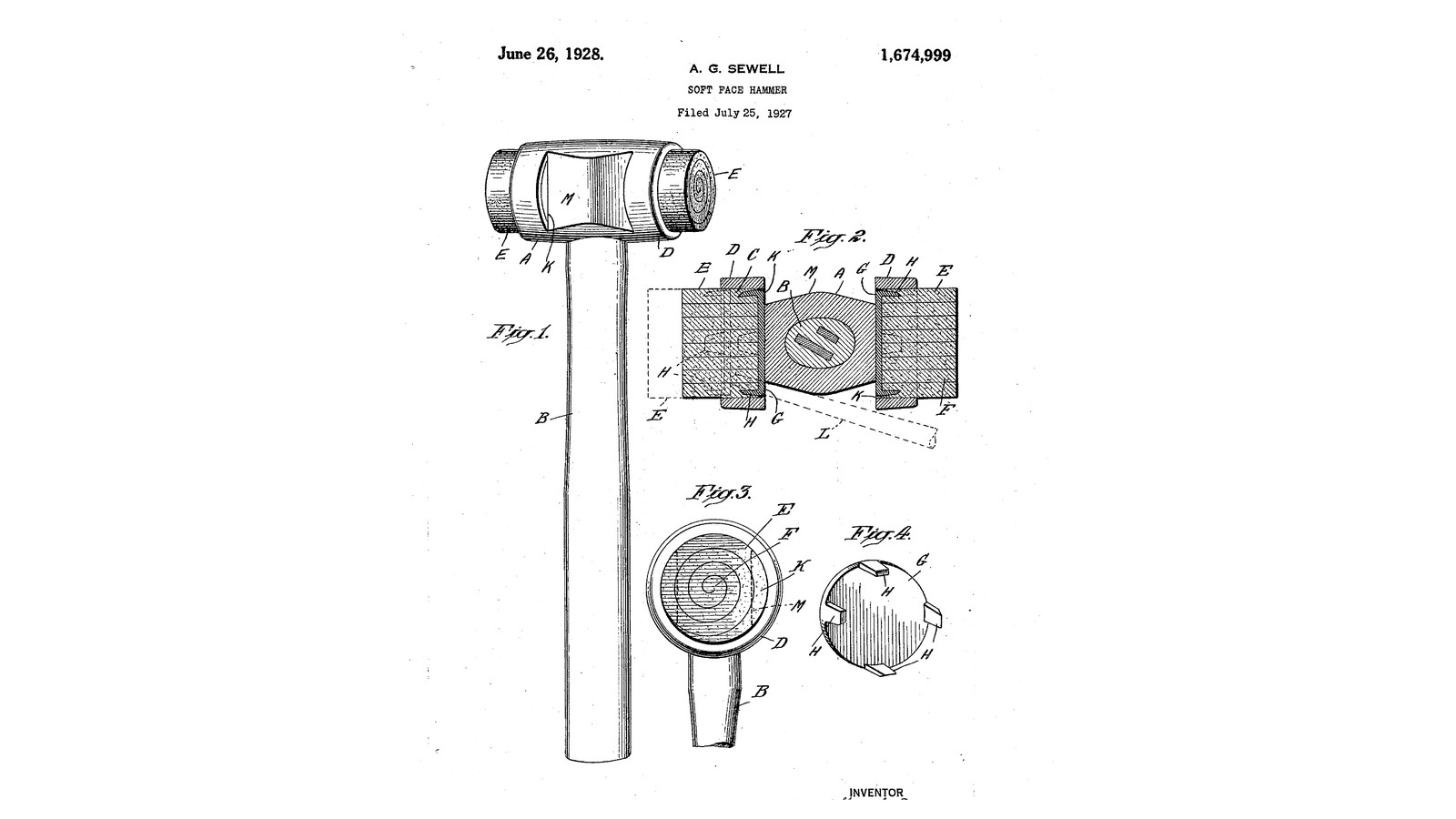


Renewable Rubber-Face Hammer: Rolled Faces Pressed Onto Pronged Discs, Driven Out Through a Notch When Worn (Sewell, 1928)
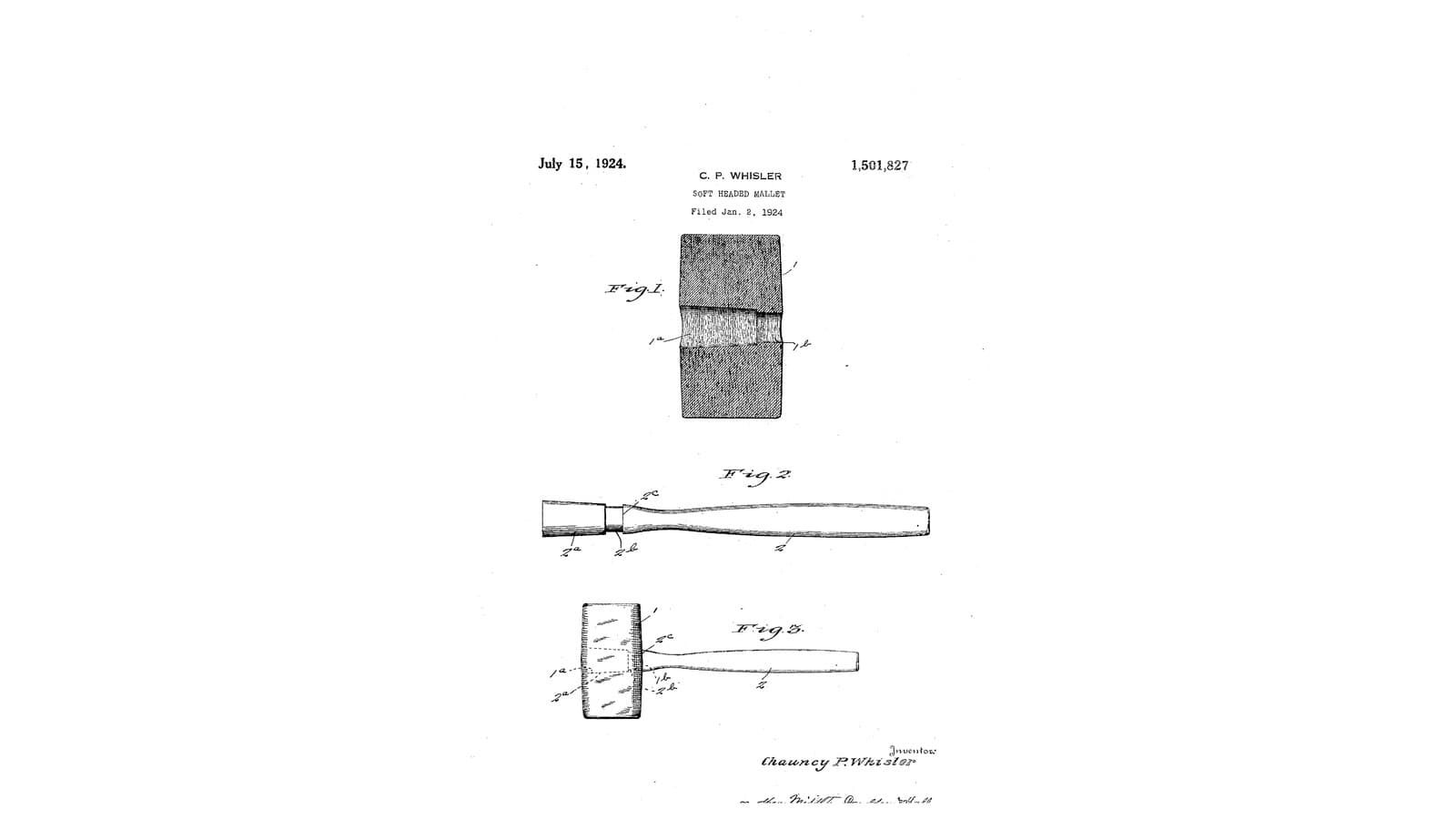
Albert G. Sewell received US 1,674,999, dated 26 June 1928, for a soft-face hammer whose worn faces can be renewed instead of throwing the hammer away. Each end of the head is a cup. A face rolled from a strip is pressed into the cup onto a loose sheet-metal disc whose prongs bite into it and wedge it tight. When a face is battered, a rod pushed through a notch at the bottom of the cup drives the disc and the face out together, and a new face goes in. He preferred rawhide and named rubber among face materials; ours are rolled from rubber sheet.
The patent gives no sizes; every size here is ours.
Hagati
About 1 day
Amabwiriza
1
1
Rolling a face plug
Rolling a face plug
Gupakira ikaye ya Jupyter…
2
2
Read US 1,674,999
Read US 1,674,999
"Thus, by hammering or otherwise thrusting a rod or suitable device against the wedging member, the latter, with the striking face member, can be forced or driven out of the socket or recess, after which a new striking face member may be forced into the socket, to be secured therein by the wedging member."
3
3
Turn the head
Turn the head
Grip 40 mm steel round bar in the chuck and turn a head 110 mm long: the two ends stay 40 mm across for 26 mm as the flanges D, and the middle is waisted to 30 mm. Bore each end 32 mm across and 22 mm deep for the sockets C, flat at the bottom. Drill a 20 mm eye B through the middle, square to the axis, in a V-block on the drill press.
Ibikoresho by'iyi ntambwe:
 Umurongo uziguye w'icyuma cyoroheje1 igice
 Amavuta yo gukata1 igice
Ibikoresho bikenewe:
 Imashini yo guhinguza icyuma
 Igikoresho gifata cy'ibirenge 3 cy'imashini ihingura
 Icyuma cyo kuca cy'itorero
 Igiti cyo gukata imbere mu mwobo
 Icyuma cyo guca ku ruziga
 Icyuma Cyivumbura Gihagaze
 Ikibumbe cya V
 Ibyuma Byinshi byo Gucukura
 Ikigereranyo cya Digitale cy'Amasentimetero 6
 Amadarubindi y'umutekano
4
4
Cut the notches K
Cut the notches K
On the handle's side of each flange, saw and file a notch 8 mm wide through the flange's wall at the very bottom of the socket, so a rod can be pushed in at a slant against the edge of the disc at the bottom.
Ibikoresho bikenewe:
 Ifatiro ry'Ameza
 Umucumita w'Ibyuma
 Amakariso Menshi
 Igicukuzi cyo Gushyira Ikimenyetso
5
5
Pronged discs G
Pronged discs G
Cut two discs of 1.5 mm steel sheet 31.5 mm across. At four places round each rim, snip two cuts 6 mm deep 5 mm apart and bend the tab between them up at a right angle with the pliers: the prongs H. Drop one disc loosely into the bottom of each socket, prongs out.
Ibikoresho by'iyi ntambwe:
 Urupapuro rw'icyuma cyoroshye1 igice
Ibikoresho bikenewe:
 Ibyuma bikata ibyuma bisanzwe
 Ipfundo Rifite Umunwa UringaniyeIfatiro ry'AmezaAmakariso Menshi
6
6
Roll and press in the faces E
Roll and press in the faces E
Cut two strips of 3 mm natural rubber sheet 32 mm wide and about 270 mm long. Roll each tightly into a coil, trimming the strip until the coil just enters a socket, and tie it. Press the coil into its socket in the vice, between soft packing, until it bottoms on the disc and its prongs bite in, leaving the face standing about 10 mm out. Cut the tie and trim the face flat with the knife.
Ibikoresho by'iyi ntambwe:
 Urupapuro rwa kawushu karemano1 igice
Ibikoresho bikenewe:
 Icyuma cy'UbukorikoriIfatiro ry'AmezaIkigereranyo cya Digitale cy'Amasentimetero 6
7
7
Handle
Handle
Turn an ash handle 300 mm long, its end a tight fit in the eye. Saw a slot down its end, drive it into the eye, and glue and drive a hardwood wedge into the slot; saw it off flush.
Ibikoresho by'iyi ntambwe:
 Ikibaho cy'Igiti Gikomeye1 igice
 Ikinyabutabire cy'Ibiti1 igice
Ibikoresho bikenewe:
 Imashini ikerekeza ibiti
 Icyegeranyo cy'ibikoresho by'imashini izunguruka (HSS)Umucumita w'Ibyuma
 Inyundo ifite umutwe wa buruta
8
8
Renew a face
Renew a face
When a face is worn, push a steel rod through the socket's notch against the disc's edge and tap it out with the hammer; the disc and the face come out together. Put the disc back, prongs out, and press in a new rolled face.
Ibikoresho bikenewe:
Inyundo ifite umutwe wa burutaIfatiro ry'Ameza9
9
Troubleshooting
Troubleshooting
Soft-face hammer troubleshooting.
Flow
Loading...
10
10
History and honest limits
History and honest limits
**Albert G. Sewell**, US 1,674,999, dated 26 June 1928, filed 25 July 1927. He describes a head with a socket at each end formed by annular flanges, a striking face member of relatively soft material rolled from a strip and pressed in as a plug, a loose sheet-metal wedging disc with prongs in the socket's bottom, and openings through which a rod drives the disc and face out. He preferred rawhide and his head was cast iron; ours is turned steel with faces rolled from rubber sheet, which he lists among the face materials in use. He gives no sizes; every size here is ours.
Ibikoresho
6- Umwanya
- 1 igiceUmwanya
- Umwanya
- Umwanya
- 1 igiceUmwanya
- 1 igiceUmwanya
Ibikoresho bikenewe
20- Umwanya
- Umwanya
- Umwanya
- Umwanya
- Umwanya
- Umwanya
- Umwanya
- Umwanya
- Umwanya
- Umwanya
- Umwanya
- Umwanya
Iki gishushanyo gikora

Blueprint zijyanye
Izi blueprint zisangira ubumenyi — uburyo, ibikoresho cyangwa amahame
CC0 Umurenge rusange
Iyi blueprint yasohowe munsi ya CC0. Ushobora gukoporora, guhindura, gukwirakwiza no gukoresha nta kwemererwa.
Shyigikira Umuremyi ugura ibicuruzwa binyuze muri Blueprint ye Komisiyo y'Umuremyi byashyizweho n'Abacuruzi, cyangwa kora verisiyo nshya y'iyi Blueprint ukayinjiza nk'isano muri Blueprint yawe kugira ngo musangire inyungu.