
Ubufatanye
UBUHANZI
UBWIZA N'UBUZIMA
UBUKORIKORI
UMUCO N'AMATEKA
IMYIDAGADURO
IBIDUKIKIJE
IBIRIBWA N'IBINYOBWA
UBWUBATSI BUSUBIRA INYUMA
UBUMENYI
SIPORO
IKORANABUHANGA
IBYAMBARWA
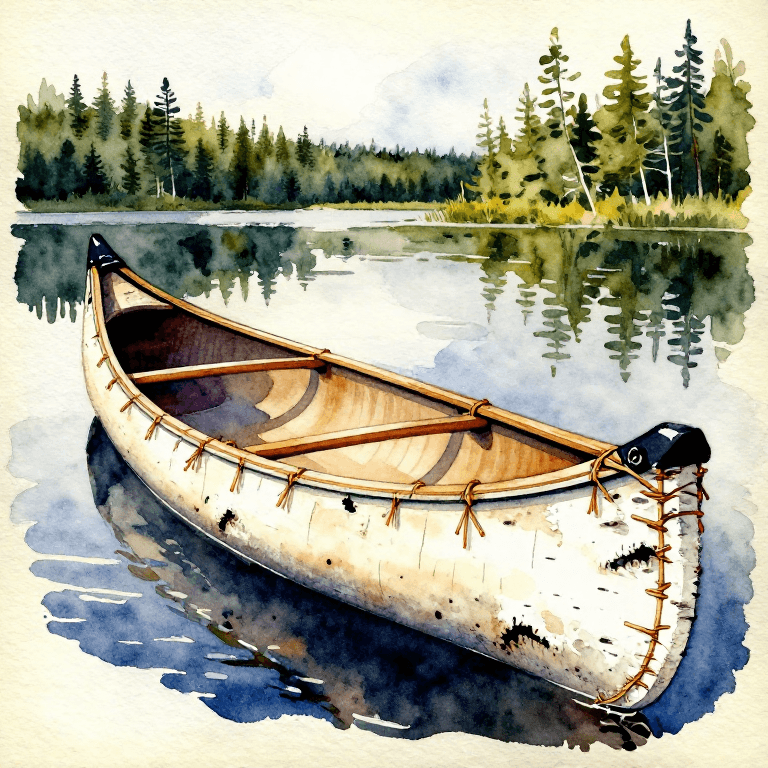
16 ft Canvas-Covered Cedar Canoe: Backbone, Seven Molds, Cedar Ribs and Planking, Glued Canvas (Boy Mechanic, 1919)
Woody

Yaremwe na

Woody

13. Ugushyingo 2026NO
0
0
0
0
0

16 ft Canvas-Covered Cedar Canoe: Backbone, Seven Molds, Cedar Ribs and Planking, Glued Canvas (Boy Mechanic, 1919)

Stillman Taylor's open Canadian canoe from The Boy Mechanic, Book 3 (1919): about 16 ft long, 31 in beam, 60 to 70 lb. Built upside down over a backbone and seven paper-pattern molds, with oak or ash stems, keelson and gunwales, 1/8 in cedar ribs and planking fastened with copper clout nails, then covered with No. 6 canvas laid in melted marine glue, painted, and varnished. Every layout dot and width is his, as printed.
Hejuru
Several weeks

Amabwiriza

1

His layout data

Gupakira ikaye ya Jupyter…
2

Read The Boy Mechanic, Book 3

"Working with light materials, the canoe builder must pay particular attention to the workmanship ... the work must not be hurried, but plenty of time taken to do each and every part well."
3

Get the materials

Stem: oak or ash 6 ft x 3/4 in square. Keelson: oak or ash 14 ft x 3-1/2 x 3/8 in. Gunwales: 2 of oak or ash 16 ft x 7/8 x 1/2 in. Seat risings: 2 of oak or ash 1/2 in square. Fenderwales: 34 ft of 1/2 in half-round molding. Outside keel (optional): oak 14 ft x 1 x 1/2 in. Deck beams: 2 of oak or ash 8 x 1-1/8 x 3/8 in. Seat frames: 2 at 30 x 3 x 3/4 and 2 at 12 x 2-1/4 x 3/4 in. Planking: cedar or pine, 100 sq ft, 1/8 in (25 ft of 1 in lumber dressed to 1/8 in, in 12, 14 and 16 ft lengths). Ribs: 360 running ft of cedar 1-3/4 x 1/8 in. Breast hooks: cedar or oak 32 x 9 x 3/4 in. Backbone, molds and ribbands from any cheap stuff. Fastenings: 1 lb 2 in wire nails; 1 lb 5/8 in and 1/2 lb 3/4 in copper clout nails; 18 brass screws 1-1/4 in No. 8 and 24 brass screws 1 in No. 6; 4 lb marine glue; 3 oz No. 2 copper tacks; 11-3/4 yd No. 6 canvas; 1 lb 3/8 in copper tacks. Rock elm or fir may replace oak or ash; spruce, pine, cypress or fir may replace cedar.

Ibikoresho by'iyi ntambwe:

Ikibaho cy'igiti cy'umwaloni w'umweruIkibaho cy'igiti cy'umwaloni w'umweru4 ibice
Urubaho rwa sederiUrubaho rwa sederi6 ibice
Ikibaho cy'igiti cya pinusiIkibaho cy'igiti cya pinusi3 ibice

Ibikoresho bikenewe:

Urukerezo rwo gusaturaUrukerezo rwo gusatura
Umucumita w'IntokiUmucumita w'Intoki
Ikoresho cyo gusiga ibitiIkoresho cyo gusiga ibiti
Umugozi wo GupimaUmugozi wo Gupima
4

Lay out the backbone and molds

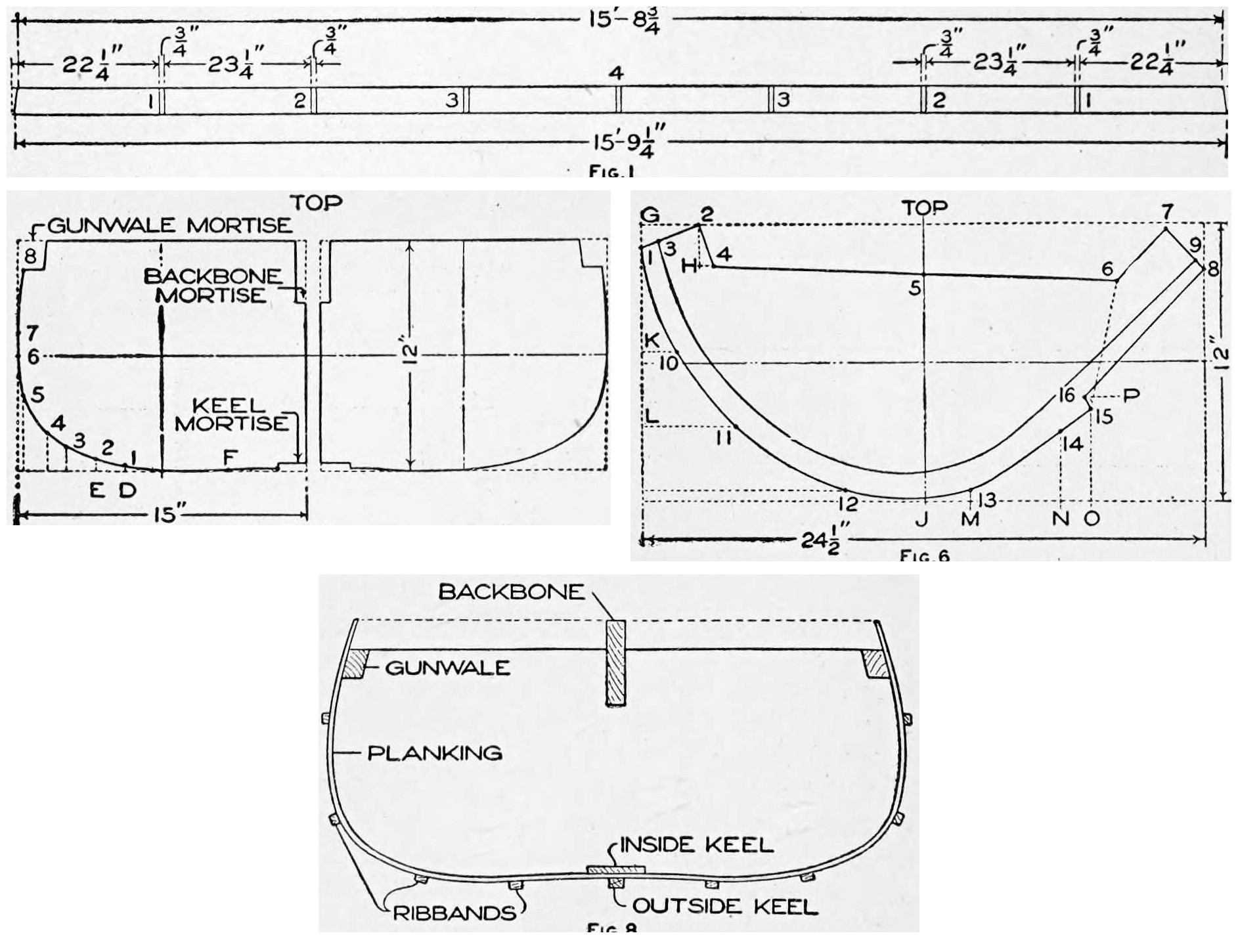
Cut the backbone from a 16 ft x 4 x 7/8 in board, top edge 15 ft 8-3/4 in, and mark the mold stations from each end: 22-1/4 in to mold 1, then 23-1/4 in to mold 2 and 23-1/4 in to mold 3, each mold space 3/4 in thick; mold 4 sits at the centre; cut the ends off on the bevel (Fig. 1). Draw each mold on stiff paper from his rectangles, mortises and dots (notebook), trace the curve through the dots, cut out the half, fold and draw the other side, and cut the molds from 7/8 in stock: seven in all, numbered alike from each end: two No. 1, two No. 2 (each in halves), two No. 3 and one No. 4; nail battens across the halves.

Ibikoresho by'iyi ntambwe:

Ikibaho cy'igiti cya pinusiIkibaho cy'igiti cya pinusi2 ibice
Impapuro ziremereyeImpapuro ziremereye1 igice
ImisumariImisumari1 igice

Ibikoresho bikenewe:

Umucumita w'IntokiUmucumita w'Intoki
Umucumita w'ImigororwaUmucumita w'Imigororwa
Umurongo w'ipimaUmurongo w'ipima
Ikaramu ya penisileIkaramu ya penisile
UmukasiUmukasi
InyundoInyundo
5

Bend the stems and shape the keelson

Make the stem mold from his Fig. 6 pattern (24-1/2 x 12 in rectangle, dots in the notebook) and bend the straight-grained 3/4 in square oak or ash stems on it. Cut the keelson 13 ft 11 in long, tapering from 3-1/2 in at the centre: 3-1/2 in at 1 and 2 ft, 3-1/4, 2-5/8, 2 and 1-1/4 in at 3 to 6 ft, and 15/16 in at the ends (Fig. 7). Fasten each stem to the keelson with a couple of 3/4 in No. 10 screws.

Ibikoresho by'iyi ntambwe:

Ikibaho cy'igiti cy'umwaloni w'umweruIkibaho cy'igiti cy'umwaloni w'umweru2 ibice
Brass Wood ScrewsBrass Wood Screws4 ibice

Ibikoresho bikenewe:
Imbugita ikururwaImbugita ikururwa
Ikoresho cyo gusiga ibitiIkoresho cyo gusiga ibiti
Umucumita w'IntokiUmucumita w'Intoki
Ivuvuzo ry'ukuboko rifite umutweIvuvuzo ry'ukuboko rifite umutwe
Agafuni k'urwasaya rugororotseAgafuni k'urwasaya rugororotse
Igifata gifite ishusho ya CIgifata gifite ishusho ya C
6

Set up the frame

Build it upside down: set the backbone on boxes about 1 ft or more off the floor and the molds in their numbered places, the backbone resting in their top mortises. True the molds with a square and toenail them. Lay the keelson in its mortises, fit the stems to the backbone angle and nail through the mold tops into them. Bevel the stem splice from the inside, leaving the outer edge about 1/8 in wide. Put on the gunwales at the sheer line with nails left proud, then four ribbands a side at 5 in centres from the keel, fastened with 1-1/4 in brads.

Ibikoresho by'iyi ntambwe:

Ikibaho cy'igiti cy'umwaloni w'umweruIkibaho cy'igiti cy'umwaloni w'umweru2 ibice
Ikibaho cy'igiti cya pinusiIkibaho cy'igiti cya pinusi1 igice
ImisumariImisumari1 igice

Ibikoresho bikenewe:

Igipimo cy'inguni ya dogere mirongo cyendaIgipimo cy'inguni ya dogere mirongo cyenda
InyundoInyundo
Ibyuma byo kubazaIbyuma byo kubaza
Ikoresho cyo gusiga ibitiIkoresho cyo gusiga ibiti
7

Rib the hull

Saw cedar ribs 1-3/4 in wide and 1/8 in thick, cut to length gunwale to gunwale over the ribbands. Space them 3 in apart on centres along the keelson, one over each mold. Fasten each rib to the outside of the keelson with two 5/8 in copper clout nails, spring it in under the ribbands and fasten it to the gunwales. Then remove the ribbands.

Ibikoresho by'iyi ntambwe:

Urubaho rwa sederiUrubaho rwa sederi2 ibice
Copper Clout NailsCopper Clout Nails1 igice

Ibikoresho bikenewe:

Umucumita w'IntokiUmucumita w'Intoki
InyundoInyundo
Umugozi wo GupimaUmugozi wo Gupima
8

Plank the hull

Plank with 1/8 in cedar, bent cold, full length stem to stem, butted edge to edge without bevel, about 3 in wide; begin with the garboard strake at the keel and end with the sheer strake level with the gunwale. Punch nail holes with an awl, staggered along the ribs; clamp the plank, drive copper clout nails and clinch them inside on a clinch iron. Trim the plank ends to the stems and gunwales, saw the backbone in two to take out the frame, tack strips across the gunwales against sagging, and nail where the molds were.

Ibikoresho by'iyi ntambwe:

Urubaho rwa sederiUrubaho rwa sederi4 ibice
Copper Clout NailsCopper Clout Nails1 igice
Copper TacksCopper Tacks1 igice

Ibikoresho bikenewe:
Urushinge RutoboraUrushinge Rutobora
Igifata gifite ishusho ya CIgifata gifite ishusho ya C
Clinch IronClinch Iron
InyundoInyundo
Umucumita w'IntokiUmucumita w'Intoki
9

Fit risings, seats, decks and thwarts

Nail 1/2 in square oak or ash seat risings, 14 ft long, about 4 in below the gunwale, boring first and clinching inside. Make the seat frames as Fig. 10 and cane them or tack on canvas (a kneeling paddler may use a 4 or 5 in seat bar instead). Notch the 8 x 1-1/8 x 3/8 in deck beams to wedge about 1/2 in against the gunwales (Fig. 11) and fix each with a 1-1/4 in No. 10 screw through the gunwale. Shape the decks 16 x 8 in (Fig. 12) and fix them with three 1-1/4 in No. 10 screws into the beam and three along each gunwale. Screw a centre thwart of oak or ash, 3/8 in thick, 2 in tapering to 1 in, under the gunwales amidships; extra thwarts behind the forward seat and about 3 ft forward of the rear seat stiffen it.

Ibikoresho by'iyi ntambwe:

Ikibaho cy'igiti cy'umwaloni w'umweruIkibaho cy'igiti cy'umwaloni w'umweru2 ibice
Urubaho rwa sederiUrubaho rwa sederi1 igice
Copper Clout NailsCopper Clout Nails1 igice
Brass Wood ScrewsBrass Wood Screws30 ibice
Umwenda wa kanvasiUmwenda wa kanvasi1 igice

Ibikoresho bikenewe:

Ivuvuzo ry'ukuboko rifite umutweIvuvuzo ry'ukuboko rifite umutwe
Agafuni k'urwasaya rugororotseAgafuni k'urwasaya rugororotse
Umucumita w'IntokiUmucumita w'Intoki
Ibyuma byo kubazaIbyuma byo kubaza
InyundoInyundo
10

Lay the canvas

Lay the No. 6 canvas smoothly on the hull and trim it to fold at the stems (Fig. 13). Melt the black marine glue in a can over a moderately hot fire and spread a fairly heavy coat over one side of the canvas with a stiff brush. Lay it on and iron it with a moderately hot flatiron so the glue melts into the planking. Tack the edges along the gunwales and fold the canvas smoothly at the stems, tacking exactly down the stem centre line.

Ibikoresho by'iyi ntambwe:

Umwenda wa kanvasiUmwenda wa kanvasi1 igice
Marine GlueMarine Glue1 igice
Copper TacksCopper Tacks1 igice

Ibikoresho bikenewe:

Ikopo ry'icyumaIkopo ry'icyuma
Uburoso bugariUburoso bugari
Ipasi y'icyumaIpasi y'icyuma
UmukasiUmukasi
InyundoInyundo
11

Fenders, stem bands and keel

Tack 1/2 in round molding over the canvas edge (or a 1 in strip of planking with 1-1/4 in brads every 2 or 3 in). Put on stem bands of wood about 3/8 in square, rounded, with 1-1/4 in brads, or better, 3/8 in brass oval stem band with 3/4 in screws. An outside keel is optional: about 1 x 1/2 in of oak or ash tapered to the stem bands, or a flat keel about 2-1/2 in wide of 3/8 in oak or ash, which turns more easily and guards the bottom.

Ibikoresho by'iyi ntambwe:

Half-Round MoldingHalf-Round Molding1 igice
Brass Stem BandBrass Stem Band2 ibice
Brass Wood ScrewsBrass Wood Screws12 ibice
Ikibaho cy'igiti cy'umwaloni w'umweruIkibaho cy'igiti cy'umwaloni w'umweru1 igice
ImisumariImisumari1 igice

Ibikoresho bikenewe:

InyundoInyundo
Agafuni k'urwasaya rugororotseAgafuni k'urwasaya rugororotse
Ikoresho cyo gusiga ibitiIkoresho cyo gusiga ibiti
Igikoresho cyo gutobora gikoreshwa n'intokiIgikoresho cyo gutobora gikoreshwa n'intoki
12

Paint and finish

Give the canvas a coat of shellac to waterproof it, then four coats of paint to fill the fibres, rubbing down the second and third with fine sandpaper. Finish all woodwork with three coats of good outside spar varnish. A removable slatted grating of soft-pine lattice, about 1-1/8 in wide and 1-1/4 in thick as printed, screwed to curved cross strips (not the ribs), protects the bottom.

Ibikoresho by'iyi ntambwe:

Varinishi ya sherakeVarinishi ya sherake1 igice
Irangi ry'amavutaIrangi ry'amavuta1 igice
Urupapuro rwo GusyaUrupapuro rwo Gusya1 igice
Spar VarnishSpar Varnish1 igice
Ikibaho cy'igiti cya pinusiIkibaho cy'igiti cya pinusi1 igice

Ibikoresho bikenewe:

Uburoso bugariUburoso bugari
Agafuni k'urwasaya rugororotseAgafuni k'urwasaya rugororotse
13

Troubleshooting

Canoe troubleshooting.

Flow

Loading...
14

History and honest limits

From "How to Build a Canoe, Part I" by Stillman Taylor, in **The Boy Mechanic, Book 3**, Popular Mechanics, 1919 (Project Gutenberg 71856; checked on the archive.org scan boymechanic0003unse, pp. 77-84). As printed, his text differs in places: the backbone's lower edge is 1/2 in longer in one sentence and 1 in in the next; the list gives No. 8 deck screws, the text No. 10; the list's seat frames (30 x 3 and 12 x 2-1/4 in) differ from Fig. 10 (29 x 9 in); the fenders are half-round in the list and round in the text. The metric figures are ours.

Ibikoresho

16

Ibikoresho bikenewe

21

CC0 Umurenge rusange

Iyi blueprint yasohowe munsi ya CC0. Ushobora gukoporora, guhindura, gukwirakwiza no gukoresha nta kwemererwa.

Shyigikira Umuremyi ugura ibicuruzwa binyuze muri Blueprint ye Komisiyo y'Umuremyi byashyizweho n'Abacuruzi, cyangwa kora verisiyo nshya y'iyi Blueprint ukayinjiza nk'isano muri Blueprint yawe kugira ngo musangire inyungu.

Ibiganiro

(0)

Injira kugira ngo ujye mu biganiro

Gutegura ibitekerezo...