Ubufatanye
UBUHANZI
UBWIZA N'UBUZIMA
UBUKORIKORI
UMUCO N'AMATEKA
IMYIDAGADURO
IBIDUKIKIJE
IBIRIBWA N'IBINYOBWA
UBWUBATSI BUSUBIRA INYUMA
UBUMENYI
SIPORO
IKORANABUHANGA
IBYAMBARWA
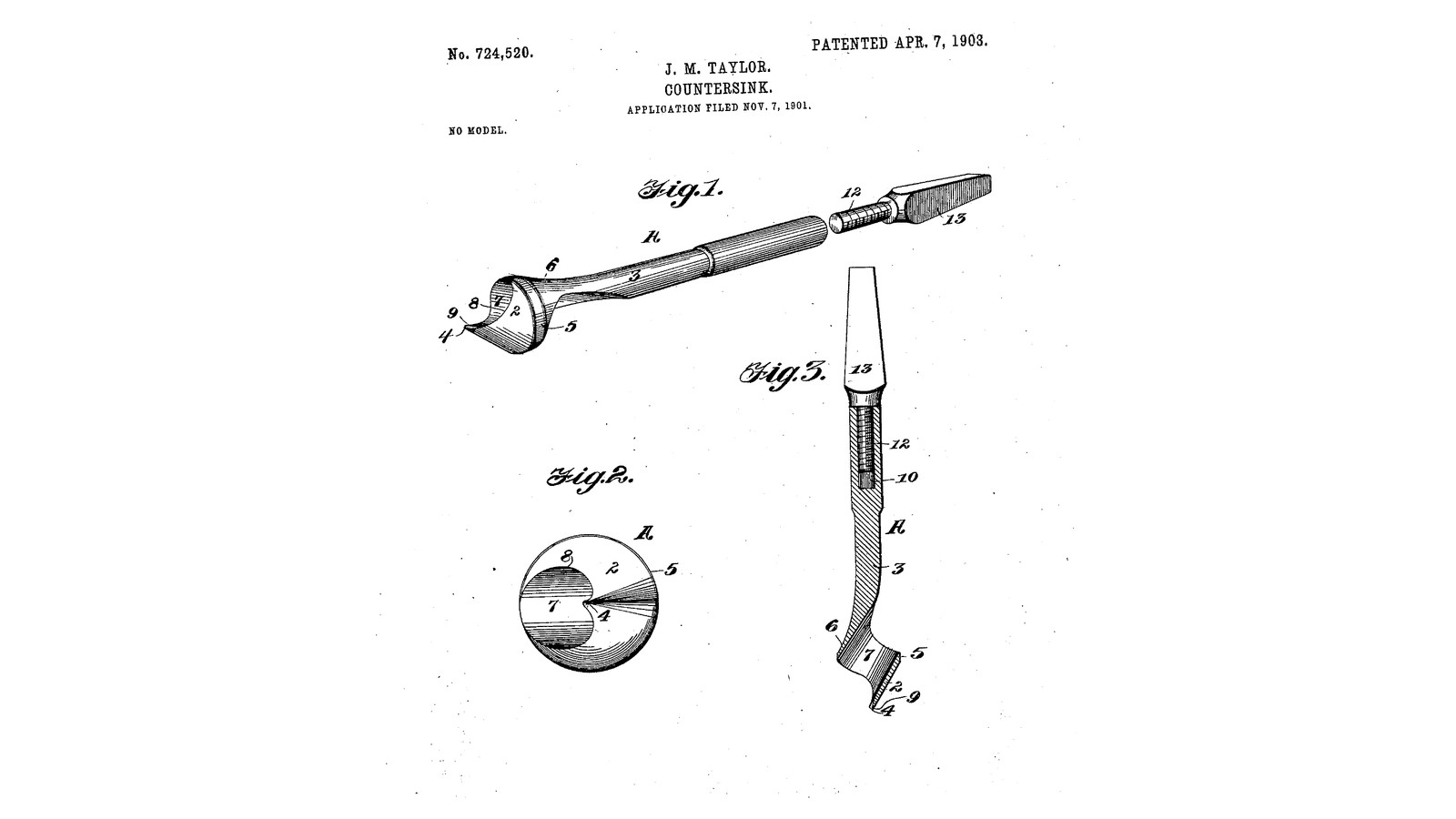


Cross-Hole Countersinks: A Slanting Hole Through the Cone Makes One Spiral Shearing Lip (Taylor, 1903)
John M. Taylor of Hartford, Connecticut, received US 724,520, dated 7 April 1903, for a countersink that shears wood smoothly. Its conical head has a hole drilled through it at a slant that crosses the axis and reaches the point. One edge of that hole is the cutting lip, a spiral curve from the point out to the rim, and the chips go straight out through the hole to the back. A short band behind the cone guides it.
We turn a set of three from tool steel and harden them. The patent gives no sizes; every size here is ours.
Hagati
About 1 day
Amabwiriza
1
1
Where the slanting hole must go
Where the slanting hole must go
Gupakira ikaye ya Jupyter…
2
2
Read US 724,520
Read US 724,520
"One of the outer edges of the wall of the opening forms a cutting-lip 8, which is of spiral formation, whereby it is effective to make a shear cut, and terminates in a shoulder 9, forming an entering or cutting point 4 at the apex of the conical head 2."
3
3
Turn the blanks
Turn the blanks
From octagonal tool steel big enough for each head, turn three blanks: a 90 degree cone 2 to a sharp point, 12, 16 and 20 mm across at its base; a band 5 2 mm long at that diameter as the guide; a truncated cone 6 down to an 8 mm shank 50 mm long. File three flats on each shank's end for the chuck. Heat each to a cherry red and let it cool slowly in the air, to soften it for drilling.
Ibikoresho by'iyi ntambwe:
 Inkoni ifite impande umunani y'icyuma cy'ibikoresho2 ibice
Ibikoresho bikenewe:
 Imashini yo guhinguza icyuma
 Igikoresho gifata cy'ibirenge 3 cy'imashini ihingura
 Icyuma cyo kuca cy'itorero
 Icyuma cyo guca ku ruziga
 Igipima Ingoro
 Ikigereranyo cya Digitale cy'Amasentimetero 6
 Amakariso Menshi
 Iziko ryo Gucura
 Amakoro y'Umucuzi
 Amadarubindi y'umutekano
4
4
Drill the slanting opening 7
Drill the slanting opening 7
Hold a blank in the machine vice tilted so the drill meets the cone's side at 35 degrees to the tool's axis, aimed to cross the axis just behind the point (the notebook gives how far). Drill through with a drill 0.45 of the head across: 5.5, 7 and 9 mm, so the hole breaks out through the point on one side and out of the back cone on the other. Open the back of the hole a little larger, so it tapers towards the shank.
Ibikoresho bikenewe:
 Icyuma Cyivumbura Gihagaze
 Ifatiro ry'imashiniIgipima Ingoro
 Ibyuma Byinshi byo GucukuraIkigereranyo cya Digitale cy'Amasentimetero 6
5
5
File the lip 8
File the lip 8
With a round needle file, clean the hole's edge on the side that leads as the countersink turns, leaving it sharp from the point to the band: that is the spiral cutting lip. File a little relief on the cone just behind it, and leave the shoulder 9 at the point.
Ibikoresho bikenewe:
 Ikusanyirizo ry'Amakariso MatoIfatiro ry'imashini
 Imashini ihyeza yo ku meza
6
6
Harden and temper
Harden and temper
Heat each head to a cherry red, until a magnet no longer sticks, and quench it point first in water, moving it about. Rub it bright with a stone, heat the shank gently 20 mm behind the head, and quench again as soon as a light straw colour reaches the cutting lip.
Ibikoresho bikenewe:
Iziko ryo GucuraAmakoro y'Umucuzi Magineti nto
 Indobo yo gukonjesha
 Amazi
 Ibuye ryo gutyaza
 Uturindantoki two gukomeza ibyumaAmadarubindi y'umutekano
7
7
Hone and test
Hone and test
Hone the lip lightly with the stone. Drill a few screw holes in hardwood and countersink them in the drill: the cone should cut a smooth bell without chatter and the chips should come out of the hole at the back.
Ibikoresho bikenewe:
Ibuye ryo gutyaza Icyuma Cyivumbura Kidafite InsingaIbyuma Byinshi byo Gucukura
 Ikibaho cy'Igiti GikomeyeAmadarubindi y'umutekano
8
8
Troubleshooting
Troubleshooting
Countersink troubleshooting.
Flow
Loading...
9
9
History and honest limits
History and honest limits
**John M. Taylor** of Hartford, Connecticut, US 724,520, dated 7 April 1903, filed 7 November 1901. He claimed "a countersink having a cone-shaped head provided with an opening crossing diagonally to the axis within the length of the tool and intersecting the apex of the cone, said opening having a curved edge forming a cutting-lip", and a two-part shank for brace or chuck. We make one-piece shanks for a chuck. He gives no sizes, angle or steel; our 90 degree cones, sizes and the house hardening are ours.
Ibikoresho
1- Umwanya
Ibikoresho bikenewe
22- Umwanya
- Umwanya
- Umwanya
- Umwanya
- Umwanya
- Umwanya
- Umwanya
- Umwanya
- Umwanya
- Umwanya
- Umwanya
- Umwanya
- Umwanya
- Umwanya
- Umwanya
- Umwanya
- 1 vendor sell this, none ship to you yetUmwanya
- Umwanya
Iki gishushanyo gikora

Blueprint zijyanye
Izi blueprint zisangira ubumenyi — uburyo, ibikoresho cyangwa amahame
CC0 Umurenge rusange
Iyi blueprint yasohowe munsi ya CC0. Ushobora gukoporora, guhindura, gukwirakwiza no gukoresha nta kwemererwa.
Shyigikira Umuremyi ugura ibicuruzwa binyuze muri Blueprint ye Komisiyo y'Umuremyi byashyizweho n'Abacuruzi, cyangwa kora verisiyo nshya y'iyi Blueprint ukayinjiza nk'isano muri Blueprint yawe kugira ngo musangire inyungu.