UBUHANZI
UBWIZA N'UBUZIMA
UBUKORIKORI
UMUCO N'AMATEKA
IMYIDAGADURO
IBIDUKIKIJE
IBIRIBWA N'IBINYOBWA
UBWUBATSI BUSUBIRA INYUMA
UBUMENYI
SIPORO
IKORANABUHANGA
IBYAMBARWA
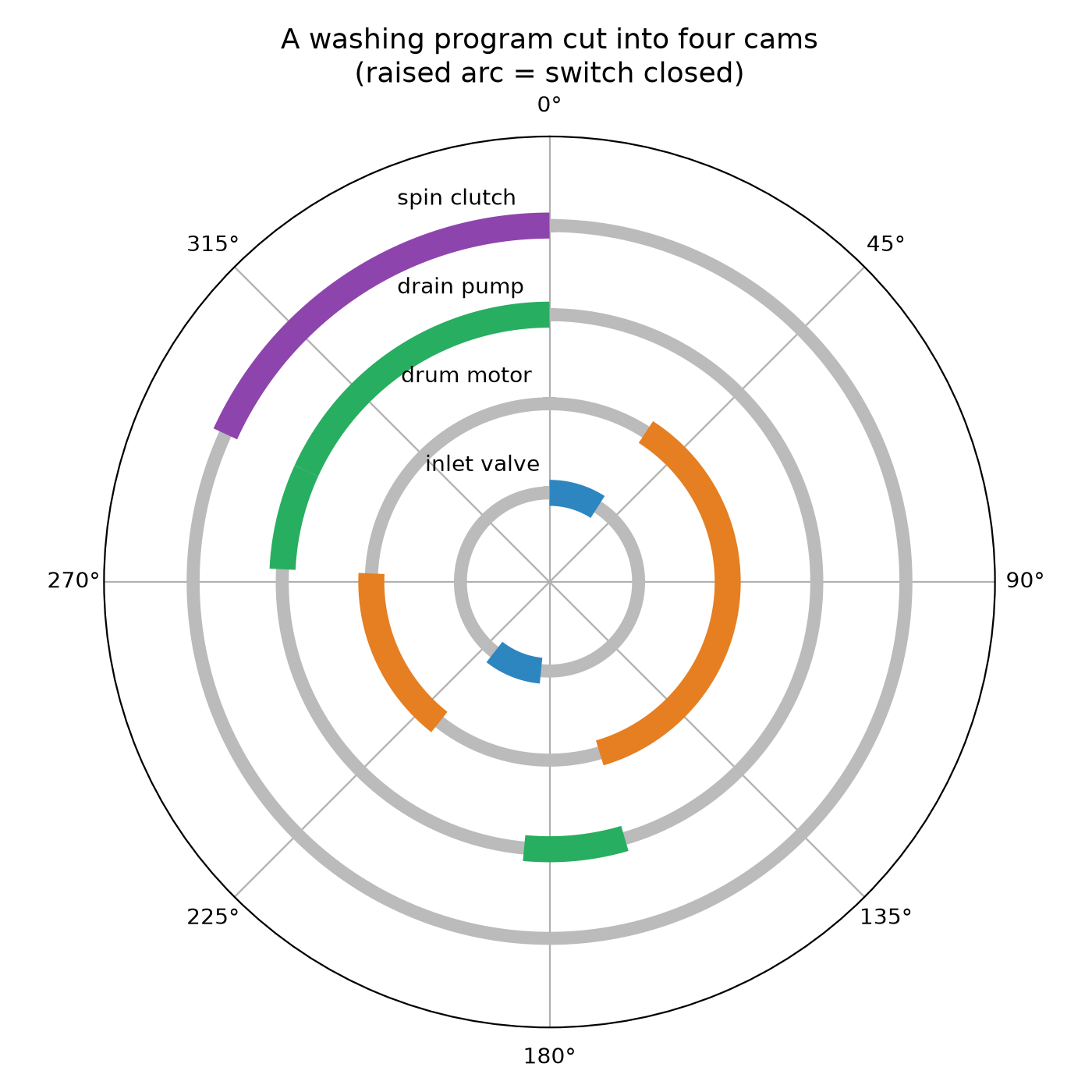
Youblob (generated from this blueprint's notebook) · CC0


The Cam Timer: A Program Cut Into Discs
Before microcontrollers, a washing machine, a dishwasher, a traffic light or an industrial process followed its sequence by turning a shaft of cam discs past a row of switches. A slow synchronous motor turns the stack once per program; each disc switches one function on while its raised arc passes; the dial on the front is simply the end of the shaft, and turning it by hand skips the program forward.
Everything about the program lives in the geometry: time is angle, and each function is an arc.
This rung turns a washing program into cam arcs, draws the cams, and builds a four-cam timer from printed discs and microswitches that switches four lamps in sequence.
Utangiye
About 4 hours
Amabwiriza
1
1
From program to cam arcs
From program to cam arcs
Gupakira ikaye ya Jupyter…
2
2
One turn of the cam shaft
One turn of the cam shaft
Ahakorerwa Blockly
Loading Blockly workspace...
3
3
How a cam moves its follower
How a cam moves its follower
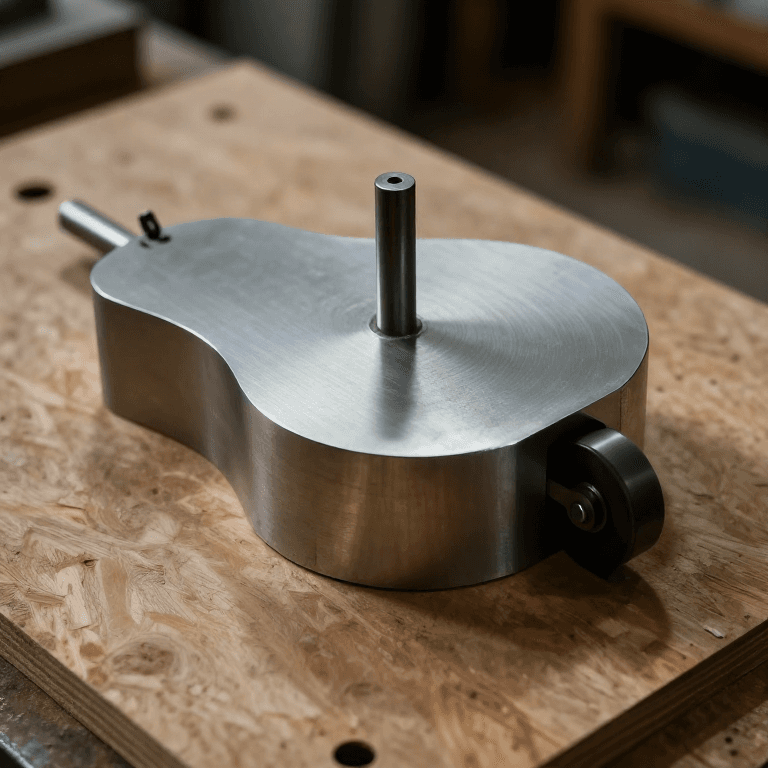
Each disc of a cam timer is a plate cam lifting a switch lever. The embedded blueprint shows how the cam's profile sets the follower's motion.
4
4
Build a four-cam timer
Build a four-cam timer
From the notebook's arcs, draw four discs 50 mm across with raised arcs 3 mm high where each function is on. Print them in PETG with a flat on their bore and stack them on an 8 mm steel shaft, with the zero marks lined up.
Turn the shaft with a slow geared DC motor — for a quick demonstration, one turn every minute or two instead of a real program's hour. Mount four lever microswitches on a plywood rail so each lever rides on one disc, and wire each through an LED and resistor from the supply.
Run it: the LEDs play the program in order. Turn the shaft by hand to jump to any step, as the dial of a washing machine does. Change one disc and the program changes.
Ibikoresho by'iyi ntambwe:
 Agati k'icyuma gitunganyijwe1 igice
 Moteri ya DC ifite gare1 igice
 Akabuto gato (gikoreshwa n'umuheha)4 ibice
 LED ya mm 54 ibice
 Igishyira umuriro cya ohm 3304 ibice
 Urupapuro rw'ibiti byometse1 igice
 Insinga zo guhuza1 igice
Ibikoresho bikenewe:
 Imashini icapa 3D ikoresha umugozi (FDM)
 Fibere ya PETG
 Inkomoko y'amashanyarazi y'umurongo umwe
 Icyuma Cyivumbura Kidafite Insinga
 Icyuma cyo gusudira
 Ikigereranyo cya Digitale cy'Amasentimetero 6
5
5
A cam timer stuck on one step
A cam timer stuck on one step
Program timer faults.
Flow
Loading...
6
6
Context and honest limits
Context and honest limits
Motor-driven cam timers ran washing machines, dishwashers, traffic signals and process plants for most of the twentieth century, until microcontrollers replaced them from the 1980s onward — keeping the same sequences.
**Honest limits.** A pure cam timer knows only time: a real washing machine timer also waits for the tub to fill or drain before it moves on, using the level switch to stop the timer motor. The printed demonstration runs fast; a real timer makes one turn per program.
Ibikoresho
7- 1 igiceUmwanya
- Umwanya
- Umwanya
- Umwanya
- Umwanya
- 1 igiceUmwanya
- Umwanya
Ibikoresho bikenewe
6- Umwanya
- 1 vendor sell this, none ship to you yetUmwanya
- 2 vendors sell this, none ship to you yetUmwanya
Iki gishushanyo gikora
Blueprint zijyanye
Izi blueprint zisangira ubumenyi — uburyo, ibikoresho cyangwa amahame


CC0 Umurenge rusange
Iyi blueprint yasohowe munsi ya CC0. Ushobora gukoporora, guhindura, gukwirakwiza no gukoresha nta kwemererwa.
Shyigikira Umuremyi ugura ibicuruzwa binyuze muri Blueprint ye Komisiyo y'Umuremyi byashyizweho n'Abacuruzi, cyangwa kora verisiyo nshya y'iyi Blueprint ukayinjiza nk'isano muri Blueprint yawe kugira ngo musangire inyungu.