UBUHANZI
UBWIZA N'UBUZIMA
UBUKORIKORI
UMUCO N'AMATEKA
IMYIDAGADURO
IBIDUKIKIJE
IBIRIBWA N'IBINYOBWA
UBWUBATSI BUSUBIRA INYUMA
UBUMENYI
SIPORO
IKORANABUHANGA
IBYAMBARWA
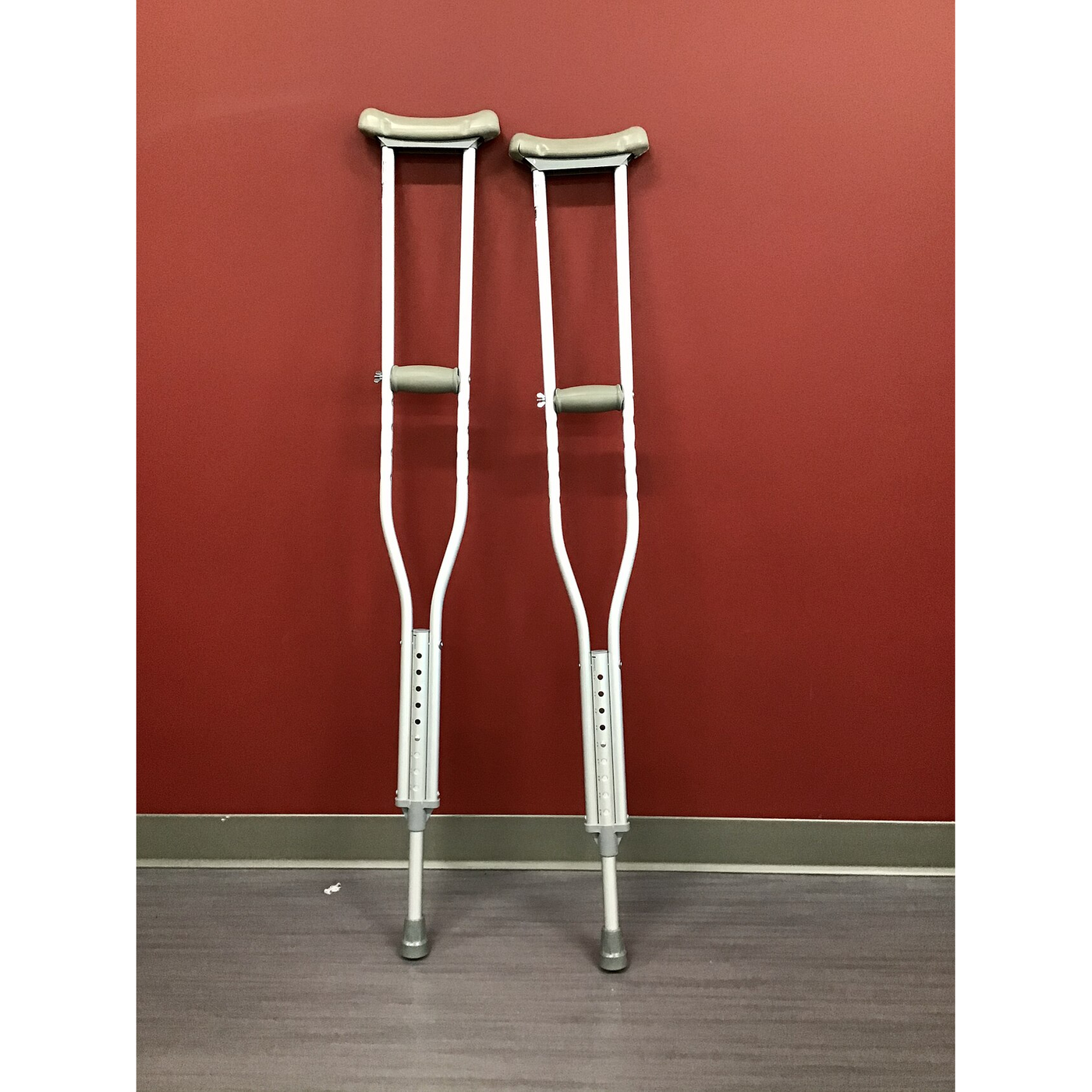


The Crutch: Carrying the Body on the Hands
When a leg cannot bear weight, the arms must take it. Crutches are among the oldest aids there are, and their design is a question of mechanics: the load must go through the hands, not the armpit, and the tip must not slide.
The underarm crutch braces against the side of the chest while the hands carry the body weight; leaning on the armpit pad instead compresses the nerves there. The tip's rubber grips only as long as the crutch is not planted too far out — the angle and the floor decide whether it holds.
This rung works out the loads through the hands and the friction the tip needs, gives the standard fitting guide, and measures both on the bench.
Utangiye
About 2 hours
Amabwiriza
1
1
Hand loads, tip friction and fitting
Hand loads, tip friction and fitting
Gupakira ikaye ya Jupyter…
2
2
The arm that carries the load
The arm that carries the load
On crutches the arms carry the body. The embedded blueprint shows the arm's bones and muscles as a lever system.
3
3
Measure the tip's grip
Measure the tip's grip
Stand a crutch on a floor surface. Holding the handgrip, press down firmly and slowly lean the top away until the tip slips. Measure the angle from vertical with a protractor at the moment it slips; $\mu = \tan\theta$.
Repeat on dry concrete, on tile, on tile wetted with a spray bottle, and with the rubber tip and without it (the bare tube). Tabulate $\mu$. The wet tile and the bare tube are the ones that put people on the floor.
Ibikoresho by'iyi ntambwe:
 Amazi1 litiro
Ibikoresho bikenewe:
 Igipima Ingoro
 Umurongo w'ipima
 Icupa ryo kuminjagira amazi
 Imbago
4
4
Fit and load-check a crutch
Fit and load-check a crutch
Adjust the crutch using its spring-button holes: overall length so the pad is about 5 cm below the armpit when standing tall, then the handgrip to wrist-crease height with the arm hanging.
Stand with one foot on a weighing scale and the crutch tip on the floor beside it; take weight off the scale onto the crutch through the hand only, pad clear of the armpit. The drop in the scale reading is the load in the hand. Then let the pad bear on the armpit and feel where the load goes. Do this briefly and on a stable floor — you are testing the crutch, not practising a gait.
Ibikoresho bikenewe:
 Umunzani
 Umugozi wo Gupima
5
5
A crutch that is not working for its user
A crutch that is not working for its user
Crutch problems and their usual causes. A physiotherapist should fit crutches for anyone who needs them.
Flow
Loading...
6
6
Context and honest limits
Context and honest limits
Crutches appear in the art of ancient Egypt and have been used ever since. The adjustable aluminium underarm crutch and the forearm (elbow) crutch, which carries the load on a cuff and handgrip with no armpit pad, are the common forms today.
**Honest limits.** The friction values in the notebook are examples, not measurements; measure your own. The 77 % length rule is a rough starting point. Crutch fitting and gait training are the job of a physiotherapist.
Ibikoresho bikenewe
6- Umwanya
- Umwanya
- Umwanya
- Umwanya
- Umwanya
- 1 vendor sell this, none ship to you yetUmwanya
Blueprint zijyanye
Izi blueprint zisangira ubumenyi — uburyo, ibikoresho cyangwa amahame



CC0 Umurenge rusange
Iyi blueprint yasohowe munsi ya CC0. Ushobora gukoporora, guhindura, gukwirakwiza no gukoresha nta kwemererwa.
Shyigikira Umuremyi ugura ibicuruzwa binyuze muri Blueprint ye Komisiyo y'Umuremyi byashyizweho n'Abacuruzi, cyangwa kora verisiyo nshya y'iyi Blueprint ukayinjiza nk'isano muri Blueprint yawe kugira ngo musangire inyungu.