UBUHANZI
UBWIZA N'UBUZIMA
UBUKORIKORI
UMUCO N'AMATEKA
IMYIDAGADURO
IBIDUKIKIJE
IBIRIBWA N'IBINYOBWA
UBWUBATSI BUSUBIRA INYUMA
UBUMENYI
SIPORO
IKORANABUHANGA
IBYAMBARWA
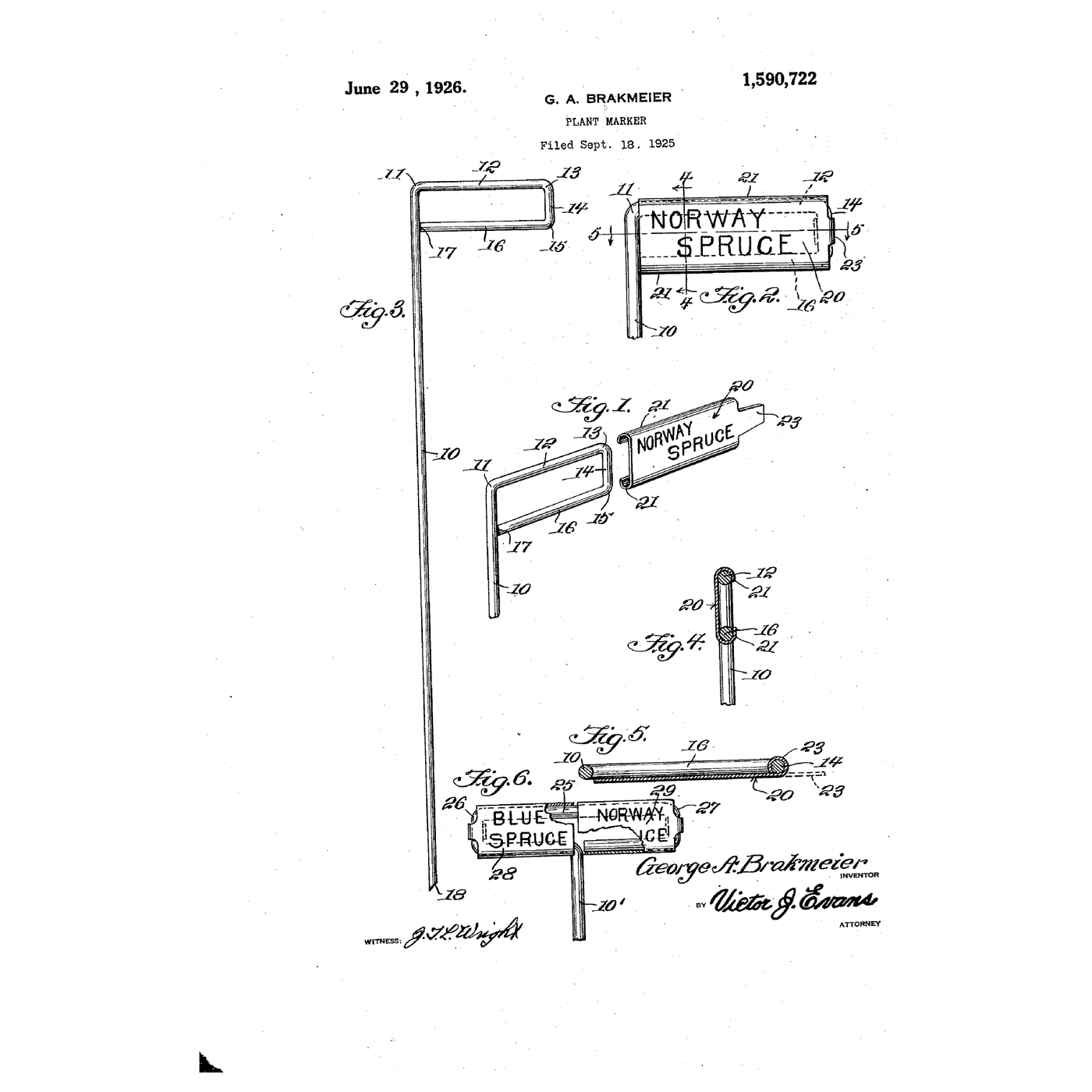


The Wire-Loop Plant Marker: The Handle You Push With Carries the Name
A thin marker stake is hard to push into firm ground without bending it or hurting the hand.
George A. Brakmeier of Louisville, Kentucky, received US 1,590,722, patented 29 June 1926, for a marker whose heavy-wire standard is bent at the top into an offset rectangular loop: the loop is the handle for pushing it in, and a name plate with rolled flanges then slides over the loop's long sides and is locked by a tongue bent round its end.
This rung works out when pushing on the loop bends the wire, then bends the standard, weighs the push that drives it into soil and slides a rolled plate onto it.
Utangiye
About 2 hours
Amabwiriza
1
1
Bending at the corner
Bending at the corner
Gupakira ikaye ya Jupyter…
2
2
A one-wire marker before it
A one-wire marker before it
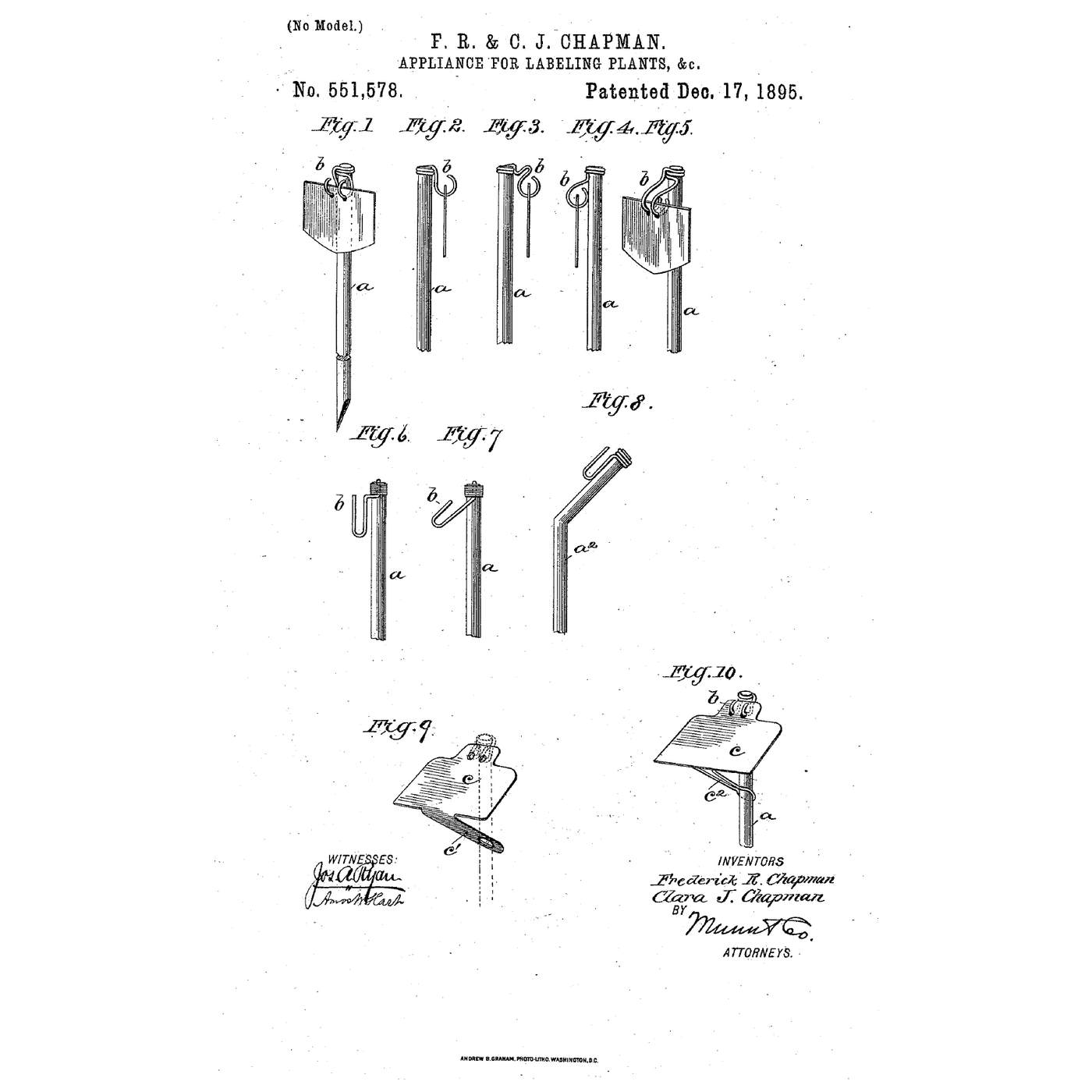
The embedded blueprint hooks a stamped plate into loops of one bent wire. Brakmeier's loop is also the handle, and the plate slides on over it.
3
3
Read US 1,590,722
Read US 1,590,722
"The looped portion thus provided constitutes in a very real sense a handle member, and permits the standard, which is sharpened at its lower end 18 to be thrust into the ground by exerting moderate pressure on the looped portion."
"A tongue 23 is provided on the extreme end of the marker, constituting the outer end when the parts are in assembled position, and this tongue is designed to be bent around the element 14 of the looped member and to constitute a retaining device."
4
4
Cut and point the standard
Cut and point the standard
Cut 600 mm of 4 mm galvanised steel wire with the hacksaw. File one end to a point.
Ibikoresho by'iyi ntambwe:
 Insinga y'Icyuma Yasizwe Zinki1 igice
Ibikoresho bikenewe:
 Umucumita w'Ibyuma
 Ifatiro ry'Ameza
 Amakariso (Ikariso ry'Intoki)
 Umurongo w'ipima
 Amadarubindi Asobanutse yo Kwirinda
5
5
Bend the loop
Bend the loop
Bend the wire 90° in the vice 340 mm from the point, then 90° down after 100 mm, then 90° back toward the upright after 30 mm. Saw off the end where it meets the upright. Tap each bend square.
Ibikoresho bikenewe:
Ifatiro ry'Ameza InyundoUmurongo w'ipima
 Uturindantoki tw'uruhu tw'akazi
6
6
Roll the plate
Roll the plate
Cut aluminium sheet 90 × 44 mm with a 10 × 15 mm tongue at one end. Stamp the plant's name in the middle. Roll 7 mm of each long edge round a 4 mm drill bit with the pliers.
Ibikoresho by'iyi ntambwe:
 Ikibaho cya aluminiyumu1 igice
Ibikoresho bikenewe:
 Ibyuma bikata ibyuma bisanzwe
 Ikusanyirizo ry'ibimenyetso byo gukubita ku cyuma (imitako)Inyundo
 Ipfundo Rifite Umunwa Uringaniye
 Ibyuma Byinshi byo Gucukura
7
7
Push it in and weigh the push
Push it in and weigh the push
Stand a pot of firm soil on the kitchen scale and zero it. Press the standard 200 mm in by the loop's middle and note the peak reading; grams × 0.0098 = newtons. Check the loop's corner against the ruler for a lasting bend.
Ibikoresho by'iyi ntambwe:
 Ubutaka bw'ubusitani1 igice
Ibikoresho bikenewe:
 Inkono y'indabo
 Iminzani ya Digitale yo mu GikoniUmurongo w'ipimaUturindantoki tw'uruhu tw'akazi
8
8
Fit the plate
Fit the plate
Slide the plate's flanges along the loop's long sides and bend the tongue round its end.
Ibikoresho bikenewe:
Ipfundo Rifite Umunwa Uringaniye9
9
A marker that bends, spins or drops its plate
A marker that bends, spins or drops its plate
Wire-loop plant marker troubleshooting.
Flow
Loading...
10
10
History and honest limits
History and honest limits
**George A. Brakmeier** of Louisville, Kentucky, filed US 1,590,722 on 18 September 1925; it was patented 29 June 1926. The standard may be formed of heavy wire or a rod of suitable size; the plate's flanges fit over the loop's sides, so it is mounted by thrusting it toward the standard after the standard is in the ground. His Figure 6 bends the loop out to both sides, carrying two plates. His claims cover a standard with a handle and a flanged plate with a tongue engaging it.
**Honest limits.** He gives no sizes; ours are examples. The notebook treats the push as one force at the loop's middle. Your pushes and bends are the result.
Ibikoresho
3- Umwanya
- 1 igiceUmwanya
- 1 igiceUmwanya
Ibikoresho bikenewe
13- Umwanya
- Umwanya
- Umwanya
- Umwanya
- Umwanya
- Umwanya
Iki gishushanyo gikora

Blueprint zijyanye
Izi blueprint zisangira ubumenyi — uburyo, ibikoresho cyangwa amahame



CC0 Umurenge rusange
Iyi blueprint yasohowe munsi ya CC0. Ushobora gukoporora, guhindura, gukwirakwiza no gukoresha nta kwemererwa.
Shyigikira Umuremyi ugura ibicuruzwa binyuze muri Blueprint ye Komisiyo y'Umuremyi byashyizweho n'Abacuruzi, cyangwa kora verisiyo nshya y'iyi Blueprint ukayinjiza nk'isano muri Blueprint yawe kugira ngo musangire inyungu.