Ubufatanye
UBUHANZI
UBWIZA N'UBUZIMA
UBUKORIKORI
UMUCO N'AMATEKA
IMYIDAGADURO
IBIDUKIKIJE
IBIRIBWA N'IBINYOBWA
UBWUBATSI BUSUBIRA INYUMA
UBUMENYI
SIPORO
IKORANABUHANGA
IBYAMBARWA
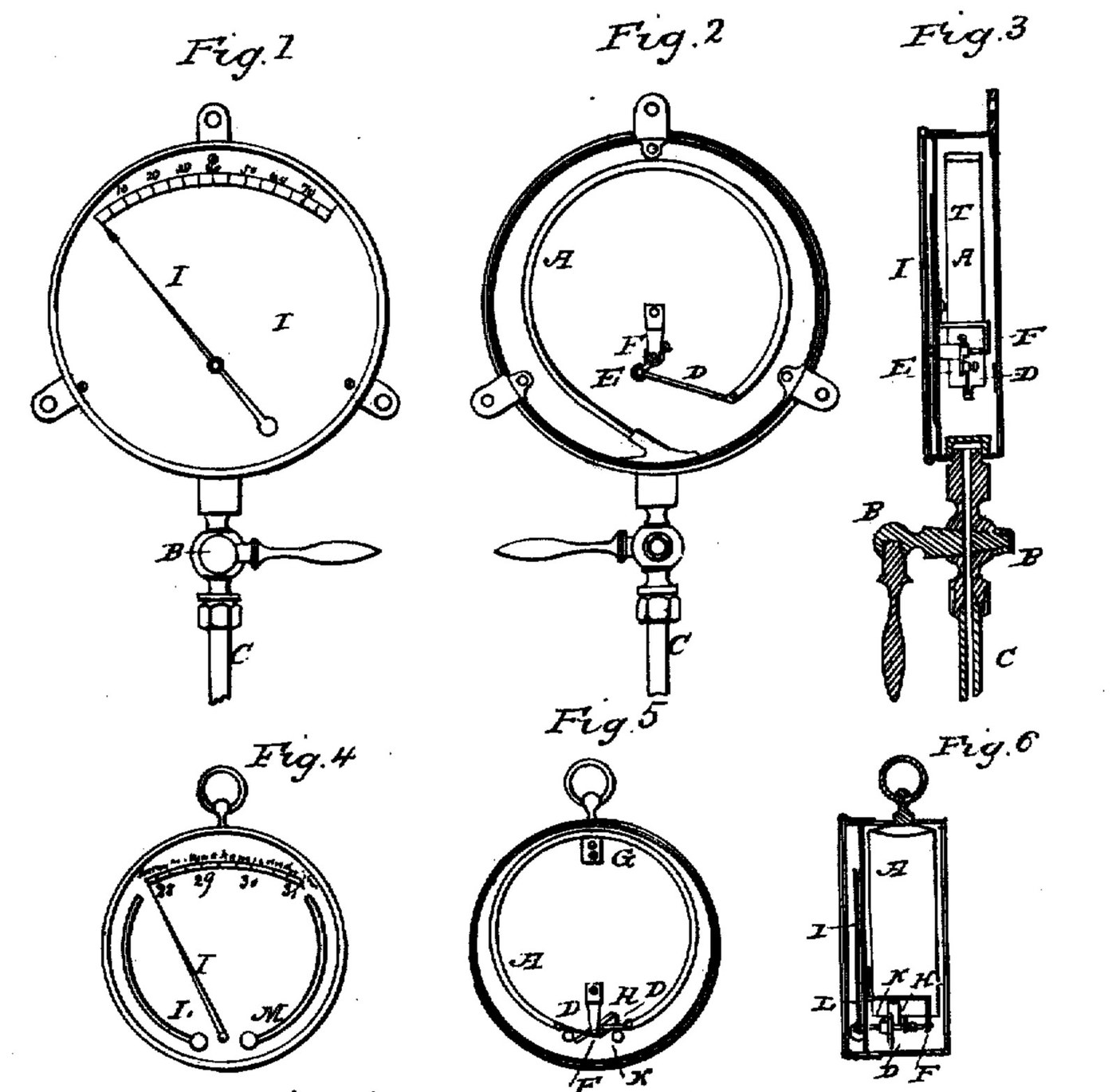


Vacuum Gauge: Flattened Curved Tube Driving an Index (Bourdon, US 9,163)
A vacuum gauge shows how far a line or vessel has been pumped below atmospheric pressure. Eugène Bourdon (US 9,163, 1852) found that a thin metal tube, flattened and bent into a curve, straightens a little under internal pressure and curls up more when the air is drawn out of it.
One end is open to the line through a cock; the closed end drives a lever on a spindle that carries the index. With the air withdrawn the index moves the opposite way to a pressure gauge, "and the instrument is then a vacuum gage."
Source: E. Bourdon, "Pressure-Gage", US Patent 9,163 (1852). Picture: its Figs. 1-6.
Hejuru
Unknown
Amabwiriza
1
1
Read Bourdon
Read Bourdon
"If the air be withdrawn from the interior of the tube A by means of an air pump or otherwise the curvature of the tube is increased and the index moves in the opposite direction and the instrument is then a vacuum gage."
2
2
Make the tube
Make the tube
Flatten a thin metal tube so its section is no longer round (Bourdon draws oval, flat, cross and Y sections) and bend it into a near circle. Close one end (how is not given) and leave the other open. Bourdon: the wall depends on the size, motion, pressure and metal; his only figure is brass about 1/100 in. thick for a barometer about 4 in. across. The metal, wall and size for the vacuum gauge are not given.
Ibikoresho by'iyi ntambwe:
 Icyuma kitazwi1 tube
Ibikoresho bikenewe:
 Uburyo bwo kubumba butazwi
 Ingano zitazwi
3
3
Fit the movement
Fit the movement
Fix the open end of the tube in the case, connected through a cock to a pipe to the line or vessel. Join the closed end by a link to a short lever on a small spindle that carries the index (or drive the spindle by a toothed sector and pinion, or by a silk thread wound round it and kept tight by a spring). The lever multiplies the tube's movement at the index.
Ibikoresho by'iyi ntambwe:
 Vanne itazwi1 cockIcyuma kitazwi1 link, lever, spindle and indexIcyuma kitazwi1 case
Ibikoresho bikenewe:
 Icyuma Cyivumbura Gihagaze
 Ibyuma Byinshi byo Gucukura
 Amakariso (Ikariso ry'Intoki)
4
4
Graduate the dial
Graduate the dial
Fit a dial behind the index. Bourdon graduates the arc by submitting the instrument to known pressures alongside an ordinary mercury gauge and marking each on the dial; equal steps of pressure give nearly equal degrees. Connect the gauge to a pump drawing the air out: the tube curls more and the index moves the opposite way to a pressure gauge. The reference used to mark a vacuum scale is not given.
Ibikoresho by'iyi ntambwe:
 Ibikoresho bitazwi1 dial
Ibikoresho bikenewe:
 Pompe ikuramo umwuka
Ibikoresho
3- 1 caseUmwanya
- 1 cockUmwanya
- 1 dialUmwanya
Ibikoresho bikenewe
6- Umwanya
- Umwanya
- Umwanya
- Umwanya
- 1 vendor sell this, none ship to you yetUmwanya
Iki gishushanyo gikora
CC0 Umurenge rusange
Iyi blueprint yasohowe munsi ya CC0. Ushobora gukoporora, guhindura, gukwirakwiza no gukoresha nta kwemererwa.
Shyigikira Umuremyi ugura ibicuruzwa binyuze muri Blueprint ye Komisiyo y'Umuremyi byashyizweho n'Abacuruzi, cyangwa kora verisiyo nshya y'iyi Blueprint ukayinjiza nk'isano muri Blueprint yawe kugira ngo musangire inyungu.