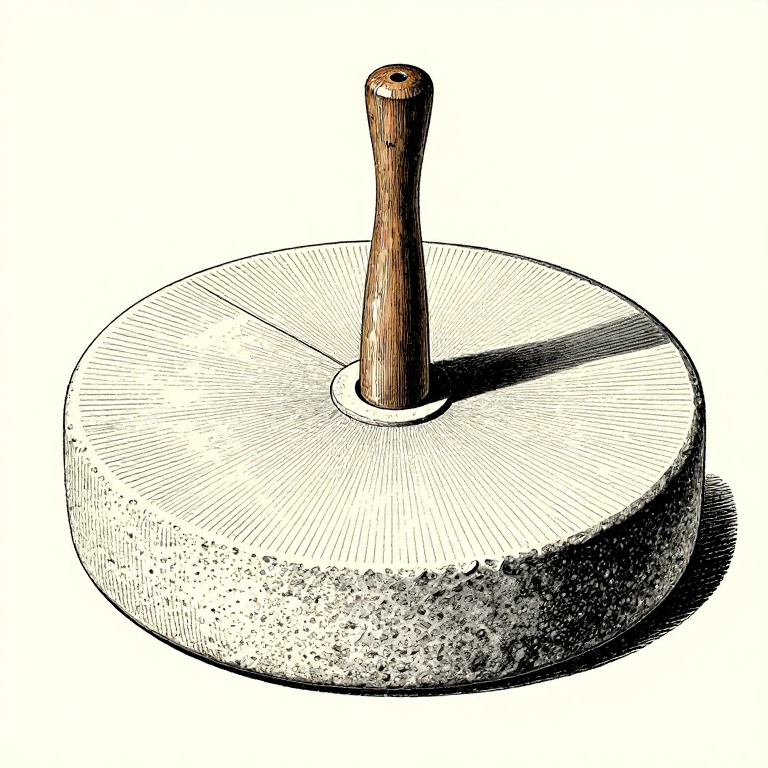


Carving a Viking Quern Stone — Hand-Grinding Grain to Flour
Amabwiriza
Select the Stone
Select the Stone
Choose a coarse-grained igneous stone — basalt or granite works best. The grain structure creates natural grinding surfaces with microscopic cutting points that shear grain kernels. Avoid fine-grained stone (like limestone or marble) as it wears smooth too quickly and may contaminate flour with calcium powder.
Select two pieces each roughly 35-50cm across and 8-15cm thick. The bottom stone (bedstone) should be slightly thicker and heavier for stability. The top stone (runner) can be slightly smaller in diameter.
Ibikoresho by'iyi ntambwe:
 Igitebo cy'ibuye2 pieces (35-50cm diameter) cm
 Igiti gikomeye cy'imikondo1 piece (20-30cm) cmIgiti gikomeye cy'imikondo1 igice
Ibikoresho bikenewe:
 Inyundo y'ibuye (gusya amabuye y'agaciro)
 Inyundo yo gushushanya urusyo
 Igicukuzi cy'Icyuma
Rough-Shape the Stones
Rough-Shape the Stones
Using a stone hammer, chip each piece into a roughly circular disc. Work around the perimeter, knocking off corners and protrusions. The bedstone should have a flat top surface and can be irregular underneath (it sits on the ground). The runner stone needs flat surfaces on both top and bottom.
An iron chisel can speed the shaping process — score a line with the chisel and strike along it to break off slabs. Aim for roughly circular shapes; they do not need to be perfect circles.
Dress the Grinding Surfaces
Dress the Grinding Surfaces
This is the most critical step. Using a stone pick or iron point, peck parallel furrows (1-2mm deep) radiating from the center to the edge on the flat grinding face of each stone. These furrows serve two purposes: they create additional cutting edges that break down grain, and they channel flour outward toward the perimeter where it is collected.
The furrows should be roughly evenly spaced (every 2-3cm) across the entire grinding face. On the runner stone, the furrows spiral slightly — this draws grain from the center outward as the stone rotates. Re-dressing (re-pecking) the furrows is needed periodically as they wear down from use.
Carve the Hopper and Eye
Carve the Hopper and Eye
Carve a funnel-shaped hole through the center of the runner stone. This is the eye (or hopper) where grain is fed into the quern. The hole should be approximately 5cm diameter at the top, narrowing to about 3cm at the bottom grinding face. The tapered shape helps feed grain steadily into the grinding gap.
In the center of the bedstone, carve a shallow socket (2-3cm deep, 3cm wide) to receive the spindle. This socket keeps the runner stone centered during rotation.
Fit the Spindle and Handle
Fit the Spindle and Handle
Insert a wooden or iron spindle (peg) through the runner stone eye, anchored into the socket in the bedstone center. The spindle acts as a pivot — the runner stone rotates around it. The spindle should be slightly shorter than the combined thickness of both stones so the runner can sit flush on the bedstone.
Drill a hole near the edge of the runner stone (about 3cm from the rim) and insert a wooden handle (20-30cm long). This handle provides leverage for turning. The operator grips the handle and rotates the runner stone clockwise while feeding grain into the hopper with the other hand.
Test Grind
Test Grind
Place the bedstone on a stable, flat surface at a comfortable working height (on the ground or on a low platform). Set the runner stone on top, aligned on the spindle. Spread a cloth below the stones to catch flour as it emerges at the edges.
Pour a handful of barley grain into the hopper while turning the runner stone clockwise at a steady pace. The grain feeds down through the eye, is caught between the grinding surfaces, and is crushed into flour that works its way outward. Coarse flour exits at the perimeter and falls onto the cloth below.
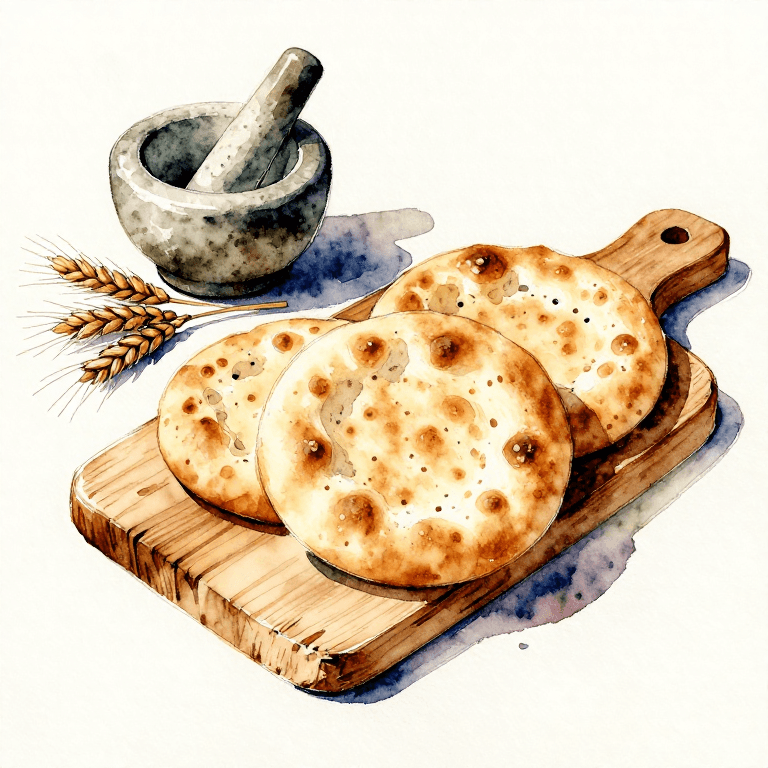
Adjust the gap between stones by shimming the spindle or adding/removing material under the bedstone. A wider gap produces coarser meal; a tighter gap produces finer flour. For Viking-era barley flatbread, a somewhat coarse grind is traditional.
Ibikoresho
3- 2 pieces (35-50cm diameter) cmUmwanya
- 1 igiceUmwanya
- 1 igiceUmwanya
Ibikoresho bikenewe
3- Umwanya
Iki gishushanyo gikora

Blueprint zijyanye
Izi blueprint zisangira ubumenyi — uburyo, ibikoresho cyangwa amahame

CC0 Umurenge rusange
Iyi blueprint yasohowe munsi ya CC0. Ushobora gukoporora, guhindura, gukwirakwiza no gukoresha nta kwemererwa.
Shyigikira Umuremyi ugura ibicuruzwa binyuze muri Blueprint ye Komisiyo y'Umuremyi byashyizweho n'Abacuruzi, cyangwa kora verisiyo nshya y'iyi Blueprint ukayinjiza nk'isano muri Blueprint yawe kugira ngo musangire inyungu.