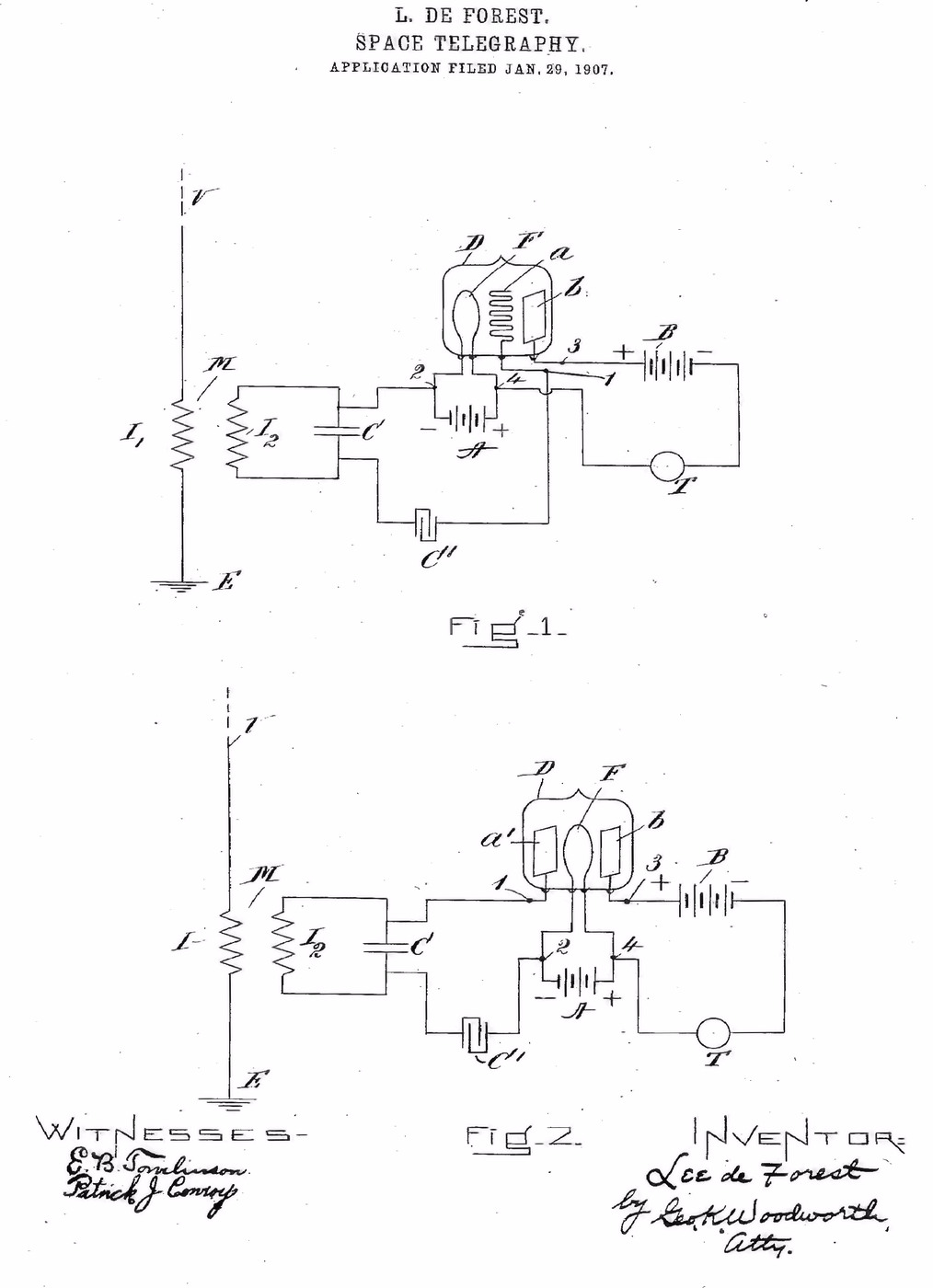


Audion Triode
Every electrical device before 1907 could switch, rectify, transform or store — none of them could make a small signal into a bigger one. A telegraph signal that faded over distance stayed faded; a radio signal too weak to hear stayed too weak.
The Audion put a third electrode into a vacuum tube, and that changed the category of what electricity could do. A grid between the hot cathode and the plate controls the electron stream flowing past it, and because the grid draws almost no current itself, a tiny voltage on it governs a much larger current. Small cause, large effect, under continuous control — amplification.
US Patent 879,532, granted to Lee De Forest on 18 February 1908, is titled "Space Telegraphy". De Forest did not understand why his device worked, and said so — which makes it one of the most consequential inventions ever made by someone with the wrong theory.
التعليمات
Evacuated glass and plate voltages both bite
Evacuated glass and plate voltages both bite
An evacuated envelope implodes if it fails, and plate supplies run at high voltage. Shield the tube, keep the high-voltage side enclosed, and discharge everything before touching it.
Read US 879,532 and note the title
Read US 879,532 and note the title
It is called "Space Telegraphy". De Forest was working on radio detection, not amplification — the amplifying property was found later, by others.
Build the two-electrode version first
Build the two-electrode version first
Put a heated filament and a cold plate in an evacuated envelope. Current flows one way only — this is the Edison effect, and Fleming's 1904 valve.
المواد لهذه الخطوة:
 أنبوب زجاجي شعري1 قطعة
Establish why it only conducts one way
Establish why it only conducts one way
The hot filament boils off electrons; the cold plate does not. Reverse the plate voltage and nothing crosses the gap. Rectification, but no gain.
Wind a fine wire grid to sit between them
Wind a fine wire grid to sit between them
Make an open zigzag or spiral of fine wire. Open, because electrons must pass THROUGH it — a solid electrode here would simply block the stream.
المواد لهذه الخطوة:
 سلك نيكروم1 متر
Place the grid much closer to the cathode than the plate
Place the grid much closer to the cathode than the plate
Spacing sets the gain. The grid is near the cathode so its voltage dominates the field where electrons are slowest and most easily steered.
الأدوات المطلوبة:
 مسطرة
مسطرةSeal all three lead-ins through the glass
Seal all three lead-ins through the glass
Fuse three wires through the envelope without cracking it. This is the hardest fabrication step and the usual cause of failure.
Evacuate as hard as you can and seal
Evacuate as hard as you can and seal
Pump down and seal off under vacuum. De Forest's early Audions were deliberately left slightly gassy, and the residual gas made them unstable and unpredictable.
الأدوات المطلوبة:
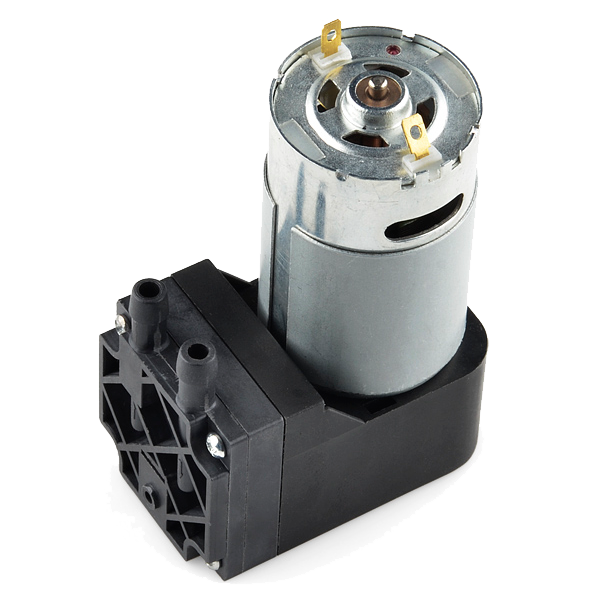 Vacuum Pump
Heat the filament and set a positive plate voltage
Heat the filament and set a positive plate voltage
Bring the cathode up to emission and put the plate positive. Measure the plate current with the grid connected to the cathode — that is your quiescent point.
الأدوات المطلوبة:
 جهاز قياس متعدد
Make the grid slightly NEGATIVE and watch plate current fall
Make the grid slightly NEGATIVE and watch plate current fall
Apply a small negative grid bias. Plate current drops sharply. A fraction of a volt on the grid moves milliamps at the plate — that ratio is the gain.
Confirm the grid draws almost no current
Confirm the grid draws almost no current
Measure grid current with the grid negative: essentially zero. The controlling electrode consumes no power, which is what makes the device an amplifier rather than a divider.
Plot plate current against grid voltage
Plot plate current against grid voltage
Sweep the grid and record plate current. The slope of that curve is transconductance, and its steepness is the whole figure of merit.
Bias into the straight part of the curve
Bias into the straight part of the curve
Choose an operating point mid-curve. Sit too near either end and the output clips — the same linearity problem as every amplifier since.
Feed a signal in and measure voltage gain
Feed a signal in and measure voltage gain
Apply a small AC signal to the grid, load the plate through a resistor, and compare output swing to input. Gain greater than one is the moment electronics begins.
Compendium — the man who did not know why it worked
Compendium — the man who did not know why it worked
The patent. US 879,532, "Space Telegraphy", granted 18 February 1908 to Lee De Forest, covering the three-electrode Audion he had devised in 1906-07. The lineage is direct: Edison noticed current flowing from a lamp filament to a stray electrode in 1883 — the Edison effect, which he patented and did not use. John Ambrose Fleming turned it into a two-electrode rectifying valve in 1904. De Forest added a third electrode between them. Each step is small; the third one changed what electricity could be made to do.
He genuinely did not understand it. De Forest believed the residual gas in the envelope was essential and deliberately left his tubes soft, which made them noisy, drifty and short-lived. He is on record as not knowing why the device worked. Irving Langmuir at General Electric established that the effect is pure thermionic emission and that a HARD vacuum makes it far better — and the reliable, high-vacuum tube that followed is what actually carried radio and long-distance telephony. Crediting De Forest with the working triode overstates it; crediting him with the third electrode is exactly right.
Why a control electrode that draws no power is the whole point. With the grid held negative it repels electrons without collecting them, so it consumes essentially no current while strongly modulating the space charge near the cathode. Input power approaches zero, output power does not — the device delivers gain, taking its energy from the plate supply. Every amplifying device since works on the same bargain, and the field-effect transistor's insulated gate is the same idea in silicon.
What it made possible. Transcontinental telephony in 1915 depended on tube repeaters; so did broadcast radio, radar, television, and the first electronic computers — ENIAC ran on about 18,000 tubes. The transistor of 1947 replaced the tube because it is smaller, cooler and more reliable, but it does the identical job: a low-power control terminal governing a larger current. The Audion is where that idea starts, and it started with a patent about telegraphy written by someone with the wrong explanation.
المواد
2- 1 قطعةعنصر نائب
- 1 مترعنصر نائب
الأدوات المطلوبة
3- عنصر نائب
- Vacuum Pump - 12Vعمولة 10%$14.04
- عنصر نائب
المخططات ذات الصلة
هذه المخططات تشارك المعرفة مع هذا — التقنيات والمواد والمبادئ

CC0 ملكية عامة
هذا المخطط مُصدر بموجب CC0. يحق لك نسخه وتعديله وتوزيعه واستخدامه لأي غرض، دون طلب إذن.
ادعم الصانع بشراء منتجات عبر مخططه حيث يكسب عمولة الصانع يحددها البائعون، أو أنشئ نسخة جديدة من هذا المخطط وضمّنه كرابط في مخططك لمشاركة الإيرادات.