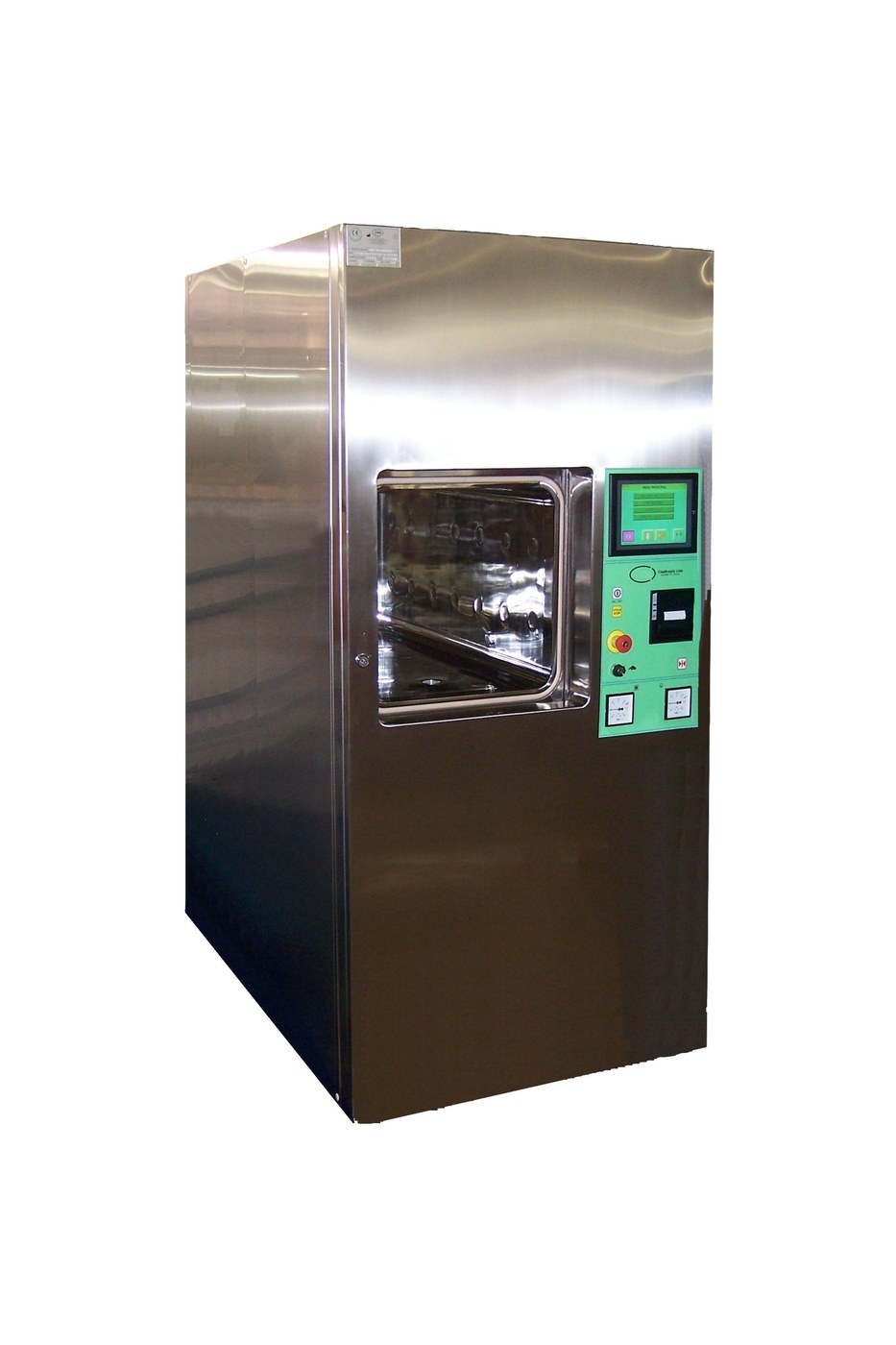


The Autoclave
Boiling water kills most things. It does not kill everything, and in surgery the exceptions are the ones that matter.
Some bacteria survive hostile conditions by forming endospores — a dormant, dehydrated, armoured state with almost no metabolism. Spores of tetanus and gas gangrene live in soil and dust, and they will sit in boiling water for hours and germinate afterwards. An instrument boiled for twenty minutes can look clean, be clean of ordinary bacteria, and still carry them.
You cannot fix this by boiling longer. Water at atmospheric pressure will not exceed 100°C no matter how much heat you add — the surplus goes into making steam, not into raising temperature.
The autoclave's move is to raise the boiling point by raising the pressure. Seal the vessel, let the steam build to about 1 bar above atmospheric, and the water now boils at 121°C. Hold that for fifteen minutes and spores die.
One more thing has to be true, and it is the part people get wrong: it must be saturated steam, not hot air. Steam condensing on a cold instrument dumps its enormous latent heat into that surface instantly and wets it. Trapped air is an insulator that stops this happening — which is why an autoclave's first job is not to heat, but to drive every pocket of air out.
التعليمات
Prove that boiling water has a ceiling
Prove that boiling water has a ceiling
Boil water in an open pan with a thermometer in it. Once it is boiling hard, turn the heat up as far as it will go and keep logging the temperature for several minutes.
Expect it to sit at about 100°C and refuse to climb, however violently it boils.
All that extra energy is going into converting liquid to vapour, not into temperature.
Write the consequence down plainly: you cannot sterilise by boiling harder. The ceiling is a property of water at one atmosphere, and the only way through it is to change the pressure.
المواد لهذه الخطوة:
 ماء1 قطعة
الأدوات المطلوبة:
 ميزان حرارة للطهي
 قِدر عميق الجوانب
Raise the pressure and watch the ceiling move
Raise the pressure and watch the ceiling move
Use a domestic pressure cooker with a gauge or a known valve rating. Bring it to pressure and record the pressure and the corresponding temperature from a steam table.
Expect roughly 1 bar gauge → 121°C, and about 2 bar → 134°C.
Plot pressure against boiling point.
That curve is the whole instrument. An autoclave is a pressure vessel whose only purpose is to move water's boiling point to somewhere lethal to spores.
Follow the cooker's instructions exactly. Never open a pressurised vessel, never block the vent, and let it depressurise fully before opening.
الأدوات المطلوبة:
 قِدر ضغط
Find the air pocket that ruins everything
Find the air pocket that ruins everything
Put two sealed but air-containing items into the cooker — a capped bottle and a tightly wrapped bundle — alongside an open dish. Run a cycle, then check the temperature reached inside each with a max-reading thermometer or a temperature indicator strip.
Expect the sealed and tightly wrapped items to have run cooler than the chamber.
Air does not condense. Where a pocket of it remains, steam never touches the surface, and that surface is being hot-air treated, not steam sterilised — a far weaker process.
This is why loads are packed loosely, why containers go in open or vented, and why real autoclaves pull a vacuum or purge repeatedly before the cycle starts.
الأدوات المطلوبة:
 ميزان حرارة
Show why steam beats dry heat at the same temperature
Show why steam beats dry heat at the same temperature
Compare two ways of delivering heat to a cold metal object: hold it in an oven at 121°C, and hold it in steam at 121°C. Time how long each takes to reach chamber temperature.
Expect steam to win decisively.
When steam condenses on a cold surface it releases its latent heat — a large quantity — all at once and directly at that surface. Hot air has to give up sensible heat only, slowly, through a poorly conducting gas.
That is why dry-heat sterilisation needs far higher temperatures and far longer times to achieve the same result, and why steam is the default everywhere it can be used.
الأدوات المطلوبة:
 فرن
فرنProve the cycle worked, rather than assuming
Prove the cycle worked, rather than assuming
Run a cycle with an indicator: autoclave tape, which changes colour, and if you can obtain one a chemical integrator strip.
Then consider what each actually tells you. Tape says this package has been in a hot place. An integrator responds to time and temperature and steam contact together.
Neither proves sterility. The real test is a biological indicator — a sealed vial of heat-resistant spores, incubated afterwards to see whether anything grew.
Write down the distinction, because it is the point: an indicator that only proves heat was present will pass a load that failed on trapped air. Verify the thing you care about, not the thing that is easy to measure.
الأدوات المطلوبة:
 شريط الأوتوكلاف
History & Context
History & Context
The vessel came first, by two centuries. Denis Papin's steam digester of 1679 — the pressure cooker in this corpus's cold batch, the one that produced the safety valve — was already a sealed vessel raising water above 100°C. It was built to soften bones into food. Nobody could have said why it would matter for surgery, because germs were not yet an idea. Charles Chamberland, in Pasteur's laboratory, turned the same vessel into the sterilising autoclave once there was a theory to aim it at.
Chamberland appears twice in this corpus. The same laboratory produced the porous ceramic filter in the sanitation batch, which removed bacteria by exclusion and, by failing to stop something infectious, revealed viruses. Filtration and autoclaving are the two ways to make a thing free of organisms — take them out, or kill them — and one laboratory built both.
It is the reason surgery stopped killing people. Lister's carbolic spray attacked germs already present in the wound; sterilising the instruments, drapes and dressings stopped them being introduced in the first place. Antisepsis was a treatment; asepsis is a system, and the autoclave is its engine. The change in surgical mortality across those decades is one of the largest in medicine.
121°C for 15 minutes is not arbitrary. It comes from measured spore death rates, with a margin. Higher temperatures work faster — 134°C for 3 minutes is standard for instruments — and the trade is thermal damage to what is being sterilised, which is why heat-sensitive items go to chemical or radiation methods instead.
Honest limits. It destroys anything that cannot take wet heat: flexible endoscopes, many plastics, electronics. Prions survive standard cycles and need harsher treatment. It cannot sterilise oils or powders, because steam cannot penetrate them. And a cycle that appears to have run can still fail on trapped air or an overpacked chamber — which is why the indicator discipline of step 5 exists, and why an autoclave is a process, not a box.
الأدوات المطلوبة
6- عنصر نائب
- عنصر نائب
- عنصر نائب
- عنصر نائب
- عنصر نائب
- عنصر نائب
مواد المخططات المرتبطة

المخططات ذات الصلة
هذه المخططات تشارك المعرفة مع هذا — التقنيات والمواد والمبادئ

CC0 ملكية عامة
هذا المخطط مُصدر بموجب CC0. يحق لك نسخه وتعديله وتوزيعه واستخدامه لأي غرض، دون طلب إذن.
ادعم الصانع بشراء منتجات عبر مخططه حيث يكسب عمولة الصانع يحددها البائعون، أو أنشئ نسخة جديدة من هذا المخطط وضمّنه كرابط في مخططك لمشاركة الإيرادات.